On this page
How to identify it
- Soft-bodied insects usually less than 1/4 inch long, with long antennae; adults may be winged or wingless.[1][4]
- At rest, winged adults hold their wings roof-like over the body.[2][3]
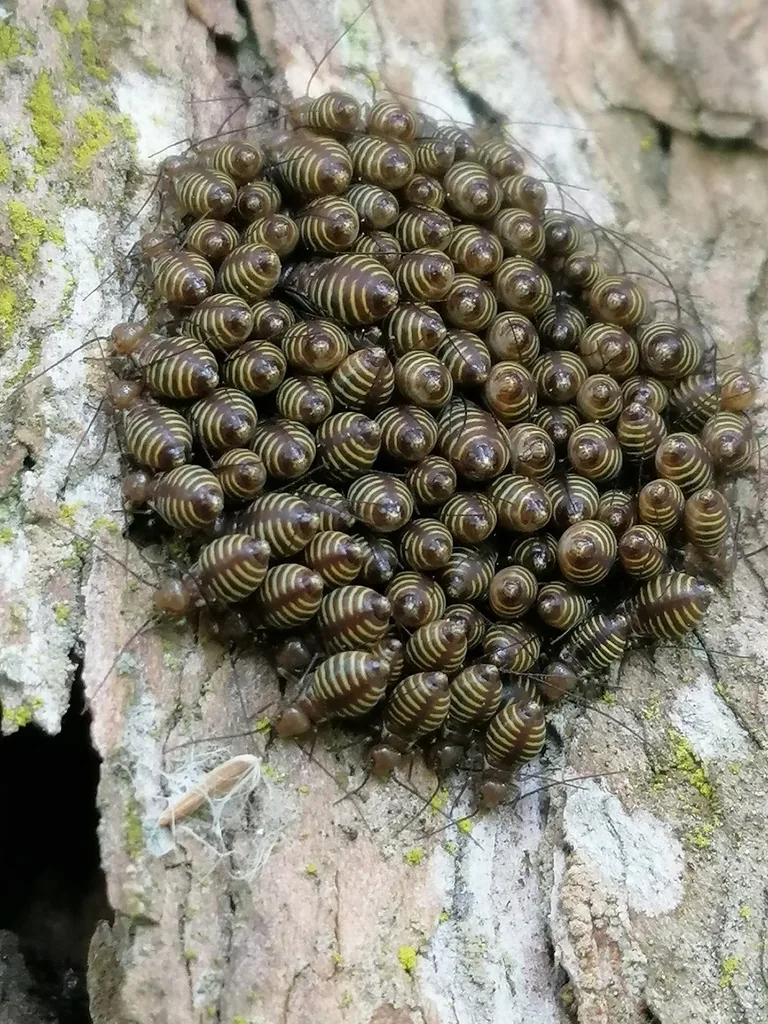
- Archipsocus nomas, the webbing barklouse, covers trunks and branches with sheets of fine silk; Cerastipsocus venosus moves over the bark in a group that looks like a herd of animals or a flock of birds, which is why they are called 'tree cattle'.[1][2]
Look-alikes
| Look-alike | How to tell them apart |
|---|---|
| Spider mites | Barklice webbing is rarely found on the foliage, which helps tell it apart from spider mite webbing.[1] |
| Webworms and tent caterpillars | Certain caterpillars web foliage; barklice webbing stays on the bark of trunks and limbs.[1] |
| Booklice | Booklice are wingless psocids found indoors near damp paper and stored goods; barklice are the outdoor, mostly winged psocids.[4] |
Where it lives
Psocids occur across the United States and Canada; the webbing barklouse is found along the Gulf Coast from Texas to Florida and up the Atlantic coast to South Carolina.[1][2]
Biology and life cycle
Barklice feed on mold, pollen, algae, lichens, fungi and fragments of dead insects.[1][4]
Young pass through six nymphal stages that look like small adults, and eggs are laid on bark or inside the webbing.[1]
Webbing barklouse colonies are scarce in winter, grow from March to June, and increase rapidly in number and size from July to October; frost reduces them and the webs weather away by early December.[2]
Large populations are usually temporary.[3]
Damage and signs
Health risk
None. Psocids are not true lice and do not bite or harm people or pets.[1][4]
Control
Prevention
No control is needed; insecticide treatment is not justified.[2][3]
Traps and physical control
If the webbing bothers you, wash it off the bark with a high-pressure stream of water.[1]
Common questions
- What is the silky webbing covering my tree trunk?
- In the Southeast it is often the webbing barklouse, a harmless insect that feeds on lichens under the silk.[1][2]
- Will barklice kill my tree?
- No. They feed on lichens, fungi and debris, not the tree.[1][3]
- Should I spray them?
- No; control is not recommended. Hose the webbing off if you dislike the look.[1][2]
- What are 'tree cattle'?
- Groups of barklice (Cerastipsocus venosus) that move together over bark like a herd.[1]
Sources
- Clemson Cooperative Extension Home & Garden Information Center, “Barklice, HGIC 2365 (revised May 7, 2024).” hgic.clemson.edu/factsheet/barklice/ (accessed 2026-10-16)
- University of Florida IFAS Extension (EDIS, Featured Creatures), “A Webbing Barklouse, A Psocid, Archipsocus nomas Gurney (EENY-275).” ask.ifas.ufl.edu/publication/IN553 (accessed 2026-10-16)
- Iowa State University Extension and Outreach (Yard and Garden), “Barklice on Trees (July 24, 2020).” yardandgarden.extension.iastate.edu/article/2020/07/barklice-trees (accessed 2026-10-16)
- University of Minnesota Extension, “Psocids (barklice, booklice).” extension.umn.edu/garden-and-home/home-maintenance/household-insects/booklice-barklice (accessed 2026-10-16)
- iNaturalist, “Archipsocus nomas taxon page (order and family).” www.inaturalist.org/taxa/270483 (accessed 2026-10-06)