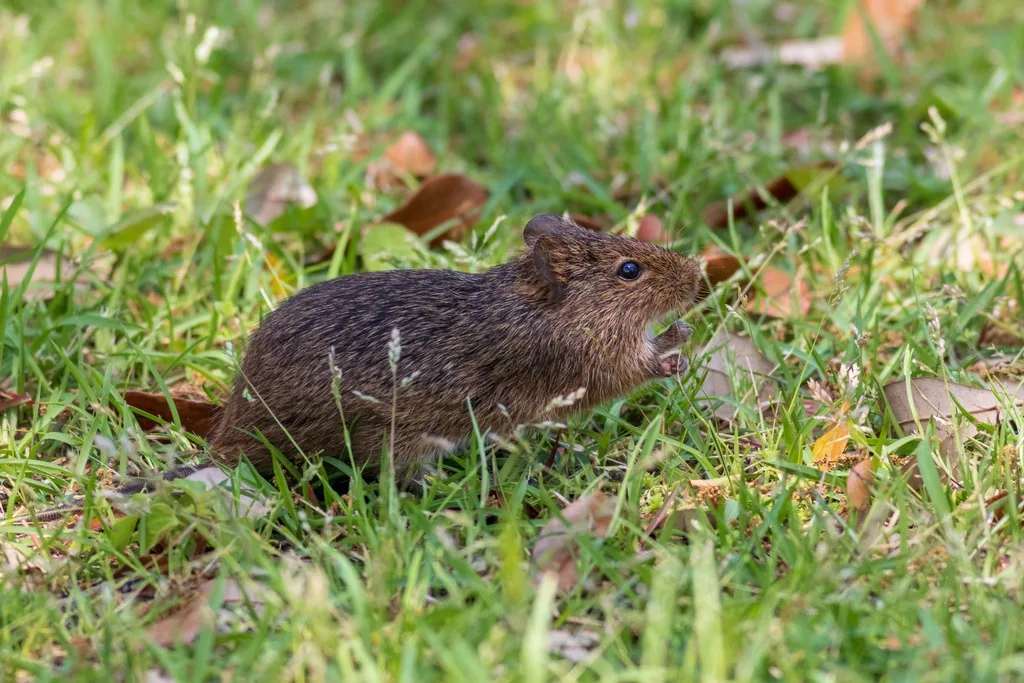
How to identify it
- A stocky, moderately large rodent averaging about 10 inches long including a 4-inch tail that is shorter than the head and body.[1][5]
- Rough, grizzled fur mixing brown, tan, black and gray, with stiff black guard hairs and a grayish or buff belly.[1][5]
- Large ears almost hidden in the fur, fairly large eyes and a high, Roman-nosed profile.[1][5]
- Signs include runways 3 to 5 inches wide through grass, piles of 2- to 3-inch cut stems, and pale greenish or yellowish droppings about 3/8 inch long.[1]
Look-alikes
| Look-alike | How to tell them apart |
|---|---|
| Norway rat | Larger, with a longer tail, shorter fur and no grizzled look.[1][5] |
| Eastern woodrat | Larger, with a well-haired tail and no grizzling in the fur.[5] |
Where it lives
Found over most of the southern U.S., from southeastern California, southern Arizona and New Mexico east through southern Kansas and Missouri, Tennessee and North Carolina, and south through Florida and the Gulf states.[1]
Biology and life cycle
Cotton rats breed all year; females have several litters annually after a 27-day pregnancy, and young can breed at 2 to 3 months old.[2][5]
They are active mostly at night but also come out by day, stay active year-round, and don't store food or hibernate.[2]
Nests are crude masses of dry grass placed in shallow hollows, clumps of coarse grass, shallow tunnels, or under rocks and logs.[2][5]
They mostly eat roots, stems, leaves and seeds, but also take insects, ground-nesting birds' eggs and chicks, and carrion.[2][5]
Populations swing widely, from about 11 to 149 per acre, and most damage happens at population peaks.[3]
Damage and signs
- They can damage alfalfa, grains, vegetables, peanuts, fruit, sweet potatoes and sugar beets, and are especially troublesome in sugarcane and melons.[3]
- They cut tall plants off at the base and keep cutting them into shorter sections.[2]
- High numbers can hurt quail nesting success, since cotton rats eat quail eggs and compete with quail for food.[3]
Health risk
The cotton rat hosts Black Creek Canal virus, a hantavirus first found in Florida; the CDC advises sealing rodents out and wetting droppings and nests with disinfectant before cleaning them up.[6][7]
Control
Prevention
Remove the dense cover they need by mowing or clearing weedy, overgrown areas; this works best as prevention, before numbers peak.[4]
Keep them out
For a small, high-value planting, an 18-inch sheet metal barrier buried about 6 inches deep keeps cotton rats out.[4]
Sanitation
Don't sweep or vacuum rodent droppings or nests; wear gloves, soak them with disinfectant or bleach solution, and wipe them up with paper towels.[7]
Traps and physical control
For a few animals, use small live traps or rat-sized snap traps baited with peanut butter and oatmeal, carrot or sweet potato, set across the runway.[4]
What doesn't work
No frightening devices are effective and no repellents are registered for cotton rats.[4]
Shooting isn't practical, and fumigants work poorly because cotton rats use their burrows only now and then.[4]
The only toxicant registered for cotton rats is limited to sugarcane fields, so check with your local extension office or state wildlife agency about options in your area.[4]
Legal status
Cotton rats are not protected in most states, though some classify them as nongame mammals; check state and local laws before control.[1]
Common questions
- Is a cotton rat the same as a regular rat?
- No. It is a native rodent of grassy fields with rough, grizzled fur and a shorter tail than the introduced Norway rat.[1][5]
- Do cotton rats carry hantavirus?
- The hispid cotton rat is the host of Black Creek Canal virus, a hantavirus, so clean up after them with the same wet-cleaning precautions used for mice.[6][7]
- How do I keep cotton rats out of my garden?
- Mow or clear dense, weedy cover around the garden, use a buried sheet metal barrier for small plots, and trap the few that remain.[4]
Sources
- Internet Center for Wildlife Damage Management, “Cotton Rats: Identification.” icwdm.org/species/rodents/cotton-rats/ (accessed 2026-10-06). Run by university wildlife damage specialists (maintained at the University of Wisconsin-Stevens Point); species modules are based on Prevention and Control of Wildlife Damage (University of Nebraska Cooperative Extension, 1994).
- Internet Center for Wildlife Damage Management, “Cotton Rat Biology.” icwdm.org/species/rodents/cotton-rats/cotton-rat-biology/ (accessed 2026-10-06). Run by university wildlife damage specialists (maintained at the University of Wisconsin-Stevens Point); species modules are based on Prevention and Control of Wildlife Damage (University of Nebraska Cooperative Extension, 1994).
- Internet Center for Wildlife Damage Management, “Cotton Rat Damage Identification.” icwdm.org/species/rodents/cotton-rats/cotton-rat-damage-identification/ (accessed 2026-10-06). Run by university wildlife damage specialists (maintained at the University of Wisconsin-Stevens Point); species modules are based on Prevention and Control of Wildlife Damage (University of Nebraska Cooperative Extension, 1994).
- Internet Center for Wildlife Damage Management, “Cotton Rat Damage Prevention and Control Methods.” icwdm.org/species/rodents/cotton-rats/cotton-rat-damage-prevention-and-control-methods/ (accessed 2026-10-06). Run by university wildlife damage specialists (maintained at the University of Wisconsin-Stevens Point); species modules are based on Prevention and Control of Wildlife Damage (University of Nebraska Cooperative Extension, 1994).
- Tennessee Wildlife Resources Agency, “Hispid Cotton Rat, Sigmodon hispidus.” www.tn.gov/twra/wildlife/mammals/small/hispid-cotton-rat.html (accessed 2026-10-06)
- Centers for Disease Control and Prevention, “Hantavirus Pulmonary Syndrome, United States: Updated Recommendations for Risk Reduction (MMWR 51(RR09), July 26, 2002).” www.cdc.gov/mmwr/preview/mmwrhtml/rr5109a1.htm (accessed 2026-10-06)
- Centers for Disease Control and Prevention, “Hantavirus Prevention.” www.cdc.gov/hantavirus/prevention/index.html (accessed 2026-10-06)
- iNaturalist, “Sigmodon hispidus taxon page (order and family).” www.inaturalist.org/taxa/44902 (accessed 2026-10-06)