On this page
How to identify it
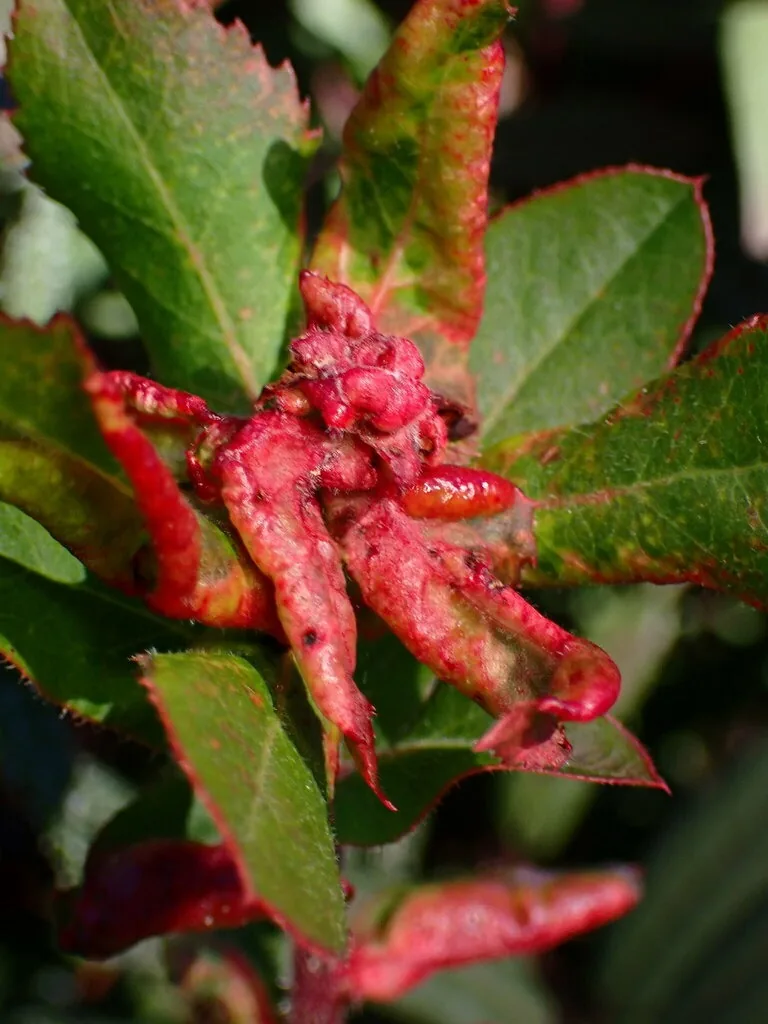
- Green or red, elongate to pod-shaped galls on manzanita leaves; galled leaves commonly look as if their edges have swollen or rolled.[1]
- Tiny gray or greenish aphids feeding on the tissue inside the leaf galls; open a gall to find them.[1]
- Only on manzanita (Arctostaphylos species); these aphids feed on nothing else, and the galls are most common on vigorous new growth.[1]
- Winged and wingless adult females occur through most of the year; the sexual generation of winged males and females appears in fall.[1]
Look-alikes
| Look-alike | How to tell them apart |
|---|---|
| Tamalia dicksoni and gall inquilines | At least one other Tamalia species, T. dicksoni, makes similar galls on Arctostaphylos, and a third, Tamalia inquilinus, cannot make galls at all but lives inside the galls of the gall makers.[1][2] |
| Other aphids | UC IPM refers readers to its general Pest Notes: Aphids for more on managing this group; the manzanita leafgall aphid is the one that feeds only on manzanita and lives inside pod-shaped leaf galls.[1] |
Where it lives
UC IPM treats the manzanita leafgall aphid as a landscape pest of manzanita in California; the gall-inducing Tamalia studied by Miller and Crespi were collected from 12 host-plant species, and T. coweni samples from different hosts were, with one exception, very closely related.[1][2]
Biology and life cycle
These aphids feed only on manzanita. Through most of the year adult females, winged or wingless, give birth to live young without mating, producing several generations a year.[1]
In fall a sexual generation of winged males and females is produced. The winged aphids disperse and mate, and the females lay overwintering eggs on bark at the base of the plant.[1]
Eggs hatch in late winter or spring; the emerging aphids walk up to the leaves, settle to feed and initiate the galls.[1]
Galls are communal, started by more than one female, and that habit apparently opened the door for a related lineage, Tamalia inquilinus, which has given up making galls and obligately inhabits the galls of the gall inducers; the inquilines descend from their gall-making hosts and have diversified along host-plant lines.[2]
Galling is heaviest on new growth, such as the flush stimulated by frequent irrigation and shearing.[1]
Damage and signs
- Feeding causes pod-shaped, green to reddish galls in manzanita leaves. The damage does not significantly affect plant health but can be aesthetically objectionable; heavily infested plants may grow slowly.[1]
Health risk
A plant-feeding aphid confined to manzanita; UC IPM reports no risk to people or pets.[1]
Control
Prevention
Avoid fertilizing established manzanitas and minimize pruning, shearing and other cultural practices that stimulate succulent growth, since the aphids are most prevalent on new growth. Do not irrigate too frequently or with too much water; if you fertilize, apply no more than necessary and use slow-release materials.[1]
Tolerate the galls where you can: UC IPM describes the galling as otherwise harmless to the plant.[1]
Pesticides
If the aphids were not tolerable the previous season, apply horticultural oil to the lower trunk bark when buds begin to swell but before they burst into new leaves, to reach the overwintering eggs. Oil is a good choice if the plant also has scale insects or other pests overwintering on bark.[1]
Certain systemic insecticides can be effective if applied before leaves become galled, but they may kill bees and natural enemies that feed on the plant's nectar and pollen; consult UC's Pest Notes: Aphids before using one.[1]
Common questions
- My manzanita's leaves are folding into red pods. Is it diseased?
- No. The pods are galls made by Tamalia aphids feeding inside the leaf. The galling does not significantly affect plant health, though heavily infested plants may grow slowly and the galls can look unsightly.[1]
- Why does the problem get worse when I water and shear the plant?
- Manzanita leafgall aphids are most prevalent on new growth, and frequent irrigation, shearing and nitrogen fertilizer all stimulate flushes of succulent new leaves. Backing off those practices is the main control.[1]
- Is spraying the galls worthwhile?
- UC IPM's chemical options both work ahead of galling: dormant-season horticultural oil on the lower trunk, where the eggs overwinter, before buds burst, or a systemic applied before galling begins, with the caution that systemics can kill bees and natural enemies.[1]
Sources
- University of California Statewide IPM Program, “Manzanita Leafgall Aphid (Home and Landscape).” ipm.ucanr.edu/home-and-landscape/manzanita-leafgall-aphid/ (accessed 2026-11-10)
- Journal of Evolutionary Biology, abstract via PubMed, “The evolution of inquilinism, host-plant use and mitochondrial substitution rates in Tamalia gall aphids (Miller and Crespi 2003, Journal of Evolutionary Biology 16:731-743; PubMed 14632236).” doi.org/10.1046/j.1420-9101.2003.00567.x (accessed 2026-11-10)
- iNaturalist, “Tamalia coweni taxon page (order and family).” www.inaturalist.org/taxa/49046 (accessed 2026-11-10)