On this page
How to identify it
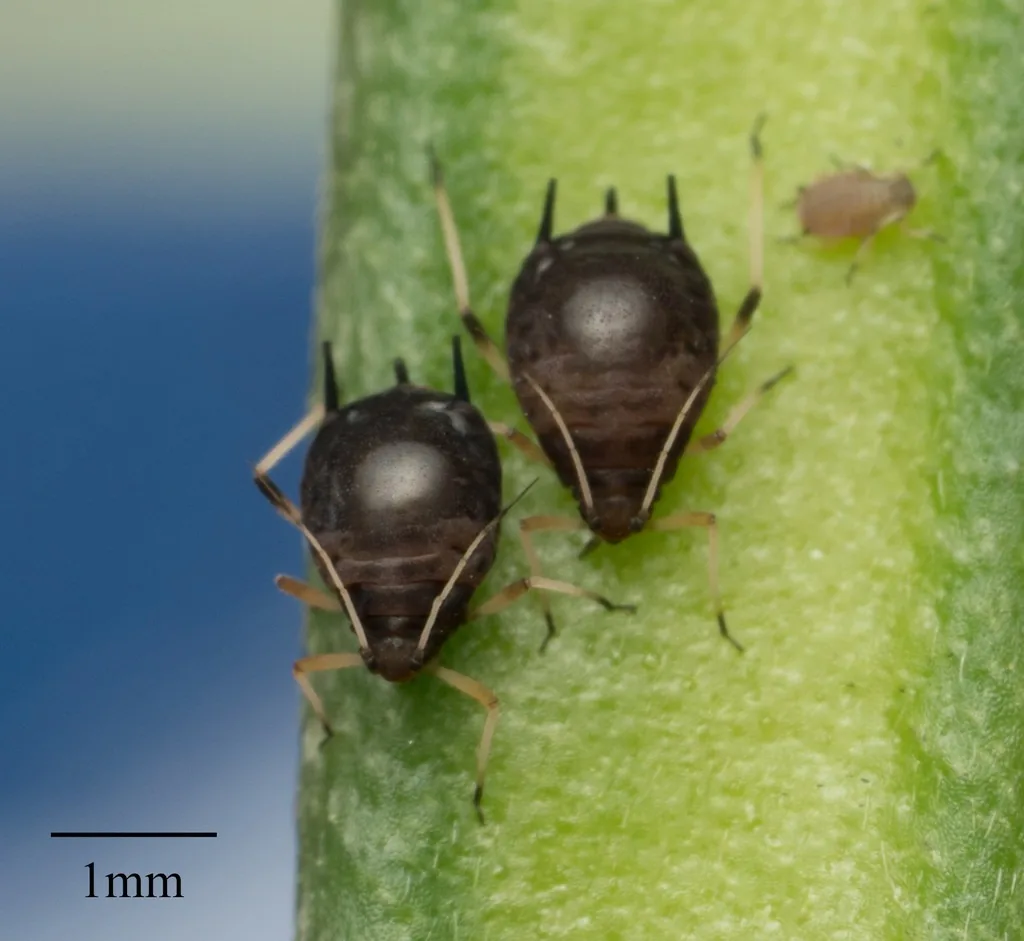
- It is a relatively small aphid. Adults are usually shiny black and nymphs slate gray, and the appendages are usually whitish with blackish tips.[1]
- It is the only black aphid that infests alfalfa.[1]
- The dark aphids generally feed near the tips of infested stems. Infestations are patchy: stems in infested spots are often completely covered with aphids, while plants elsewhere in the field look aphid-free.[2][1]
Look-alikes
Where it lives
In California, numbers are highest from April to September in the Sacramento Valley and peak from October to January in the desert, and populations can reach treatable levels from March to October in the San Joaquin Valley; it is a sporadic pest in the Intermountain Region. Kansas State has had reports from several Kansas alfalfa fields since 1999.[1][2]
Biology and life cycle
Its host range is extensive and includes beans, cotton and weeds as well as alfalfa.[1]
Early infestations in particular tend to be patchy within a field.[1]
Damage and signs
- It injects a powerful toxin while feeding, and high numbers can stunt or even kill plants. On alfalfa breaking dormancy, shoots that fail to grow normally where cowpea aphids are present are a sign that control may be needed.[1]
- It produces a lot of honeydew. Black sooty mold growing on the honeydew reduces photosynthesis and may make leaves unpalatable to livestock, and sticky alfalfa causes problems at harvest.[1]
Health risk
UC IPM and Kansas State describe it as a plant pest and mention no direct risk to people; the indirect concern is that sooty mold on its honeydew may make alfalfa leaves unpalatable to livestock.[1][2]
Control
Prevention
Border-strip cutting at harvest helps keep parasites and predators in the field. No alfalfa varieties are known to resist cowpea aphid.[1]
Start checking alfalfa for cowpea aphid in February and keep monitoring through fall. Because infestations are spotty, spot treatments may be feasible, especially when the infestation is on the field border.[1]
Biological control
Two common aphid parasites, Lysiphlebus and Diaeretiella species, attack it in desert production areas. Parasitism as high as 95% has been documented, although numbers can climb so high that enough unparasitized aphids remain to cause injury.[1]
Predators include lady beetles such as the convergent, multicolored Asian and twicestabbed lady beetles, plus lacewings, bigeyed bugs, damsel bugs and syrphid flies. Many of these are not active in February and early March, but in the low desert the sevenspotted lady beetle is abundant then and feeds on the aphid.[1]
Pesticides
No thresholds have been developed specifically for cowpea aphid. UC IPM suggests using the blue alfalfa aphid thresholds until they are: 10 to 12 aphids per stem on alfalfa under 10 inches tall, and 40 to 50 per stem on taller alfalfa. Kansas State expects thresholds comparable to the pea aphid's but has limited data on insecticide efficacy against this aphid.[1][2]
Organically certified azadirachtin, neem oil and pyrethrin products are registered for aphids on alfalfa, but California studies found that at best they suppress populations without controlling them.[1]
Common questions
- What are the small black aphids on my alfalfa?
- Most likely cowpea aphids: UC IPM describes the cowpea aphid as the only black aphid that infests alfalfa. Its other hosts include beans, cotton and weeds.[1]
- Why is my alfalfa sticky and black?
- Cowpea aphids produce a lot of honeydew, which makes alfalfa sticky at harvest, and black sooty mold grows on it, reducing photosynthesis and possibly making leaves unpalatable to livestock.[1]
Sources
- University of California Statewide IPM Program, “Cowpea Aphid (Pest Management Guidelines: Alfalfa).” ipm.ucanr.edu/agriculture/alfalfa/cowpea-aphid/ (accessed 2026-11-08)
- Kansas State University Department of Entomology, “Cowpea Aphid (J. P. Michaud, Facts and Information on Alfalfa Pests).” entomology.k-state.edu/extension/crop-protection/alfalfa/cowpea-aphid.html (accessed 2026-11-08)
- iNaturalist, “Aphis craccivora taxon page (order and family).” www.inaturalist.org/taxa/145414 (accessed 2026-11-08)