On this page
How to identify it
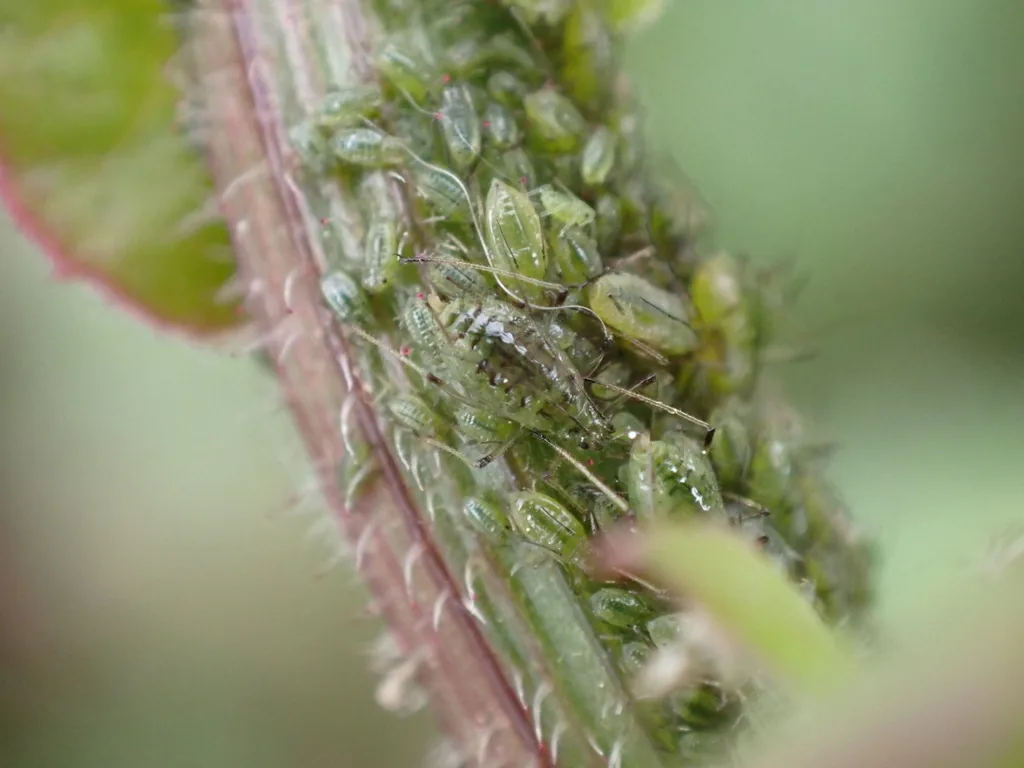
- It comes in several color forms, from green to orange to pink.[1]
- Both winged and wingless adults have black markings at the joints of the legs and antennae, and some wingless adults also have many black markings across the top of the abdomen. Winged adults are browner, with various black markings.[1]
- Unlike the green peach aphid, it lacks strongly converging bumps (antennal tubercles) at the bases of the antennae, and it tends to spread out through the plant instead of forming colonies.[1]
Look-alikes
| Look-alike | How to tell them apart |
|---|---|
| Green peach aphid | The green peach aphid has strongly converging antennal tubercles and forms colonies, while the lettuce aphid disperses through the plant.[1] |
Where it lives
It is found worldwide in all but the coldest land habitats. In California, UC IPM describes it as a relatively new pest of lettuce.[2][1]
Biology and life cycle
Its host range is fairly narrow, covering plants in 13 families. It is especially important on currants and gooseberries (Ribes) and also attacks lettuce, chicory and endive (Cichorium), hawksbeards, hawkweeds, nipplewort, eyebrights, speedwells, Nicotiana and petunias.[2]
In California it appears to spend the winter as nymphs and adults on lettuce, radicchio, Nicotiana species and some other plants in the daisy family. Its life cycle is very short, so numbers can climb fast.[1]
Damage and signs
Health risk
UC IPM and AphID treat it purely as a pest of lettuce, currants and other plants; neither mentions bites, stings or any risk to people or animals.[1][2]
Control
Prevention
Check plants carefully, since early infestations hide within the lettuce and are easy to miss.[1]
Biological control
Syrphid (hover) fly larvae and green lacewing larvae are its main natural predators; lady beetles and parasites do not play a significant role. Syrphid flies cannot be bought from insectaries, so they have to arrive from the surroundings.[1]
Organic growers on California's Central Coast intercrop lettuce with quick-flowering annuals such as baby's breath, coriander, Persian clover and sweet alyssum to feed adult syrphid flies and increase their egg-laying near the lettuce. Skip sweet alyssum when bagrada bugs are building up, since it is one of their favorite host plants.[1]
Pesticides
For commercial lettuce, UC IPM lists insecticides including flupyradifurone, flonicamid, spirotetramat, acetamiprid, pymetrozine and soil-applied imidacloprid. Syrphid larvae and parasitoids are susceptible to many insecticides, especially spinosad.[1]
Common questions
- Why are lettuce aphids so hard to control?
- They multiply quickly and live deep inside the plant, at the heart of head lettuce, where early infestations are hidden from view.[1]
- Does the lettuce aphid spread plant viruses?
- AphID says it has been implicated in transmitting four plant viruses, while UC IPM says it does not appear to be an important virus vector.[2][1]
- What else does it feed on?
- Besides lettuce, it is especially important on currants and gooseberries and also feeds on chicory, radicchio, hawkweeds, speedwells, Nicotiana and petunias.[2][1]
Sources
- University of California Statewide IPM Program, “Lettuce Aphid, UC IPM Pest Management Guidelines: Lettuce (UC ANR Publication 3450).” ipm.ucanr.edu/agriculture/lettuce/lettuce-aphid/ (accessed 2026-11-09)
- USDA APHIS PPQ Identification Technology Program (idtools.org), “Nasonovia ribisnigri fact sheet, AphID: Identification guide for cosmopolitan and polyphagous aphid species (C. Favret and G. Miller).” www.aphid.aphidnet.org/Nasonovia_ribisnigri.php (accessed 2026-11-09)
- iNaturalist, “Nasonovia ribisnigri taxon page (order and family).” www.inaturalist.org/taxa/474122 (accessed 2026-11-09)