On this page
How to identify it
- It lives on the roots, in clustered colonies covered with white powdery wax, often with masses of white, woolly material.[1][2]
- It can be told from other aphids found on lettuce by its short antennae, less than one-third of its body length, and its undeveloped cornicles (the paired 'tailpipes' on the rear of most aphids).[1][2]
Look-alikes
| Look-alike | How to tell them apart |
|---|---|
| Lettuce aphid | The lettuce aphid feeds on the leaves, deep in the heart of the plant, rather than on the roots.[1] |
Where it lives
Both the University of California and the Pacific Northwest handbooks cover it as a lettuce pest, and both say it is a serious problem mostly where lettuce is planted near Lombardy poplars.[1][2]
Biology and life cycle
Where lettuce or related weeds are not available, it spends the winter as eggs on the bark of Lombardy poplar. The aphids that hatch reproduce once on the poplar before migrating to lettuce.[1][2]
On lettuce the aphids feed and reproduce, and winged adults develop that can spread from field to field.[1][2]
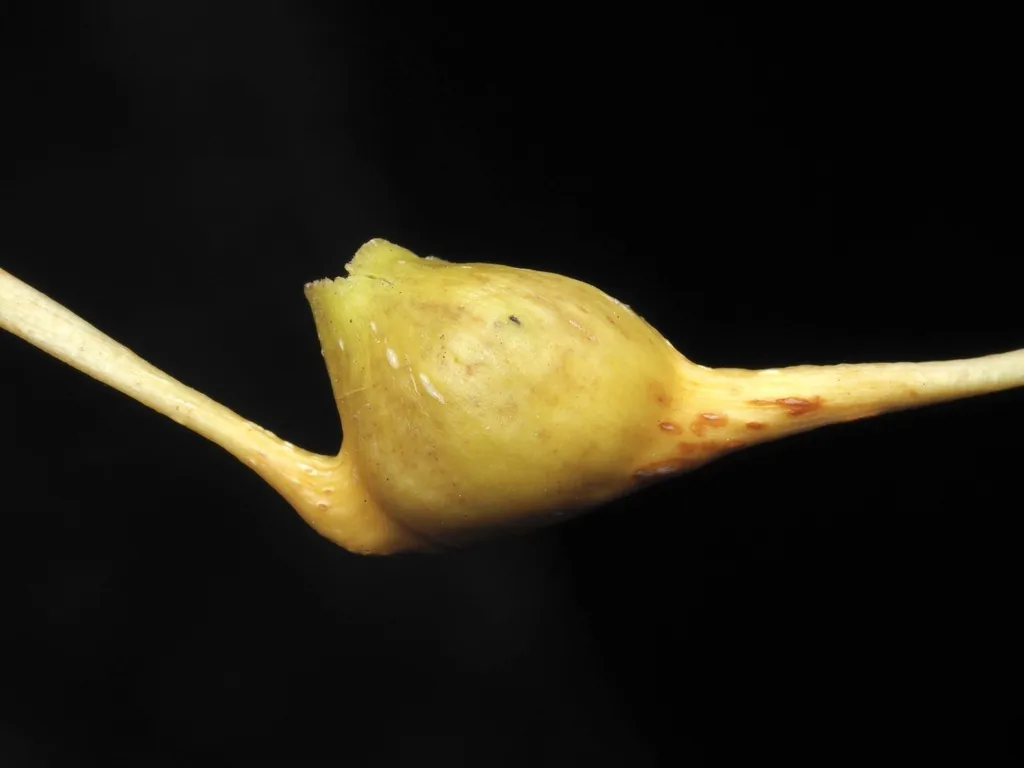
On nearby Lombardy poplars, look for galls on the leaf stalks (petioles); winged aphids leave the trees and fly to lettuce fields.[1]
Damage and signs
- Heavily attacked plants may wilt during the day. The developing heads stay soft and fail to form properly, and yields drop.[1][2]
- Infested rootlets turn brown and die, and very heavy infestations that last a long time can make plants collapse and die. If infested lettuce keeps growing quickly, a satisfactory crop often still results.[1][2]
Health risk
Both handbooks treat it only as a pest of lettuce roots and poplars; neither reports any risk to people or pets.[1][2]
Control
Prevention
Avoid planting lettuce near Lombardy poplars, or remove poplars growing near lettuce fields, to reduce the severity of infestations.[1][2]
Where root aphid problems are frequent, plant lettuce varieties that have shown resistance. Avoid stressing plants and keep water at optimum levels.[1][2]
Sanitation
If the previous crop was infested, work the soil deeply and let it dry thoroughly before replanting lettuce; tilling the old crop under does not get rid of the aphids. Closing soil cracks, where the aphids enter the soil to reach the roots, also helps.[1][2]
Pesticides
For commercial lettuce, imidacloprid banded under the seed line at planting may prevent infestation, but no insecticide controls the aphid once the crop is infested. In organic crops, an insect-killing fungus applied with azadirachtin gave good control of root aphids in similar crops.[1]
For home gardens, the Pacific Northwest handbook lists azadirachtin mixed with pyrethrins, bifenthrin mixed with zeta-cypermethrin, and zeta-cypermethrin.[2]
Common questions
- What are the signs of lettuce root aphids?
- Heavily attacked plants may wilt during the day, and their heads stay soft. Look for stunted or wilting plants and examine their roots for clustered aphid colonies covered in white powdery wax.[1][2]
- What do poplar trees have to do with lettuce root aphids?
- Lombardy poplar is the aphid's winter host. Eggs spend the winter on its bark, and the aphids reproduce once on the tree before moving to lettuce. The pest is a serious problem mostly where lettuce grows near these trees.[1][2]
- Can I spray an infested lettuce crop?
- UC IPM says no insecticides are available to control the root aphid after a lettuce crop is already infested. In commercial lettuce, an imidacloprid band under the seed line at planting may prevent infestation.[1]
Sources
- University of California Statewide IPM Program, “Lettuce Root Aphid, UC IPM Pest Management Guidelines: Lettuce (UC ANR Publication 3450).” ipm.ucanr.edu/agriculture/lettuce/lettuce-root-aphid/ (accessed 2026-11-09)
- Pacific Northwest Pest Management Handbooks (Oregon State University, Washington State University and University of Idaho Extension), “Lettuce-Lettuce root aphid, Pacific Northwest Insect Management Handbook.” pnwhandbooks.org/insect/vegetable/vegetable-pests/hosts-pests/lettuce-lettuce-root-aphid (accessed 2026-11-09)
- iNaturalist, “Pemphigus bursarius taxon page (order and family).” www.inaturalist.org/taxa/334095 (accessed 2026-11-09)