On this page
How to identify it
- The aphids are about 2 mm (1/13 inch) long, pale green with a dark thorax, and covered in a waxy film. Most are wingless, though winged forms occur.[1][2]
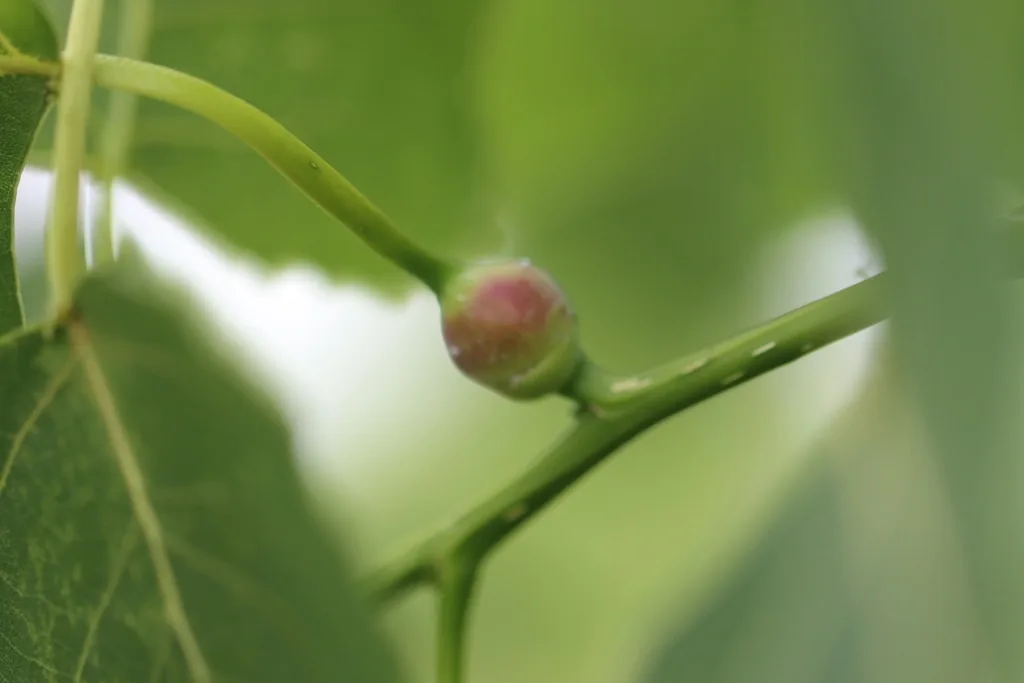
- The easiest sign is the gall: a round, marble-sized swelling on a leaf stem, with the aphids enclosed inside.[1][2]
- In summer, colonies on the roots of cabbage-family plants are marked by large amounts of white wax produced by the nymphs.[2]
Look-alikes
| Look-alike | How to tell them apart |
|---|---|
| Vagabond gall aphid | Its galls form at the ends of cottonwood and aspen branches, where feeding at the growing buds turns leaf tissue into a dense, irregular, bladder-like mass. The galls turn brown and dry and are most noticeable after leaf fall, rather than sitting as round swellings on the leaf stems.[4][5][1] |
| Poplar budgall mite | Microscopic mites make woody, cauliflower-like galls on the buds instead of round galls on the leaf stems.[3] |
Where it lives
Utah State and Colorado State universities both cover it among the gall makers of cottonwoods, poplars and aspens, and Colorado State illustrates its summer colonies on cabbage roots.[1][2]
Biology and life cycle
Eggs overwinter in old galls or bark crevices and hatch in spring as the leaves expand. Each young nymph feeds on a developing leaf stem, and the gall grows up around it.[1][2]
Inside the gall the aphid reproduces without mating. In late June or July its offspring develop wings, the gall splits open, and the winged aphids fly to cabbage-family plants, where they colonize the roots and produce several generations of females through the rest of the summer.[2][1]
At the end of summer, winged aphids fly back to poplars and produce small, mouthless males and females. The males die soon after mating, and each mated female lays a single egg and then dies.[2][1]
Damage and signs
- Both the nymphs and the adults feed, but the galls have little effect on the health of cottonwoods, poplars and aspens; the damage is mainly aesthetic.[1]
- During summer the aphids feed on the roots of cabbage-family plants, and Colorado State treats them as a pest to manage in those crops as well.[2]
Health risk
It is a sap-feeding aphid of trees and cabbage-family roots; Utah State and Colorado State mention no risk to people or pets.[1][2]
Control
Prevention
For trees, Utah State's advice is to tolerate the galls and keep the trees healthy and free of stress. Proper watering and fertilizing that keep plants growing vigorously can offset some of the feeding injury.[1][2]
Pesticides
If you do treat a tree, Utah State suggests horticultural oil on the overwintering eggs in spring before budbreak, or a systemic neonicotinoid in spring. Once galls have formed, cover sprays won't work.[1]
Colorado State suggests insecticides only when aphid numbers pass acceptable levels and quick control is needed, and favors selective, often systemic products that spare beneficial insects and last longer. Systemics are especially useful late in the season on cabbage-family crops, whose plant structure shelters aphids from contact sprays. Rotate modes of action, because aphids can quickly develop resistance.[2]
Common questions
- What are the round green balls on my cottonwood's leaf stems?
- Round, marble-sized galls on the leaf stems are typical of the poplar petiolegall aphid. Each one holds aphids that started feeding there in spring, and they do little harm to the tree.[1][2]
- Do these aphids also feed on garden cabbage?
- Their summer generations live on the roots of cabbage-family plants. Winged aphids leave the poplar galls in late June or July and colonize crucifer roots, where the nymphs produce a lot of white wax; Colorado State shows such an infestation on cabbage roots.[2]
- Is it too late to spray once I see galls?
- Yes. Cover sprays don't work once galls have formed. Utah State's options are horticultural oil on the overwintering eggs before budbreak or a systemic neonicotinoid in spring, and because the galls do little harm, it also advises simply tolerating them.[1]
Sources
- Utah State University Extension, Integrated Pest Management, “Petiolegall and Vagabond Gall Aphids (Ornamental Pest Guide).” extension.usu.edu/planthealth/ipm/ornamental-pest-guide/arthopods/aphids-adelgids/petiolegall-vagabond-gall-aphids.php (accessed 2026-11-08)
- Colorado State University, Department of Agricultural Biology, “Insect and mite galls.” agsci.colostate.edu/agbio/ipm-pests/insect-and-mite-galls/ (accessed 2026-11-08)
- Utah State University Extension, Integrated Pest Management, “Poplar Budgall Mite (Ornamental Pest Guide).” extension.usu.edu/planthealth/ipm/ornamental-pest-guide/arthopods/mites/poplar-budgall-mite.php (accessed 2026-11-08)
- University of Wyoming Agricultural Experiment Station, “Poplar vagabond gall aphid fact sheet, B-1041 (T. Noma, J. K. Wangberg and M. J. Brewer, August 1996).” www.wyoextension.org/agpubs/pubs/B1041.pdf (accessed 2026-11-08)
- Wisconsin Department of Natural Resources, Division of Forestry, “Poplar vagabond aphid (Forestry News, L. Williams, July 2017).” forestrynews.blogs.govdelivery.com/2017/07/27/poplar-vagabond-aphid/ (accessed 2026-11-08)
- iNaturalist, “Pemphigus populitransversus taxon page (order and family).” www.inaturalist.org/taxa/179801 (accessed 2026-11-08)