On this page
How to identify it
- iNaturalist and Natural Resources Canada use the name Aceria parapopuli; Utah State Extension calls it Eriophyes parapopuli.[3][1][6]
- The mites are about 0.2 mm long, four-legged and cigar-shaped, too small to see without a hand lens or microscope, so they are identified by their galls.[1][2][3]
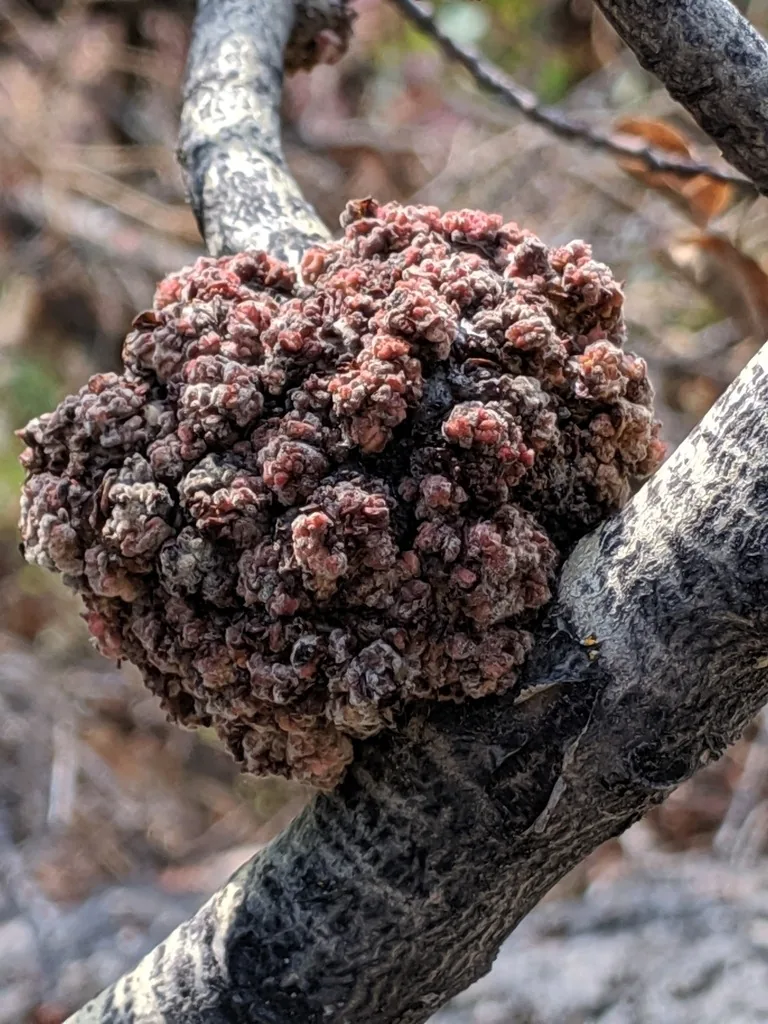
- The galls are woody, cauliflower-like growths on the buds, often on one side of a branch and mostly on the lower branches. Active galls are dark green, succulent and covered with tiny hairs, turn hard, dry and brick red by late summer, and grow to about 4 cm (1 1/2 inches) across. Old, abandoned galls are gray and hard, with a ridged and furrowed surface.[1][3][2]
Look-alikes
| Look-alike | How to tell them apart |
|---|---|
| Poplar twiggall fly | Its galls on aspen twigs are smooth and spherical, with green or yellow fly maggots inside, rather than lumpy, cauliflower-like growths.[4] |
| Poplar petiolegall aphid | Its galls are round, marble-sized swellings on the leaf stems (petioles), each holding aphids, not woody growths on the buds.[5][4] |
Where it lives
Natural Resources Canada reports it on poplars across the Prairie Provinces and western Canada, with the worst infestations on ornamental and shelterbelt hybrids in the southern Prairies. Utah State University Extension covers it as a pest of poplars, cottonwoods and aspens.[3][2]
Biology and life cycle
Hosts are poplars, cottonwoods and aspens. Natural Resources Canada lists balsam poplar; eastern, black, plains, narrowleaf and lanceleaf cottonwoods; Lombardy, Carolina, European black and European white poplars; largetooth aspen; and hybrid poplars.[2][3]
In spring, adult mites attack buds and unfolding leaf clusters. Their feeding stops normal twig growth and starts a gall that forms around the cluster of mites, which keep feeding on sap inside it.[3]
A new generation develops every 2 to 3 weeks until October, eight or more a year, and one active gall can hold more than 3,000 mites.[3]
Mites spend the winter mainly in the galls, less often in or under bud scales. Utah State reports activity from April through September, with mites moving to new buds from about May through August. A gall can stay inhabited for up to 4 years before it is abandoned, and the tiny mites are easily carried by the wind to new areas, where they start new infestations.[1][2][3]
Damage and signs
- The harm is mainly aesthetic. New galls form every year and old ones can stay on the tree for 5 years or more, so an infested tree soon looks rough, and the galls can reduce leaf production.[1][3]
- A persistent infestation stunts and bends the lower branches and often kills them. The tree itself is seldom killed, but continued heavy attack may leave it more open to other pests and to frost or drought.[3][1]
Health risk
It is a plant-feeding mite; Utah State and Natural Resources Canada describe only damage to poplars.[1][3]
Control
Prevention
Where the mite is common, plant resistant poplars. Natural Resources Canada rates the Dunlop, Walker, Griffin and Wheeler hybrids highly resistant, and Brooks No. 5, Northwest and Saskatchewan highly susceptible.[3][1]
A tree given enough water, weed control and fertilizer can tolerate the mites and galls without major effects, and Utah State's general advice is to tolerate the damage, since it is mainly aesthetic.[3][1]
Traps and physical control
Prune out galls or heavily infested twigs in early spring, while the tree is dormant and the mites are still in the galls. Bury, burn or otherwise dispose of the cuttings so they can't reinfest the tree.[1][2]
Pesticides
Control is difficult because the mites live inside the galls and breed quickly. Utah State's guide times treatment to budbreak, when mites move to new buds: horticultural oil at budbreak, or an avermectin, carbamate, METI acaricide, insecticidal soap, lime sulfur or tetronic or tetramic acid product at or just before budbreak. Its tree page names dormant oil or carbaryl for heavy infestations, applied after budbreak. Don't use horticultural oil with sulfur or within 30 days of a sulfur product.[3][1][2]
Common questions
- What are the lumpy, cauliflower-like growths on my cottonwood?
- Woody, cauliflower-like galls on the buds, often on one side of a branch and on the lower crown, are typical of poplar budgall mites. New galls are green, soft and hairy, turn hard and brick red by late summer, and go gray with a ridged surface once abandoned.[1][3]
- Will the galls kill my tree?
- Rarely. Heavy, persistent infestations stunt and kill lower branches and may make the tree more vulnerable to other pests, frost and drought, but the tree itself is seldom killed.[3][1]
- Why don't sprays clear up the galls?
- The mites spend most of their time protected inside the galls and reproduce quickly. Utah State relies on pruning out galls during dormancy and timing any treatment to budbreak, when the mites leave old galls for new buds.[3][1][2]
Sources
- Utah State University Extension, Integrated Pest Management, “Poplar Budgall Mite (Ornamental Pest Guide).” extension.usu.edu/planthealth/ipm/ornamental-pest-guide/arthopods/mites/poplar-budgall-mite.php (accessed 2026-11-08)
- Utah State University Extension, Integrated Pest Management, “Poplar Bud Gall Mite (trees and shrubs pest page).” extension.usu.edu/planthealth/ipm/notes_orn/list-treeshrubs/poplar-bud-gall-mite.php (accessed 2026-11-08)
- Natural Resources Canada, Canadian Forest Service, “Poplar bud gall mite (Trees, insects and diseases of Canada's forests).” tidcf.nrcan.gc.ca/en/insects/factsheet/50 (accessed 2026-11-08)
- Colorado State University, Department of Agricultural Biology, “Insect and mite galls.” agsci.colostate.edu/agbio/ipm-pests/insect-and-mite-galls/ (accessed 2026-11-08)
- Utah State University Extension, Integrated Pest Management, “Petiolegall and Vagabond Gall Aphids (Ornamental Pest Guide).” extension.usu.edu/planthealth/ipm/ornamental-pest-guide/arthopods/aphids-adelgids/petiolegall-vagabond-gall-aphids.php (accessed 2026-11-08)
- iNaturalist, “Aceria parapopuli taxon page (order and family).” www.inaturalist.org/taxa/334090 (accessed 2026-11-08)