On this page
How to identify it
- The aphids are tiny, about 0.6 to 4.6 mm (2/100 to 18/100 inch) long, winged or wingless, and pale green to dark brown; their form, size and color change with age and generation. They are coated in white waxy material.[1][3][2]
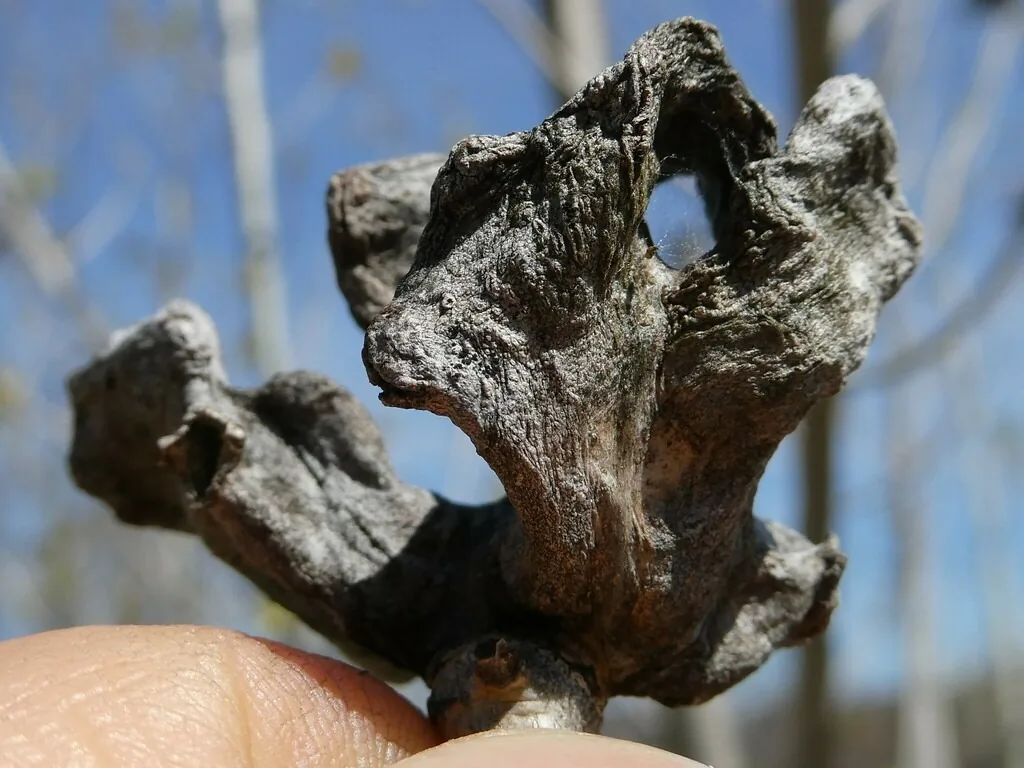
- They are easiest to identify by the galls, because on the tree, apart from brief migrations, they are always inside them. A new gall is a fleshy, hollow, dense and irregular bladder-like mass at the end of a shoot. After the aphids leave it turns brown and woody and can stay on the tree for several years before it weathers off.[1][2]
- Eggs are laid singly and are too small to see without magnification. Most are in old, dried galls left from the year before; some are tucked into bark crevices.[1][2]
Look-alikes
| Look-alike | How to tell them apart |
|---|---|
| Poplar petiolegall aphid | It forms round, marble-sized galls on the leaf stems rather than bladder-like galls at the branch tips.[3][4] |
| Poplar budgall mite | Microscopic mites make woody, cauliflower-like galls on the buds, typically on one side of a branch, and a single gall can harbor mites for up to 4 years.[5] |
Where it lives
It occurs through much of the United States and is commonly found on cottonwoods in Wyoming. In Wisconsin it infests aspen and cottonwood, and the state's forest health specialist reports always finding it on open-grown trees along stand edges, roads, fence rows and in yards.[1][2]
Biology and life cycle
Eggs hatch in spring at budbreak, and the young nymphs move to growing buds and suck the plant juices. Their feeding turns the leaf tissue into a gall that soon encloses the founding aphids, which mature quickly and produce hundreds of offspring.[1][2]
Their combined feeding keeps the gall growing until it matures by midsummer, when it turns brown and dry and splits open. Winged aphids then leave on the wind for a secondary host that is still unknown, where they are believed to feed and reproduce.[1][2]
In late summer or fall a winged generation returns to cottonwoods and aspens, moves into old galls and lays the overwintering eggs on them or in bark crevices. There are several generations a year.[1][2][3]
Because the returning aphids go back to trees that already carry galls, one tree can be heavily infested while a neighboring tree has none.[2]
Damage and signs
- Injury is limited to the galled shoots. Each gall kills the terminal bud, which stops that shoot from lengthening and pushes out side shoots, so a heavily infested tree, which can carry hundreds of galls in its upper branches, takes on a changed look that is most noticeable after leaf fall.[1][2]
- The galls don't usually kill the tree and are not detrimental to its overall health; the main complaint is that many owners find galled trees unsightly.[2][1][3]
Health risk
It is a sap-feeding aphid that stays inside its galls; Wyoming and Wisconsin describe only effects on trees and mention no risk to people or pets.[1][2]
Control
Prevention
Control isn't needed for the tree's health, and Utah State's advice is to tolerate the galls and keep the tree healthy and free of stress.[1][3]
Traps and physical control
Prune off galled stems and remove old galls while the tree is dormant, before the eggs hatch in early spring. This reduces or eliminates reinfestation the next year, but it has to be repeated every winter or gall numbers tend to build up again.[1][2]
Pesticides
Direct control is hard because the aphids are protected inside the galls. Sprays work only in a narrow window: a labeled insecticide during budbreak, as eggs hatch and nymphs look for open buds, or, per Utah State, horticultural oil on the overwintering eggs in spring before budbreak; Utah State also lists a systemic neonicotinoid in spring. Once galls have formed, sprays won't work, and treatment may be needed again in later years because neighboring galled trees can reinfest a tree.[1][3]
Common questions
- What are the brown, woody clumps at the tips of my cottonwood or aspen branches?
- Brown, woody galls at the branch tips that stand out after the leaves drop are typical of the vagabond gall aphid. The galls form in spring, turn brown and woody once the aphids leave in summer, and can stay on the tree for several years.[2][1][3]
- Do I need to treat for vagabond gall aphids?
- Not for the tree's sake: the galls are not detrimental to its overall health. If you want fewer of them, prune galls off during dormancy each winter. Sprays only work around budbreak, before new galls form.[1][3]
- Why does one tree have hundreds of galls and the one next to it none?
- The aphids return to the same trees that carry the original galls, so infestations stay concentrated on those trees.[2]
Sources
- University of Wyoming Agricultural Experiment Station, “Poplar vagabond gall aphid fact sheet, B-1041 (T. Noma, J. K. Wangberg and M. J. Brewer, August 1996).” www.wyoextension.org/agpubs/pubs/B1041.pdf (accessed 2026-11-08)
- Wisconsin Department of Natural Resources, Division of Forestry, “Poplar vagabond aphid (Forestry News, L. Williams, July 2017).” forestrynews.blogs.govdelivery.com/2017/07/27/poplar-vagabond-aphid/ (accessed 2026-11-08)
- Utah State University Extension, Integrated Pest Management, “Petiolegall and Vagabond Gall Aphids (Ornamental Pest Guide).” extension.usu.edu/planthealth/ipm/ornamental-pest-guide/arthopods/aphids-adelgids/petiolegall-vagabond-gall-aphids.php (accessed 2026-11-08)
- Colorado State University, Department of Agricultural Biology, “Insect and mite galls.” agsci.colostate.edu/agbio/ipm-pests/insect-and-mite-galls/ (accessed 2026-11-08)
- Utah State University Extension, Integrated Pest Management, “Poplar Budgall Mite (Ornamental Pest Guide).” extension.usu.edu/planthealth/ipm/ornamental-pest-guide/arthopods/mites/poplar-budgall-mite.php (accessed 2026-11-08)
- iNaturalist, “Mordwilkoja vagabunda taxon page (order and family).” www.inaturalist.org/taxa/454530 (accessed 2026-11-08)