On this page
How to identify it
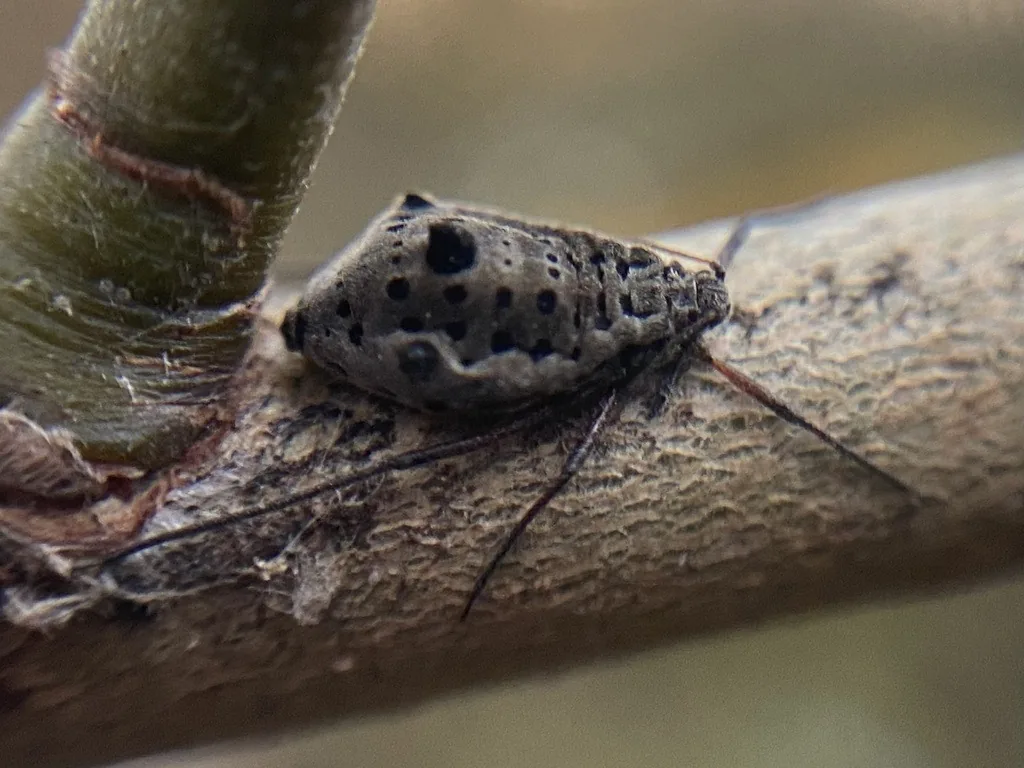
- Adults are about 1/4 inch (5 to 5.8 mm) long, with rows of black spots and a raised, shark-fin-like cone in the middle of the back.[1][2][3]
- NC State describes them as gray; UMass as medium to dark brown with fine hairs that give a grayish-golden sheen.[1][2]
- Antennae are short, about half the body length or less.[1][2]
Where it lives
Reported on willows in North Carolina, Massachusetts and the Pacific Northwest.[1][2][3]
Biology and life cycle
All are females that reproduce without mating; no males have been found, and each aphid can produce about 30 young.[1][2]
Colonies appear by midsummer, peak in late summer or fall and can persist on the bark into February; where they spend late winter to midsummer is not known.[1][2]
In the PNW, colonies often concentrate on bark close to the ground.[3]
Damage and signs
Health risk
None to people or pets, though the honeydew attracts stinging insects.[1]
Control
Traps and physical control
Prune out heavily infested twigs when numbers are low, or knock aphids off with a strong stream of water.[1]
Biological control
NC State notes parasitic wasps, lady beetles, hover fly larvae, lacewings and an aphid-killing fungus reduce colonies in warm weather, while UMass reports natural enemies are rare.[1][2]
Pesticides
For organic control NC State suggests insecticidal soap or horticultural oil, which also helps weather away sooty mold.[2]
Common questions
Sources
- UMass Extension Landscape, Nursery and Urban Forestry Program (Landscape Insect & Mite Guide), “Tuberolachnus salignus (Giant Willow Aphid).” www.umass.edu/agriculture-food-environment/landscape/publications-resources/insect-mite-guide/tuberolachnus-salignus (accessed 2026-10-16)
- NC State Extension, “Giant Willow Aphid (PDIC Factsheet, revised May 11, 2021).” content.ces.ncsu.edu/giant-willow-aphid (accessed 2026-10-16)
- Pacific Northwest Insect Management Handbook (Oregon State, Washington State, University of Idaho), “Willow (Salix)-Aphid (Hosts and Pests of Landscape Plants).” pnwhandbooks.org/insect/hort/landscape/hosts-pests-landscape-plants/willow-salix-aphid (accessed 2026-10-16)
- iNaturalist, “Tuberolachnus salignus taxon page (order and family).” www.inaturalist.org/taxa/354036 (accessed 2026-10-06)