How to identify it
- Colonies are conspicuous for the large amounts of white woolly wax they produce on leaf undersides; brown droplets of honeydew collect in the wax.[2]
- The aphids beneath the wax are pale; young nymphs can be pale green and move more than adults.[2]
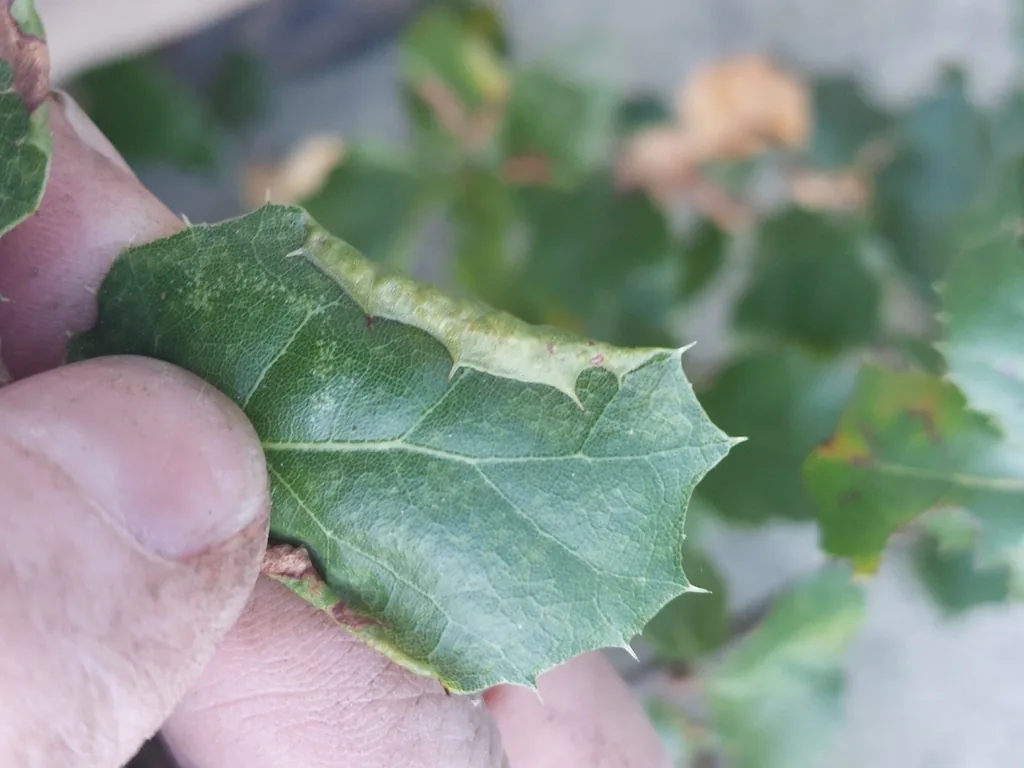
- New leaves of red oaks may curl noticeably in spring.[1]
Look-alikes
| Look-alike | How to tell them apart |
|---|---|
| Mealybugs | Woolly oak aphid colonies are sometimes mistaken for mealybugs or whiteflies.[2] |
| Whiteflies | Woolly oak aphid colonies are sometimes mistaken for whiteflies.[2] |
Where it lives
Both species occur in eastern North America; UF notes Stegophylla brevirostris is a pest only in Florida.[2]
Biology and life cycle
In Florida, all forms are live-bearing females year-round, with no egg-laying or winged forms known there.[2]
Damage and signs
Health risk
Control
Traps and physical control
On small trees, a strong spray of water from a hose dislodges and drowns many aphids.[1]
Biological control
They are native species with native natural enemies, and in most cases control isn't needed.[2]
Pesticides
Horticultural oils or insecticidal soaps work, but spraying large trees is difficult, expensive and not worth the effort.[1]
Common questions
- What is the white fluff under my oak leaves?
- Likely woolly oak aphids, which secrete white woolly wax.[1][2]
- Do woolly oak aphids hurt oaks?
- Usually not enough to need control, though they curl leaves and make a mess.[1][2]
- Will spraying uncurl the leaves?
- No; by the time curling shows, it is too late for that year.[1]
Sources
- NC State Extension, “Woolly Oak Aphids.” content.ces.ncsu.edu/woolly-oak-aphids-1 (accessed 2026-10-15)
- University of Florida IFAS Extension (Featured Creatures), “Woolly Oak Aphids (EENY-574).” ask.ifas.ufl.edu/publication/IN1011 (accessed 2026-10-15)
- iNaturalist, “Stegophylla taxon page (order and family).” www.inaturalist.org/taxa/454656 (accessed 2026-10-06)