On this page
How to identify it
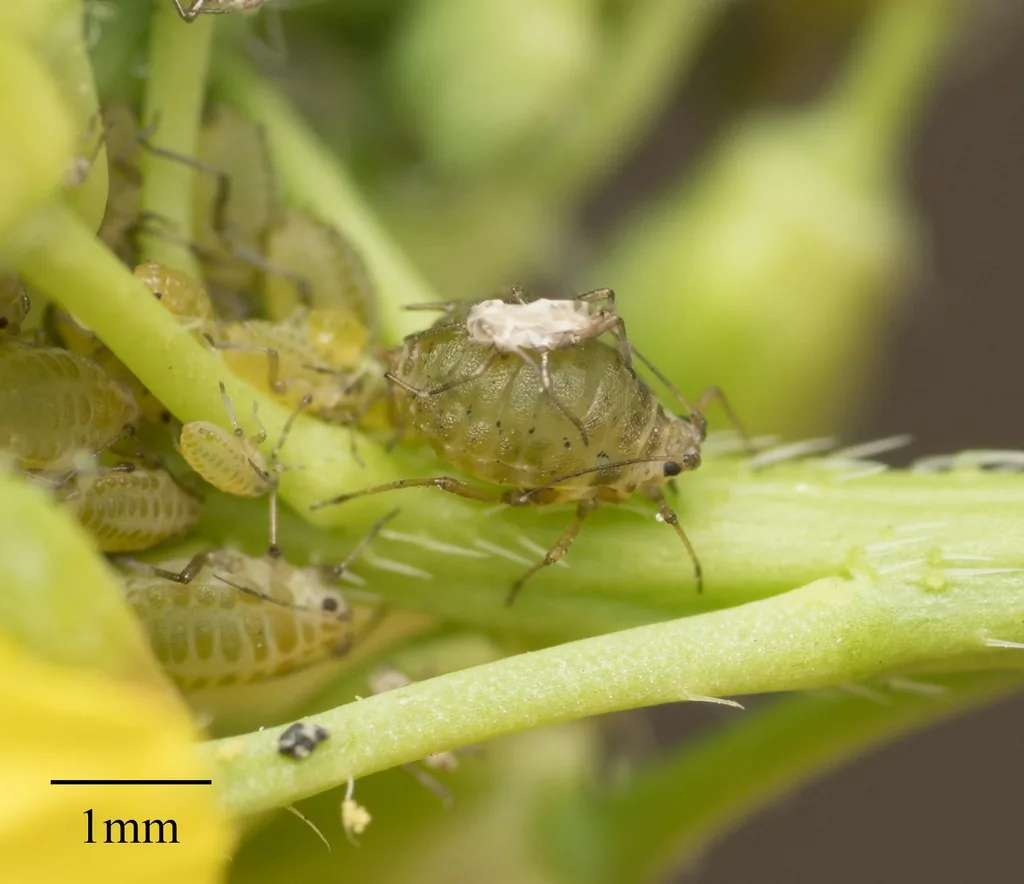
- Dark to olive green, with visible cornicles (the pair of tubes on the rear of the abdomen) that are shorter than a green peach aphid's.[1]
- It has a thin waxy coating, much less obvious than the heavy wax of the cabbage aphid.[1]
- Instead of packing into dense colonies like the cabbage aphid, turnip aphids are scattered more randomly over the plant.[1]
Look-alikes
| Look-alike | How to tell them apart |
|---|---|
| Cabbage aphid | Covered in a thick, waxy coating and packed into dense colonies; the turnip aphid's wax is thin and its colonies are more scattered.[1] |
| Green peach aphid | Pale green to yellowish, sometimes pinkish, with longer cornicles that are swollen or club-like at the tip.[1] |
Where it lives
Found worldwide in all but the coldest land habitats. In California cole crops it is mostly a problem in the low desert and rare along the coast.[2][1]
Biology and life cycle
It prefers plants in the mustard family but has been recorded on plants in more than 10 families.[2]
Turnip aphid problems tend to come back in the same fields year after year.[1]
In the California low desert, turnip aphids typically need treatment between January and April.[1]
Damage and signs
- It is particularly important on cabbage, cauliflower, mustards, radish and turnip, and also on cucurbits and solanaceous plants.[2]
- Turnip aphids feeding on cole crop roots can seriously stunt and even kill plants.[1]
- Large numbers of aphids can contaminate the marketable heads of cole crops.[1]
- It has been implicated in transmitting at least 16 plant viruses.[2]
Health risk
The sources describe it only as a crop pest; neither mentions any risk to people or pets.[1][2]
Control
Sanitation
Remove infested culls and weeds around fields that can harbor aphids. Because turnip aphid keeps returning to the same fields, long-term rotation to other crops such as lettuce is advised.[1]
Biological control
General predators and parasitic wasps such as Diaeretiella rapae, Aphidius matricariae, Aphelinus semiflavus and Lysiphlebus testaceipes attack foliage-feeding aphids; brown or black mummified aphids show the wasps at work. Insectary plants can draw in these natural enemies.[1]
Pesticides
In coastal areas turnip aphids rarely need insecticides. In the low desert, treat when they are numerous enough to contaminate the marketable heads, timing the spray before they reach the heads. Insecticidal soap is among the options for organic growers.[1]
Common questions
- Is the turnip aphid the same as the mustard aphid?
- Yes. Both UC IPM and AphID give mustard aphid as another common name for the turnip aphid.[1][2]
- How can I tell turnip aphids from cabbage aphids?
- Cabbage aphids wear a thick, waxy coat and pack into dense colonies. Turnip aphids are dark to olive green with only a thin wax coating and are scattered more loosely.[1]
- Why do turnip aphids keep coming back in the same field?
- UC IPM notes the problem tends to recur in the same fields and recommends long-term rotation to other crops, such as lettuce.[1]
Sources
- University of California Statewide IPM Program, “Green Peach Aphid and Turnip Aphid, UC IPM Pest Management Guidelines: Cole Crops.” ipm.ucanr.edu/agriculture/cole-crops/aphids (accessed 2026-11-09)
- USDA APHIS PPQ Identification Technology Program (AphID), “AphID: Lipaphis pseudobrassicae fact sheet.” www.aphid.aphidnet.org/Lipaphis_pseudobrassicae.php (accessed 2026-11-09)
- iNaturalist, “Lipaphis pseudobrassicae taxon page (order and family).” www.inaturalist.org/taxa/391746 (accessed 2026-11-09)