On this page
How to identify it
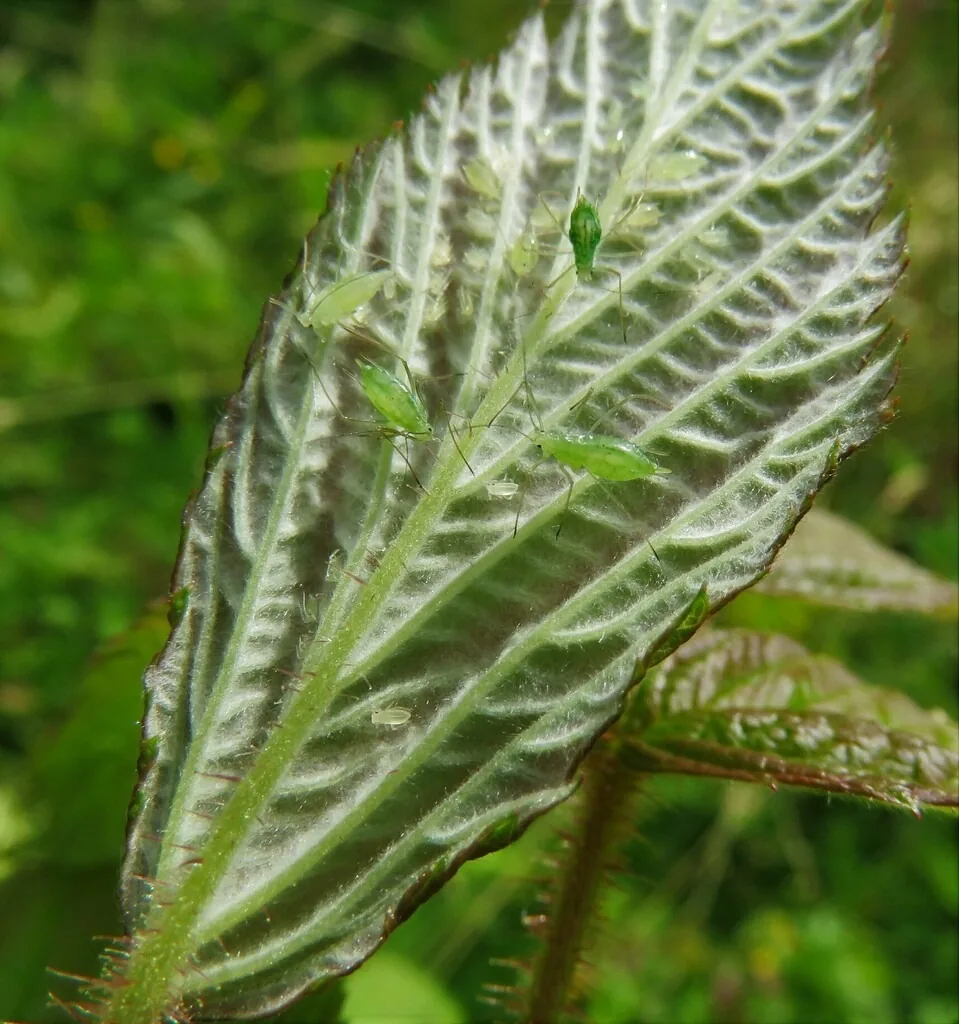
- A large aphid, up to 3 mm long when compared with other species, dark green to yellow.[1]
- Colonies concentrate in hot spots on new growth; look for sticky honeydew, sooty mold, ants and yellowjackets drawn to the honeydew, and for yellowed or deformed leaves.[1]
- Overwintering eggs on the canes are light yellowish white when laid in November and turn black later; winged aphids appear in fall to lay them.[1]
Look-alikes
| Look-alike | How to tell them apart |
|---|---|
| Other aphids on caneberries | Several aphid species occur on blackberry and raspberry; the larger raspberry aphid stands out by size, up to 3 mm, and is the major pest and virus vector.[1] |
| Strawberry aphid | A different aphid of a different crop; the larger raspberry aphid is the major aphid pest of blackberry and raspberry.[1] |
Where it lives
A North American species that is the primary aphid virus vector in red raspberry in the Pacific Northwest and an important vector in red and black raspberry plantings across North America.[2][3]
Biology and life cycle
The aphid overwinters as eggs on the canes. Eggs begin hatching by late February or March, the population builds slowly through several overlapping generations, and winged forms produced in fall lay the next winter's eggs.[1]
Field studies in northern Washington estimated a lower developmental threshold of 2.7 C; wingless and winged populations began increasing rapidly at about 800 growing degree-days and peaked at about 1,050. Aphid flights are most common at moderate temperatures of 60 to 80 F.[2][1]
Raspberry resistance to this aphid has been bred around a single dominant gene, Ag1. On the resistant cultivar Tulameen the aphids reach the phloem normally but then salivate more and ingest much less sap than on a susceptible cultivar, which likely explains why aphid-transmitted viruses are scarce in resistant plantings.[3]
Damage and signs
- Large populations weaken and stunt new growth, yellow and deform leaves and devitalize plants. The honeydew they excrete grows sooty mold that lowers fruit quality and attracts ants and yellowjackets.[1]
- The major problem is virus disease, which this aphid transmits readily. Raspberry leaf mottle virus spread rapidly in Washington fields, infecting 30 to 60 percent of plants in three seasons, and infection was not predictable from the number of aphids counted on sampled leaves.[1][2]
Health risk
None of the sources mentions any effect on people or pets; the concern is plant viruses, fruit quality and the ants and yellowjackets that honeydew attracts.[1]
Control
Prevention
Plant resistant raspberry cultivars where virus is a concern; resistance based on the Ag1 gene has been relied on to keep aphid-transmitted viruses out of plantings. Go easy on nitrogen, since heavily fertilized plants carry more aphids, and prune out suckers and excess growth that invite colonies.[3][1]
Traps and physical control
Home gardeners can wash aphids off with a strong stream of water. Check plants often once new growth begins, concentrating on hot spots.[1]
Biological control
Many parasites and predators attack this aphid. Watch the share of parasitized mummies and the number of lady beetles; if natural enemies are gaining, skip sprays, because most products available for aphid control are highly disruptive to them. Control ants, which farm the aphids and protect them from predators.[1]
Pesticides
Home-use options in the Pacific Northwest include a dormant-season superior-type oil and, in the growing season, insecticidal soap, azadirachtin or neem oil, pyrethrins, spinosad, plant essential oils, malathion, carbaryl, imidacloprid and pyrethroids such as bifenthrin, esfenvalerate, zeta-cypermethrin and permethrin (permethrin on raspberry only). Do not spray plants in bloom, to protect bees.[1]
When to call a professional
Commercial caneberry growers time treatments to monitoring and degree-day phenology and rely on resistant cultivars to hold down aphid-transmitted viruses; a university small-fruit specialist or crop adviser can help with field-scale decisions.[2][3]
Common questions
- I only see a few aphids. Do I still have a virus problem?
- Possibly. In Washington fields the number of aphids on sampled leaves did not predict which plants became infected with raspberry leaf mottle virus, and infection reached 30 to 60 percent of plants in three seasons. Resistant varieties and clean stock matter more than aphid counts.[2][3]
- When do they show up?
- Eggs on the canes hatch in late February or March and the population builds slowly through spring with several overlapping generations; flights are commonest at 60 to 80 F, and winged forms lay eggs in fall.[1]
- What is the simplest control for a backyard patch?
- Wash them off with water, control the ants that protect them, avoid heavy nitrogen fertilizer and leave natural enemies alone unless they are losing. If you spray, insecticidal soap or oil are the least disruptive choices, and never spray open bloom.[1]
Sources
- Pacific Northwest Pest Management Handbooks (Oregon State University, Washington State University and University of Idaho), “Blackberry and Raspberry: Aphid (includes larger raspberry aphid, Amphorophora agathonica), Pacific Northwest Insect Management Handbook.” pnwhandbooks.org/insect/small-fruit/blackberry-raspberry/blackberry-raspberry-aphid (accessed 2026-11-10)
- Environmental Entomology (Entomological Society of America), abstract via PubMed, “Lightle, Quito-Avila, Martin and Lee 2014. Seasonal phenology of Amphorophora agathonica and spread of viruses in red raspberry in Washington. Environmental Entomology 43(2):467-473.” pubmed.ncbi.nlm.nih.gov/24763099/ (accessed 2026-11-10)
- Journal of Economic Entomology (Entomological Society of America), abstract via PubMed, “Lightle, Dossett, Backus and Lee 2012. Location of the mechanism of resistance to Amphorophora agathonica in red raspberry. Journal of Economic Entomology 105(4):1465-1470.” pubmed.ncbi.nlm.nih.gov/22928330/ (accessed 2026-11-10)
- iNaturalist, “Amphorophora agathonica taxon page (order and family).” www.inaturalist.org/taxa/454182 (accessed 2026-11-10)