On this page
How to identify it
Look-alikes
| Look-alike | How to tell them apart |
|---|---|
| Elm sack gall aphid | Tetraneura ulmi, also called the elm-grass root aphid, makes pouch-like sack galls on elm leaves rather than ridged cockscombs, though it also moves to grass roots in summer.[2] |
Where it lives
It occurs on native elms, mainly American elm and red or slippery elm, where galls are especially common, and Extension services from Massachusetts and Ohio to Virginia describe it.[1][2][3]
Biology and life cycle
Elm is the spring host: aphids feed in the leaf galls, and by early summer winged aphids leave the galls and fly to grasses.[1][2]
On the grasses their offspring feed on the roots through summer.[2][3]
In fall, winged aphids return to elm, and their offspring spend the winter on the tree, in bark crevices or as eggs around the buds.[2][1]
Damage and signs
Health risk
It feeds only on elm leaves and grass roots; UMass, Ohio State and Virginia Extension mention no risk to people.[1][2][3]
Control
Prevention
Management is often unnecessary, since the galls are cosmetic and the aphids leave the elm by early summer.[1][2]
Common questions
- What are the red, comb-shaped growths on my elm leaves?
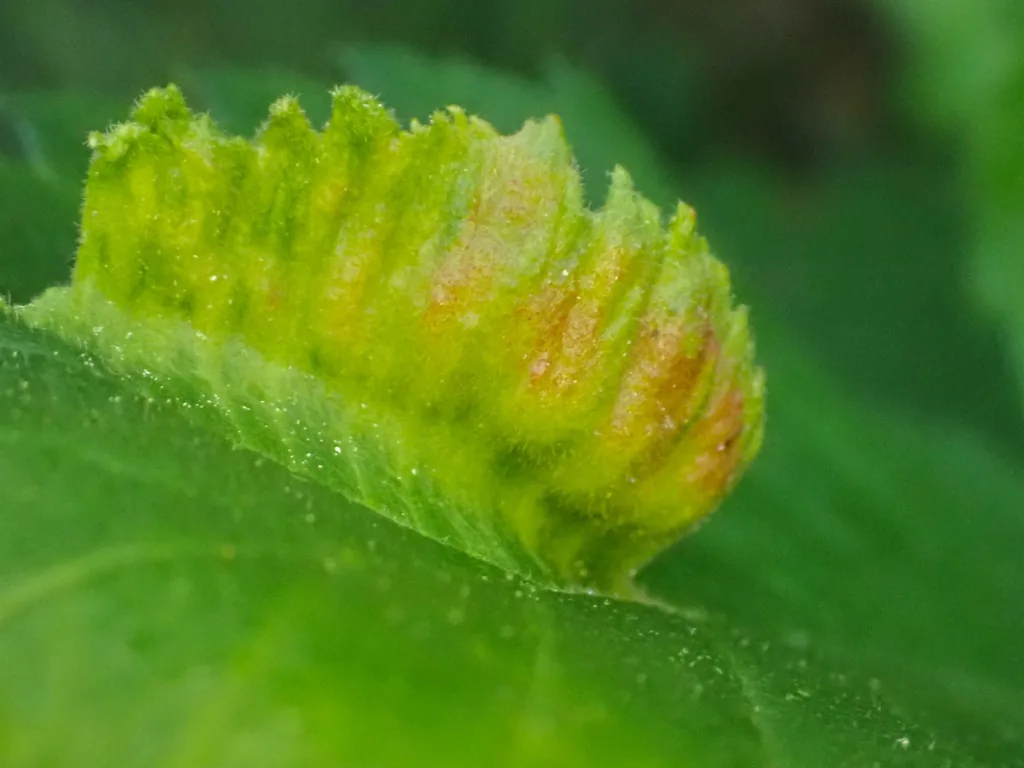
- Elm cockscomb galls, made by an aphid that feeds inside them in spring before moving to grass roots.[1][3]
- Do elm cockscomb galls hurt the tree?
- No. They look odd but don't significantly affect the tree's health, so treatment is usually unnecessary.[1][2]
Sources
- UMass Extension Landscape, Nursery and Urban Forestry Program, “Colopha ulmicola, Elm Cockscomb Gall Aphid (Insect & Mite Guide).” www.umass.edu/agriculture-food-environment/landscape/publications-resources/insect-mite-guide/colopha-ulmicola (accessed 2026-10-19)
- Ohio State University Extension, “Aphid Galls Rising on Elms (Buckeye Yard & Garden onLine).” bygl.osu.edu/node/1586 (accessed 2026-10-19)
- Virginia Cooperative Extension, “Gall-making insects and mites, ENTO-506.” pubs.ext.vt.edu/ENTO/ENTO-146/ENTO-146.html (accessed 2026-10-19)
- iNaturalist, “Colopha ulmicola taxon page (order and family).” www.inaturalist.org/taxa/332245 (accessed 2026-10-06)