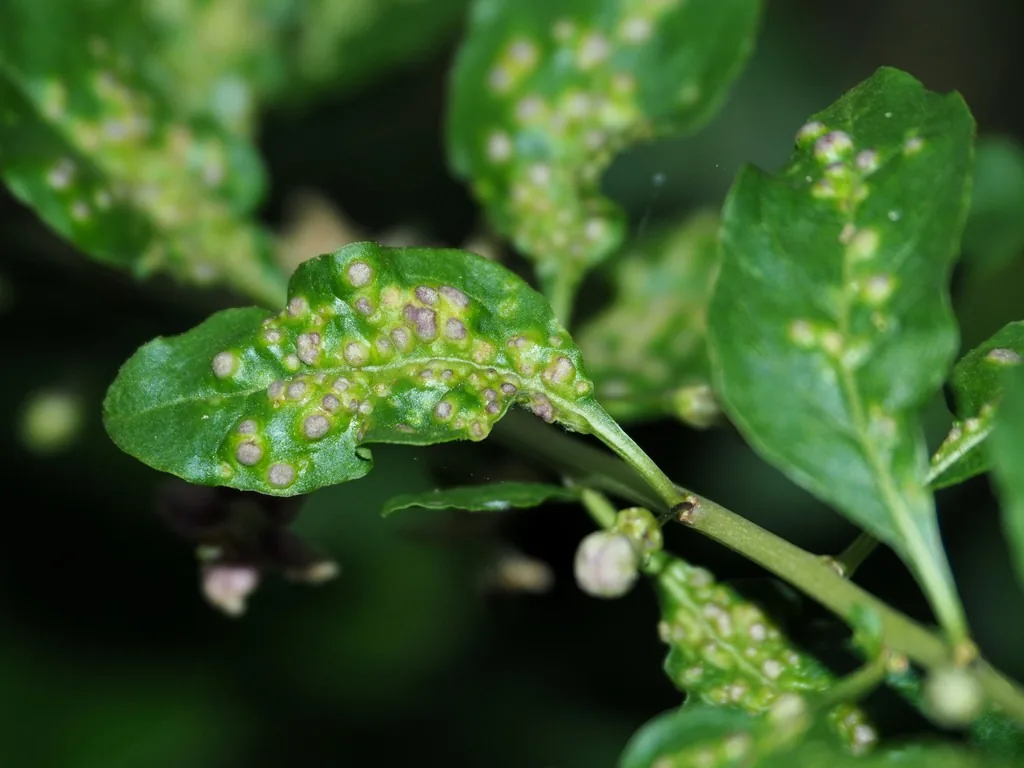
How to identify it
Look-alikes
| Look-alike | How to tell them apart |
|---|---|
| Insect galls | Gall wasps, midges, aphids and psyllids also make galls; the mites themselves are visible only with magnification.[2][3] |
Where it lives
Gall-making eriophyid mites occur widely on trees, shrubs and flowers, from ash, maple and birch in Minnesota to fuchsia in California.[3][2]
Biology and life cycle
They spend the winter on the host plant and start feeding and forming galls in spring as buds open.[3]
Gall mites have several generations a year.[2]
Ash flower galls start green and turn brown by late summer, and can stay on the tree up to two years.[3]
Damage and signs
Health risk
These mites feed only on plants; the sources describe no concern for people.[2][3]
Control
Prevention
Usually no control is needed; most mite galls don't seriously harm the plant.[3][2]
Sanitation
On flowers such as fuchsia, start with pest-free plants and remove infested ones, since mites feeding inside tissue are hard to reach.[1]
Pesticides
For mites that winter on the plant, horticultural oil before spring activity is the timing Minnesota Extension gives; sprays after galls form don't work.[3]
Common questions
Sources
- University of California Statewide IPM Program, “Gall and Bud Mites (Pests in Gardens and Landscapes).” ipm.ucanr.edu/PMG/GARDEN/FLOWERS/INVERT/gallmite.html (accessed 2026-10-06)
- University of California Statewide IPM Program, “Gall Makers (Pests in Gardens and Landscapes).” ipm.ucanr.edu/PMG/GARDEN/PLANTS/INVERT/gallmakers.html (accessed 2026-10-06)
- University of Minnesota Extension, “Insect and mite galls (Yard and garden insects).” extension.umn.edu/yard-and-garden-insects/insect-and-mite-galls (accessed 2026-10-06)
- iNaturalist, “Eriophyidae taxon page (order and family).” www.inaturalist.org/taxa/55584 (accessed 2026-10-06)