On this page
How to identify it
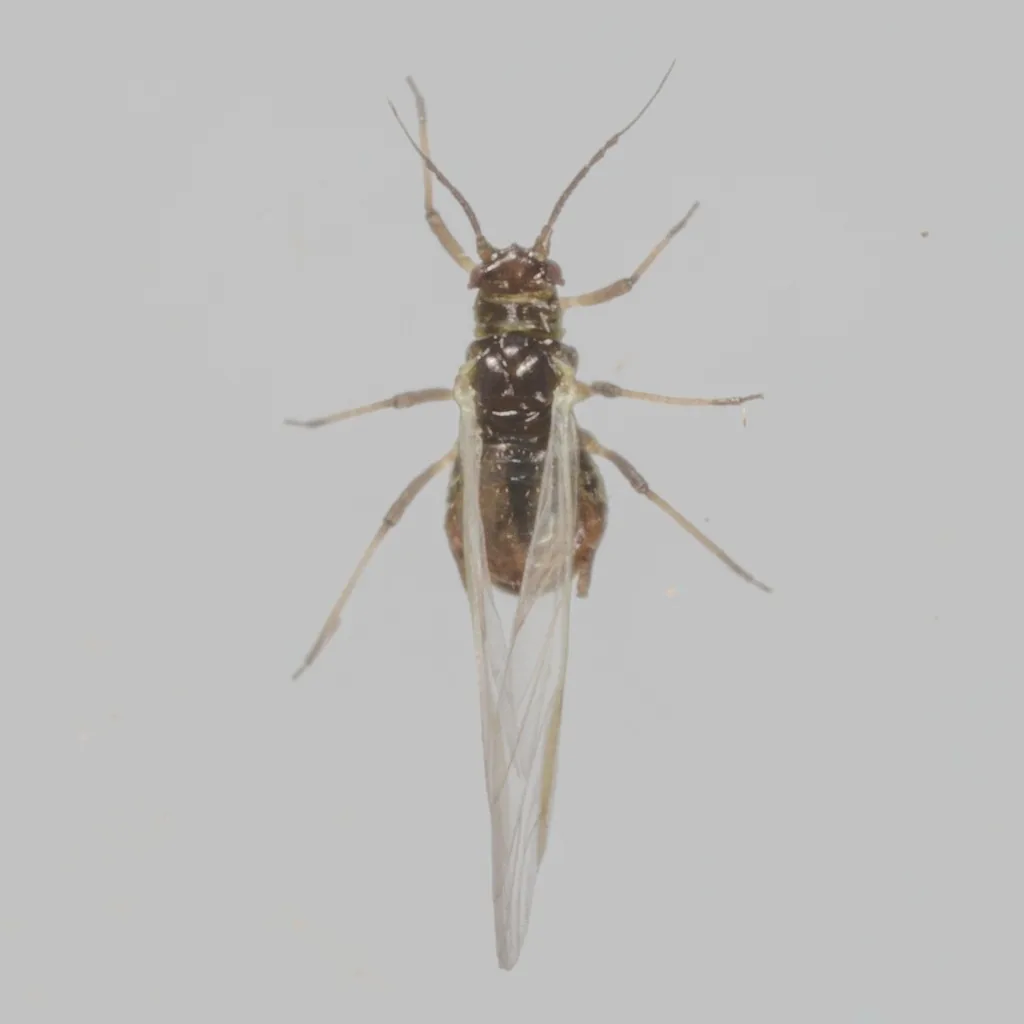
- An aphid with a round, dark olive-green body.[1]
- Wingless aphids live mostly on the roots and in the soil around the base of the plant. Winged ones, which have dark bodies, sometimes turn up on leaves and stems or on yellow sticky traps.[1]
- The name is spelled two ways: research papers use Rhopalosiphum rufiabdominale, while iNaturalist lists it as R. rufiabdominalis.[2][3][4]
Look-alikes
| Look-alike | How to tell them apart |
|---|---|
| Other winged aphids | On foliage, the winged adults look like many other winged aphids. Finding colonies on the roots and in the soil at the plant base is what points to rice root aphid.[1] |
| Cannabis aphid | The cannabis aphid also feeds on cannabis (hemp), but rice root aphid colonies live mainly on the roots and in the soil. Both species have been tested as possible carriers of hop latent viroid.[2][1] |
| Bird cherry-oat aphid | This close relative is the other aphid found carrying and transmitting yellow dwarf viruses into winter wheat in Alabama and western Florida surveys.[3] |
Where it lives
It feeds on small grains in North America and has been documented in greenhouse hemp. In the South it has turned up in wheat in Alabama and western Florida, and in traps around cotton fields from North Carolina to Texas, where it was caught at every survey location though in low numbers. In Utah it has been found only rarely, in greenhouse hemp.[1][3][4]
Biology and life cycle
In the United States, populations reproduce without mating and lay no eggs. Females give birth to live young, all female, and live about a month.[1]
Winged females fly to host plants in spring. Numbers can double about every two days until winter brings higher mortality.[1]
It hasn't been seen on hemp grown outdoors, but in greenhouses and hydroponic operations it may be present all year.[1]
It is one of several aphids reported to feed on cotton without often infesting it.[4]
Damage and signs
- Nymphs and adults feed on roots, causing reduced vigor, slow growth, wilting and yellowing leaves. USU says it won't cause severe economic damage unless populations are high.[1]
- It carries and transmits barley yellow dwarf virus-PAV and cereal yellow dwarf virus-RPV, and fall surveys found it among the aphids bringing yellow dwarf into winter wheat in Alabama and western Florida, though the numbers of aphids and of virus carriers were low.[3]
- In a lab test, one of eight groups of rice root aphids that fed on cannabis infected with hop latent viroid picked up the viroid. Whether it can pass the viroid to healthy plants is still unknown.[2]
Health risk
The sources treat it only as a plant pest; none mentions bites, stings or other risk to people or pets.[1][3]
Control
Prevention
Avoid excess nitrogen, and manage weeds in and around the crop, especially grasses and sedges.[1]
Traps and physical control
Check the soil at the base of plants and the leaf surfaces regularly for dark winged aphids, and hang yellow sticky traps in the greenhouse to detect winged adults.[1]
Biological control
Encourage natural enemies.[1]
Pesticides
Consider treatment only if populations are high and causing economic damage. Approved insecticides are available but must contact the aphids to work. USU's list of Utah-registered products for hemp includes insecticidal soaps (potassium salts of fatty acids), mineral oil, neem oil, other plant oils such as rosemary, thyme and sesame oil, and pyrethrins; several are restricted to greenhouse-only or outdoor-only use.[1]
Common questions
- Why are my greenhouse hemp plants wilting and yellow with no pests on the leaves?
- Rice root aphids feed on roots, in soil or hydroponic systems, and cause reduced vigor, slow growth, wilting and yellowing. Check the root zone and the base of the plant for dark olive-green aphids.[1]
- Does the rice root aphid spread plant diseases?
- It transmits barley and cereal yellow dwarf viruses to wheat. It can pick up hop latent viroid from infected cannabis, but transmission to healthy plants hasn't been shown.[3][2]
Sources
- Utah State University Extension IPM Program, “Hemp pest note: Rice Root Aphids.” extension.usu.edu/planthealth/ipm/notes_ag/hemp-rice-root-aphid.php (accessed 2026-11-09)
- Springer Nature (Archives of Virology), “Ong M, Munz J, Feng A, Yaqub S, Buirs L, Gries G. Acquisition of hop latent viroid from viroid-infected cannabis plants by rice root aphids and cannabis aphids. Archives of Virology (2025) (abstract).” doi.org/10.1007/s00705-025-06422-2 (accessed 2026-11-09)
- Entomological Society of America (Journal of Economic Entomology), “Hadi BA, Flanders KL, Bowen KI, Murphy JF, Halbert SE. Species composition of aphid vectors (Hemiptera: Aphididae) of barley yellow dwarf virus and cereal yellow dwarf virus in Alabama and western Florida. Journal of Economic Entomology 104(4):1167-1173 (2011) (abstract).” doi.org/10.1603/ec10425 (accessed 2026-11-09)
- MDPI (Insects), “Mahas JW et al. The spatiotemporal distribution, abundance, and seasonal dynamics of cotton-infesting aphids in the southern U.S. Insects 14(7):639 (2023) (abstract).” doi.org/10.3390/insects14070639 (accessed 2026-11-09)
- iNaturalist, “Rhopalosiphum rufiabdominalis taxon page (order and family).” www.inaturalist.org/taxa/330190 (accessed 2026-11-09)