On this page
How to identify it
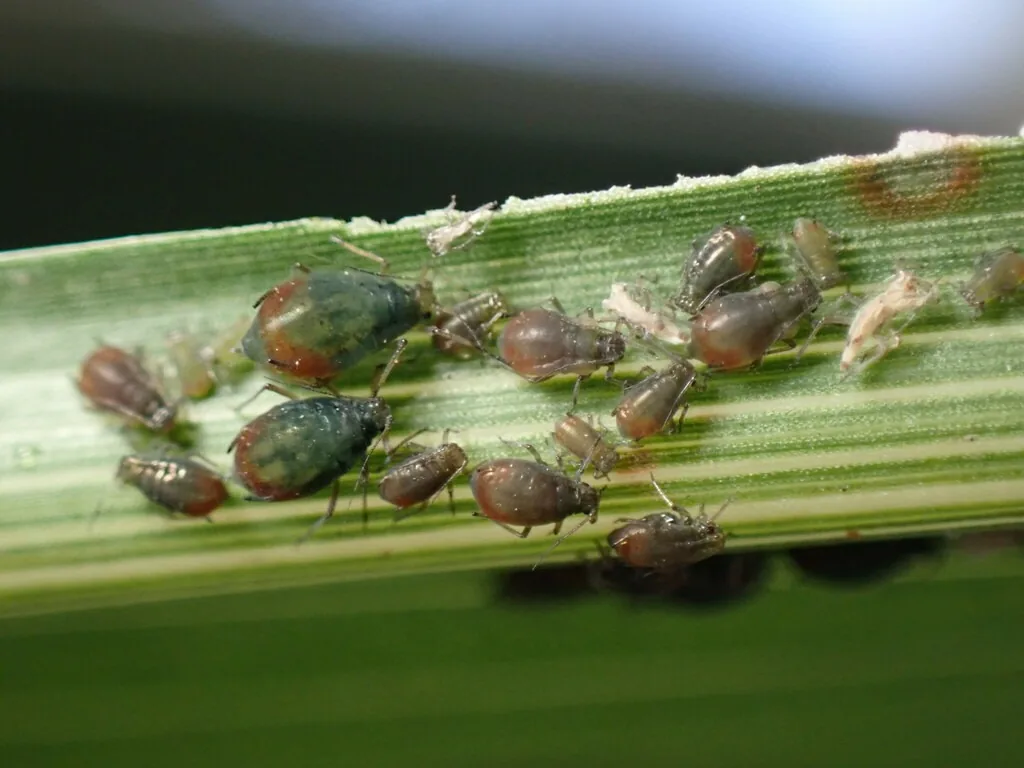
- Adults are olive green, and Kansas State calls it the darkest aphid found on Kansas wheat; nymphs are usually paler, yellowish green. Color varies with temperature, and adults can be much paler in very warm weather.[1][2]
- Look at the rear of the abdomen around the cornicles. Nebraska Extension describes a reddish-orange area at their bases; Kansas State describes a dark brown patch across the rear of the abdomen spanning both cornicles, which can be hard to see on the darkest aphids.[2][1]
- The cornicles and the tips of the antennae are black, and the tips of the legs are black too. Winged adults are darker than wingless ones.[1][2]
- It does not form dense colonies; the aphids tend to spread out over the plant, on the undersides of leaves, on leaf sheaths and on heads.[1][2]
Look-alikes
| Look-alike | How to tell them apart |
|---|---|
| Greenbug | In Nebraska Extension's key, the greenbug has no reddish-orange spot around the cornicle bases; instead it has a dark green stripe down a pale green back.[2] |
| Russian wheat aphid | The Russian wheat aphid is light green and spindle shaped, with very short, reduced cornicles, and it feeds inside tightly rolled leaves.[2] |
Where it lives
Kansas State and Nebraska Extension both cover it as a wheat aphid. Kansas State notes that populations in Oklahoma, and possibly southern Kansas, can reproduce year-round without the sexual generation when winters are warm.[1][2]
Biology and life cycle
It alternates hosts. In fall it returns to cherry, its woody host, where egg-laying females leave eggs on the twigs for the winter. In spring the eggs hatch into females whose daughters grow wings and fly to grasses such as wheat, oats and barley once the new cherry growth hardens.[1]
Many populations now skip the sexual generation: where winters are warm enough, they keep reproducing without mating on grasses all year.[1]
On grasses the females give birth to live young without mating. A female may produce two to three young a day in warm weather, and young females mature in 7 to 10 days, so numbers can build quickly.[2]
It handles cold better than other cereal aphids, appearing on wheat later in fall and earlier in spring, often while snow is still on the ground. It has been recorded on several hundred grasses, though corn and sorghum are generally less suitable hosts.[1]
Damage and signs
- Its feeding causes no yellowing or other visible damage, but heavy infestations can lower grain quality, protein content and test weight. Large colonies that last past the boot stage can twist the flag leaf into a corkscrew that traps the awns, leaving fish-hooked heads.[1]
- Its greatest cost comes from spreading plant viruses, especially barley yellow dwarf virus in wheat and barley; infections do the most harm when they start in young plants. In Nebraska it also transmits maize dwarf mosaic virus to corn and sorghum.[1][2]
- A few aphids moving quickly into or out of a field can spread virus, so infection can happen even when aphids are hard to find. Nebraska Extension notes these aphid-spread diseases usually are not serious there, though they can be in some years.[2]
Health risk
It feeds only on plants. Kansas State and Nebraska Extension describe it as a crop pest and mention no risk to people or animals.[1][2]
Control
Prevention
Kansas State notes that some studies suggest neonicotinoid seed treatments, such as imidacloprid or thiamethoxam, reduce barley yellow dwarf infection by keeping aphid colonies from getting established on seedlings.[1]
Biological control
Lady beetles, lacewings, hover flies and parasitic wasps usually keep it below damaging levels in Kansas wheat.[1]
Pesticides
Its threshold is quite high, and Kansas State does not recommend treating wheat for this aphid alone in the vegetative stages. From boot stage to heading, count aphids on 25 to 50 random tillers along a zig-zag path; an aphid-labeled insecticide can be considered when the average reaches 50 or more per tiller. Contact insecticides do not reduce virus spread.[1]
It often mixes with greenbugs or Russian wheat aphids, and the same weather (a sudden return to cold after a spring warm spell) favors all three. When those more harmful aphids are present, base treatment decisions on the total aphid count and aim at the more damaging species.[1]
Common questions
- Do I need to spray wheat for bird cherry-oat aphids?
- Usually not. Natural enemies normally keep it in check, its threshold is high, and Kansas State does not recommend treating for it alone in the vegetative stages. From boot to heading the threshold is an average of 50 aphids per tiller.[1]
- Why does the bird cherry-oat aphid matter if it causes little visible damage?
- Because it is a key carrier of barley yellow dwarf virus, and infections are more damaging when they start in young wheat. It keeps feeding in cold weather that stops other aphids, so it can reach young wheat late in the fall.[1][2]
- How do I tell a bird cherry-oat aphid from a greenbug?
- The bird cherry-oat aphid is darker, olive green, with a reddish-orange or dark patch around the cornicle bases. The greenbug lacks that patch and has a dark green stripe down its pale green back.[2][1]
Sources
- Kansas State University Department of Entomology, “Bird Cherry-Oat Aphid (J. P. Michaud, Facts and Information on Wheat Pests, updated June 2024).” entomology.k-state.edu/extension/crop-protection/wheat/bird-cherry.html (accessed 2026-11-08)
- University of Nebraska-Lincoln Extension, “Cereal Aphids, NebGuide G1284 (G. L. Hein, J. A. Kalisch and J. Thomas; revised August 2005).” extensionpublications.unl.edu/assets/html/g1284/build/g1284.htm (accessed 2026-11-08)
- iNaturalist, “Rhopalosiphum padi taxon page (order and family).” www.inaturalist.org/taxa/396383 (accessed 2026-11-08)