On this page
How to identify it
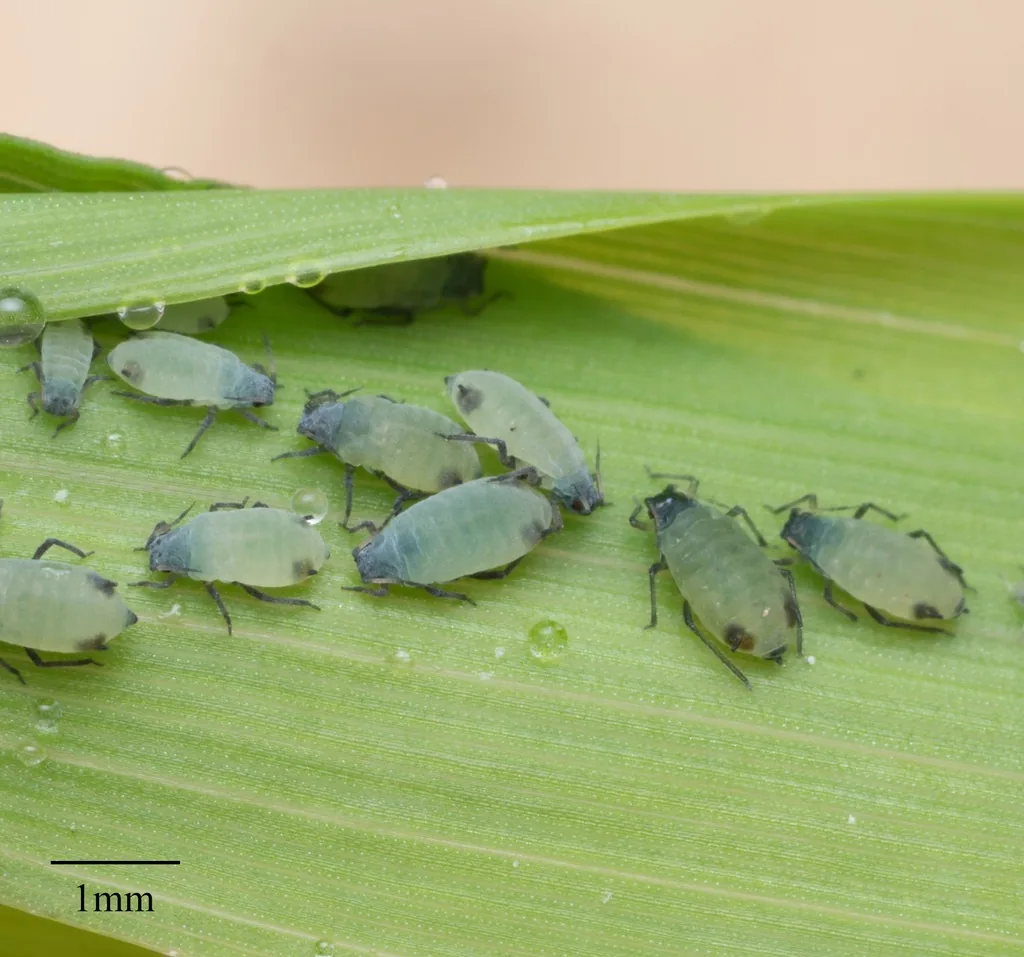
- Wingless aphids range from pale yellowish green to dark blue-green, mostly depending on temperature; they get paler as it gets warmer. Nebraska Extension describes the wingless form as bluish green.[1][2]
- The legs are dark or black, the antennae and cornicles are short and dark, and there are dark patches around each cornicle.[1][2]
- Winged forms are darker and can look nearly black.[2]
- The aphids pack together in dense colonies, often starting inside the whorl before spreading onto the upper surfaces of the leaves.[1]
Look-alikes
| Look-alike | How to tell them apart |
|---|---|
| Bird cherry-oat aphid | Found on wheat and other grasses, it is olive green with a reddish-orange area around the cornicle bases, while the wingless corn leaf aphid is bluish green.[2] |
Where it lives
Kansas State covers it in corn, and Nebraska Extension reports it on corn, sorghum, wheat and barley in Nebraska. Its spring movement north comes later than that of the greenbug and English grain aphid.[1][2]
Biology and life cycle
In Nebraska it shows up on wheat late in the spring and moves to corn and sorghum after the wheat heads. On corn it feeds in the whorl, and numbers fall off after heading or tassel emergence.[2]
Later in the season it can also feed on stems, tassels and developing ears.[1]
Like other cereal aphids it reproduces mainly without mating, giving birth to live young; a female may produce two to three young a day in warm weather, and young mature in 7 to 10 days.[2]
Damage and signs
- It excretes a lot of honeydew but does not cause the yellowing, loss of leaf function or leaf death that some other aphids do, and plants in vegetative stages easily make up for what it removes.[1]
- Extremely heavy infestations can coat the tassel with sticky honeydew and interfere with pollination.[2]
- It can transmit barley yellow dwarf virus to wheat and barley and maize dwarf mosaic virus to corn and sorghum. Nebraska Extension notes these diseases usually are not serious there, though they can be significant in some years.[2]
Health risk
It feeds only on plants. Kansas State and Nebraska Extension describe it as a crop aphid and mention no risk to people or animals.[1][2]
Control
Biological control
Corn leaf aphids feed aphid parasitoids and generalist predators, drawing them into the field where they help control other corn pests. For example, the insidious flower bug, an important predator of corn earworm and fall armyworm eggs, arrives earlier when corn leaf aphids are present before tasseling.[1]
Pesticides
Only very large numbers after tasseling have any effect on field corn yield, and Kansas State does not recommend chemical treatment.[1]
Common questions
- Should I spray the blue-green aphids in my corn tassels?
- Kansas State does not recommend it. Only very large numbers after tasseling affect field corn yield, and the aphids attract predators that also attack corn earworm and fall armyworm eggs. Extremely heavy infestations can gum up tassels with honeydew and interfere with pollination.[1][2]
- Why are my corn leaves and tassels sticky?
- Corn leaf aphids are one cause: they excrete large amounts of sticky honeydew as they feed in the whorl, on the upper leaves and on the tassels.[1][2]
Sources
- Kansas State University Department of Entomology, “Corn Leaf Aphid (J. P. Michaud, Facts and Information on Corn Pests, updated March 2024).” entomology.k-state.edu/extension/crop-protection/corn/cla.html (accessed 2026-11-08)
- University of Nebraska-Lincoln Extension, “Cereal Aphids, NebGuide G1284 (G. L. Hein, J. A. Kalisch and J. Thomas; revised August 2005).” extensionpublications.unl.edu/assets/html/g1284/build/g1284.htm (accessed 2026-11-08)
- iNaturalist, “Rhopalosiphum maidis taxon page (order and family).” www.inaturalist.org/taxa/330189 (accessed 2026-11-08)