On this page
How to identify it
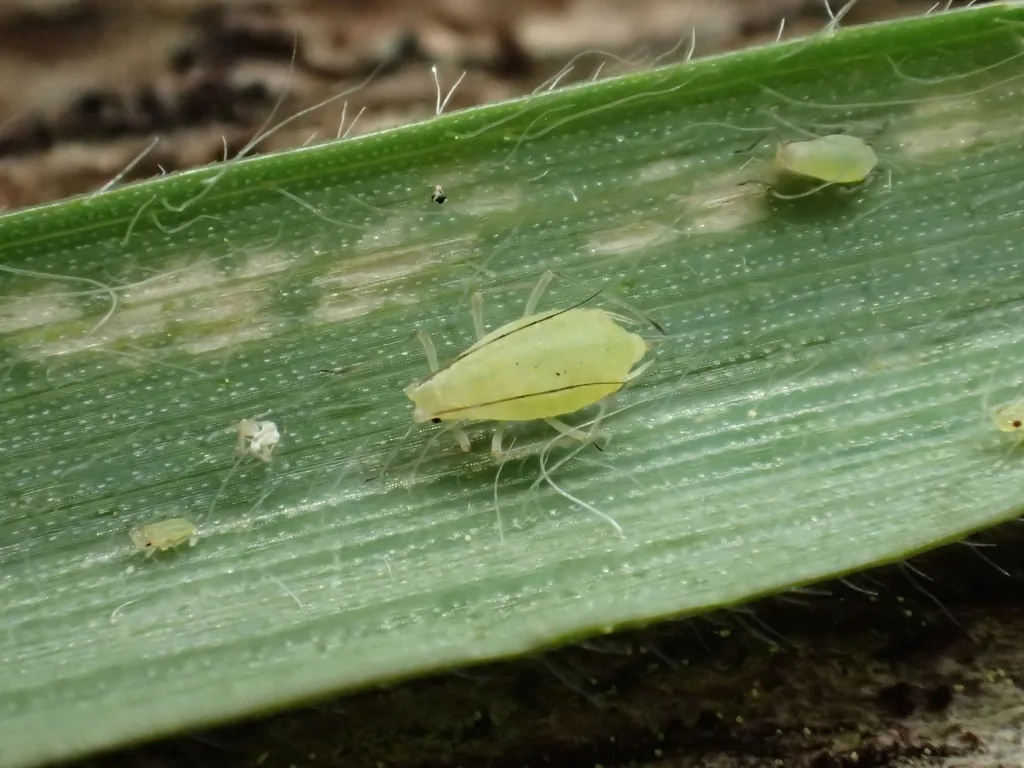
- A large green aphid that may have a darker green stripe down the middle of its back.[1]
- The joints of the antennae are darker than the middle of each segment, and the antennae usually reach past the base of the cornicles, the pair of short tubes near the rear of the abdomen.[1][2]
- The Pacific Northwest handbook lists it as the rose-grass aphid, one of six aphid species it covers on small grains.[2]
Look-alikes
| Look-alike | How to tell them apart |
|---|---|
| Greenbug | Looks similar, but the rose-grain aphid is larger and has darker antennal joints and longer antennae. Greenbug is the more damaging of the two, so check which one you have before spraying.[1] |
| Other small-grain aphids | Bird cherry-oat aphid, corn leaf aphid, English grain aphid and greenbug feed on the same crops, and grain aphids come in green, yellow and reddish colors.[2] |
Where it lives
Both the UC IPM small-grains guidelines in California and the Pacific Northwest handbook cover it, and researchers have described it as a predominant aphid species in wheat fields.[1][2][3]
Biology and life cycle
It feeds on wheat and other small grains, and a 2025 study called it a predominant aphid species in wheat agroecosystems.[2][3]
It does not inject a toxin as it feeds.[1]
Damage and signs
- Feeding by rose-grain aphids generally causes very little injury.[1]
- It is a vector of barley yellow dwarf virus, which can lower yield and quality in small grains, especially winter wheat and winter barley.[1][2]
- In glasshouse tests it transmitted two barley yellow dwarf virus strains (BYDV PAS and BYDV PAV) at rates similar to those of the bird cherry-oat aphid and the corn leaf aphid.[4]
Health risk
The sources describe it only as a crop pest; none mentions any risk to people or pets.[1][2]
Control
Prevention
Make sure of the species before spraying: the rose-grain aphid is easily confused with greenbug, and no economic threshold has been set for it. If you are unsure, ask your farm advisor.[1]
Spraying established aphid populations has not reduced barley yellow dwarf virus. Neonicotinoid seed treatments have lowered virus incidence, especially combined with later fall planting.[2]
Biological control
Grain aphids are usually held in check by predators and parasitic wasps. Syrphid fly larvae and lady beetle larvae are common predators, so look for them and for parasitized, mummified aphids before using a broad-spectrum insecticide.[2]
Pesticides
There is rarely a need to spray for aphids in small grains, and insecticides applied after the grain reaches the milk stage are of no value.[2]
Common questions
- How do I tell rose-grain aphid from greenbug?
- The rose-grain aphid is larger, its antennal joints are darker than the middle of each segment, and its antennae usually reach past the base of the cornicles.[1]
- Does rose-grain aphid damage wheat?
- Its feeding causes very little injury, but it is a vector of barley yellow dwarf virus.[1]
- Should I spray rose-grain aphids?
- Usually not. No economic threshold has been set for this aphid, natural enemies normally hold grain aphids in check, and spraying established aphids has not reduced barley yellow dwarf virus.[1][2]
Sources
- University of California Statewide IPM Program, “Rose-Grain Aphid, UC IPM Pest Management Guidelines: Small Grains.” ipm.ucanr.edu/agriculture/small-grains/rose-grain-aphid/ (accessed 2026-11-09)
- Pacific Northwest Pest Management Handbooks (Oregon State University, Washington State University and University of Idaho Extension), “Small grain-Aphid, Pacific Northwest Insect Management Handbook.” pnwhandbooks.org/insect/agronomic/small-grain/small-grain-aphid (accessed 2026-11-09)
- Entomological Society of America (Journal of Economic Entomology), “Sublethal and intergenerational effects of flonicamid on biological traits in the rose-grain aphid, Metopolophium dirhodum (Li et al. 2025).” doi.org/10.1093/jee/toaf234 (accessed 2026-11-09)
- American Phytopathological Society (Plant Disease), “Yellow dwarf viruses: aphid transmission efficiency and cereal host range (Nancarrow et al. 2025).” doi.org/10.1094/PDIS-11-24-2523-RE (accessed 2026-11-09)
- iNaturalist, “Metopolophium dirhodum taxon page (order and family).” www.inaturalist.org/taxa/392599 (accessed 2026-11-09)