On this page
How to identify it
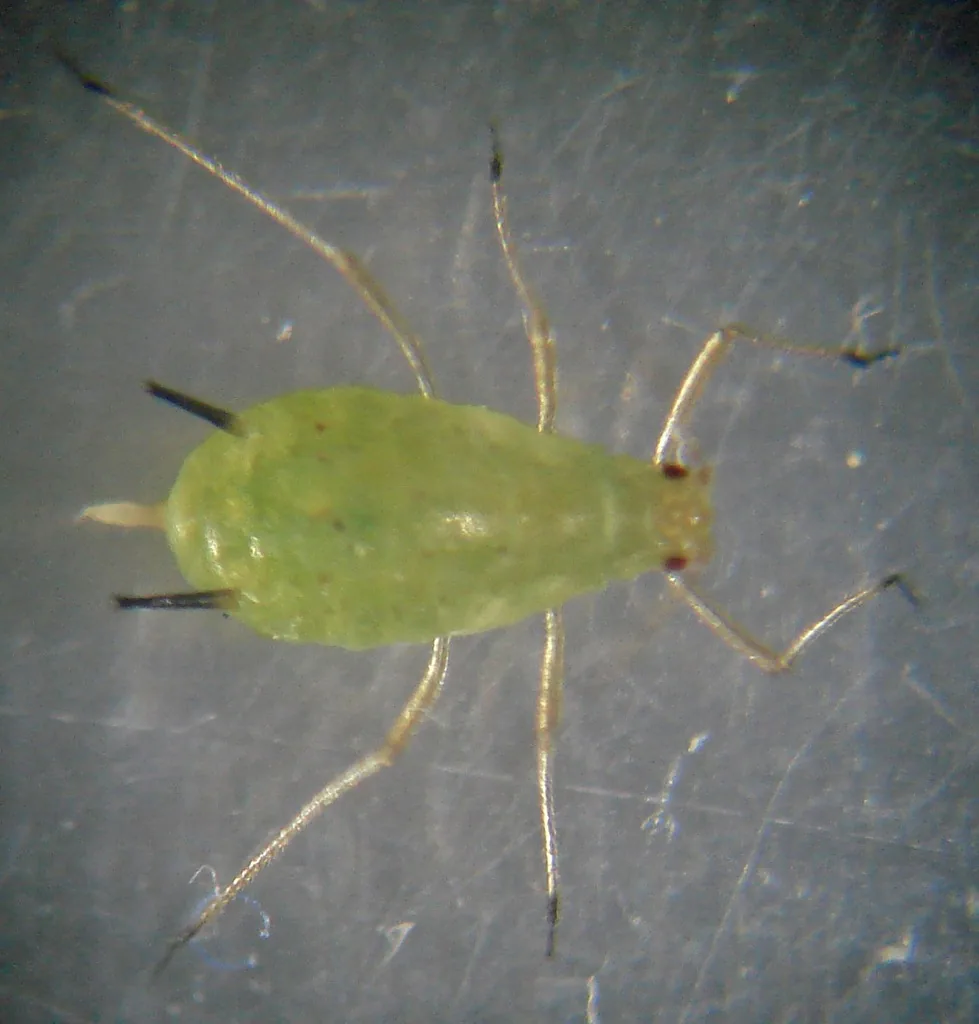
- It is the only aphid on wheat with long, black cornicles. The legs are long as well, and the antennae, which are black, reach slightly more than half the length of the body.[1][2]
- It is among the largest aphids on wheat, much larger than a greenbug.[1][2]
- Color varies: usually bright or pale green to yellowish green, but some are yellow, orange or reddish brown.[1][2]
- It feeds mostly on the upper parts of the plant and keeps feeding inside the heads during heading, more than other cereal aphids do.[1][2]
Look-alikes
| Look-alike | How to tell them apart |
|---|---|
| Bird cherry-oat aphid | An olive-green aphid with a reddish-orange area around the bases of its cornicles. The English grain aphid is the only aphid on wheat with long, black cornicles.[2][1] |
| Greenbug | The greenbug is smaller and forms tightly packed colonies; the English grain aphid moves around more and does not crowd into dense colonies.[1] |
Where it lives
It is found throughout Kansas wheat and on small grains, corn and grasses in Nebraska, moving north in spring along with the greenbug. Kansas State notes it can be a serious cereal pest in Europe.[1][2]
Biology and life cycle
Infestations in wheat begin when winged aphids arrive from wild grasses or other cereal crops. It can colonize wheat at any growth stage.[1]
Females give birth to live young without mating for much of the year. Winged forms develop when colonies get crowded or the host plant declines, and the aphids are active, moving quickly from plant to plant.[1][2]
In temperate regions some populations add a sexual generation in fall: each egg-laying female lays 6 to 12 oval black eggs at the base of a host plant. The eggs resist freezing and hatch in spring into females that start new colonies.[1]
Damage and signs
Health risk
It feeds only on plants. Kansas State and Nebraska Extension describe it as a crop pest and mention no risk to people or animals.[1][2]
Control
Prevention
Seed treatments containing imidacloprid or thiamethoxam reduce the establishment of aphid colonies on seedlings and lower barley yellow dwarf infection.[1]
Biological control
The same natural enemies that suppress other cereal aphids normally keep it in check, and Kansas State says chemical treatment is rarely, if ever, justified.[1]
Common questions
- Should I spray wheat for English grain aphids?
- Rarely. They are common in Kansas wheat but do not normally cause economic damage, and Kansas State says chemical treatment is rarely if ever justified. Heavy infestations at flowering are the main concern, since they may lower test weight.[1][2]
- How do I recognize the English grain aphid?
- Look for a large aphid with long legs and long black cornicles; it is the only aphid on wheat with long black cornicles. Its body is usually green but can be yellow, orange or reddish brown.[1][2]
Sources
- Kansas State University Department of Entomology, “English Grain Aphid (J. P. Michaud, Facts and Information on Wheat Pests, updated June 2024).” entomology.k-state.edu/extension/crop-protection/wheat/english.html (accessed 2026-11-08)
- University of Nebraska-Lincoln Extension, “Cereal Aphids, NebGuide G1284 (G. L. Hein, J. A. Kalisch and J. Thomas; revised August 2005).” extensionpublications.unl.edu/assets/html/g1284/build/g1284.htm (accessed 2026-11-08)
- iNaturalist, “Sitobion avenae taxon page (order and family).” www.inaturalist.org/taxa/454653 (accessed 2026-11-08)