On this page
How to identify it
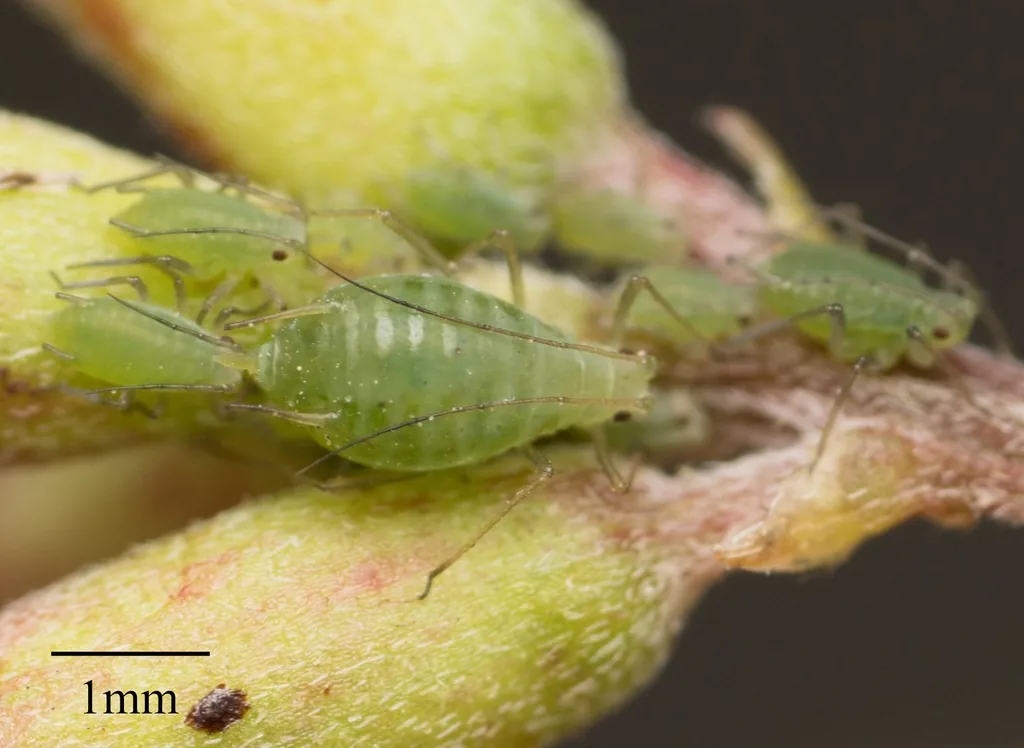
- UC IPM describes a large blue-green aphid with long legs, antennae, cornicles and cauda. Next to the pea aphid, Kansas State finds it slightly smaller, more blue-green and sometimes waxy-looking, while the pea aphid is lighter green and shinier.[2][1]
- The antennae tell it apart from the pea aphid: in the blue alfalfa aphid they darken gradually to brown toward the tip, and the third segment is evenly brown, while the pea aphid's segments have narrow dark bands at their tips.[2][1]
- Winged blue alfalfa aphids have a dark brown thorax, where winged pea aphids have a light brown one.[1]
- It clusters on the tender, fast-growing tips of the plant and prefers stems to leaves. Colonies left unchecked can spread to cover whole plants.[1][2]
Look-alikes
| Look-alike | How to tell them apart |
|---|---|
| Pea aphid | The pea aphid is lighter green and shinier, its antennal segments have narrow dark bands at their tips, and winged pea aphids have a light brown thorax. Its toxin is not particularly damaging to alfalfa, the two species have different treatment thresholds, and blue alfalfa aphids stunt plants at lower densities.[1][2] |
Where it lives
First found in California in 1975, it has spread to Arizona, Nevada, New Mexico and as far east as Kansas and Oklahoma. Only light infestations have been recorded in Kansas, and serious damage there has been rare.[1]
Biology and life cycle
It prefers cool temperatures, around 60°F being best for development, and tolerates cold better than the pea aphid, so it shows up earlier in the season. Damaging numbers are most common in mid to late winter in California's desert production areas, late winter to early spring in the Central Valley and spring to early summer in intermountain areas, and it may also be found in fall.[2]
In the Midwest it overwinters as eggs. In fall, short days and low temperatures trigger sexual forms, and egg-laying females glue tiny black eggs to the stems and fallen leaves of alfalfa and clover. The eggs hatch in early spring, and after one or two generations born without mating, most nymphs become winged females that fly to nearby fields and start new colonies.[1]
At 70°F the life cycle takes about 7 to 10 days, and each female gives birth to 50 to 100 live nymphs. Populations fall off quickly once daily temperatures reach 85 to 90°F.[1]
Damage and signs
- It injects a toxin, more potent than the pea aphid's, that slows growth, reduces yield and may kill plants. Toxin left in the stems and crown after harvest can keep stunting regrowth into the next cutting or even the two after that.[2]
- Heavily infested alfalfa has severely stunted stems, shortened internodes and small leaves, and leaves curl and drop in severe cases. Usually only a patch of the field is affected, but heavy infestations have delayed cutting schedules or cost a full cutting.[1]
- Sooty mold growing on its honeydew makes the hay less palatable to livestock, and damage is worse on short alfalfa than on tall.[2]
Health risk
UC IPM and Kansas State describe it as an alfalfa pest and mention no risk to people; the livestock concern is that sooty mold on its honeydew makes hay less palatable.[2][1]
Control
Prevention
Resistant alfalfa varieties have been the most effective control, although long spells of below-normal temperatures can weaken resistance; it should be fully expressed at around 70°F. Kansas State advises having heavy infestations on pea aphid-resistant varieties identified by an entomologist.[2][1]
Border-strip cutting at harvest helps keep parasites and predators in the field. To scout, sample at least 20 to 30 stems across the field, count healthy, parasitized (mummified) and diseased (brown, flattened) aphids per stem, and measure stem length.[2][1]
Biological control
Lady beetles, including the convergent and sevenspotted lady beetles, are the main predators, along with green lacewings, bigeyed bugs, damsel bugs and syrphid fly larvae. The parasitic wasps Aphidius smithi and A. ervi leave large golden-brown aphid mummies on upper leaf surfaces, and a fungal disease favored by cool, rainy or foggy weather can also control the aphids. Weevil sprays that kill natural enemies can make aphid problems worse.[2]
Pesticides
Kansas State says 20 blue alfalfa aphids per stem on 10-inch alfalfa, or 50 on 20-inch alfalfa, may justify treatment when diseased and parasitized aphids are scarce, and products registered for pea aphids may be used. UC IPM stresses telling the two species apart because the blue alfalfa aphid is more damaging and the two have different thresholds; when both are present, use the blue alfalfa aphid levels.[1][2]
Organically certified azadirachtin, neem oil and pyrethrin products are registered for aphids on alfalfa, but California studies found they give at best slight suppression.[2]
Common questions
- How do I tell a blue alfalfa aphid from a pea aphid?
- Look at the antennae: the blue alfalfa aphid's darken gradually to brown toward the tip, while the pea aphid's have narrow dark bands at the tips of the segments. The blue alfalfa aphid is also more blue-green and less shiny, and winged ones have a dark brown thorax.[2][1]
- Why is my alfalfa still stunted after I cut it?
- Blue alfalfa aphid toxin left in the stems and crown after harvest can keep stunting regrowth into the next cutting, or even the two after that.[2]
Sources
- Kansas State University Department of Entomology, “Blue Alfalfa Aphid (J. P. Michaud, Facts and Information on Alfalfa Pests, updated April 2024).” entomology.k-state.edu/extension/crop-protection/alfalfa/blue-alfalfa-aphid.html (accessed 2026-11-08)
- University of California Statewide IPM Program, “Blue Alfalfa Aphid (Pest Management Guidelines: Alfalfa).” ipm.ucanr.edu/agriculture/alfalfa/blue-alfalfa-aphid/ (accessed 2026-11-08)
- iNaturalist, “Acyrthosiphon kondoi taxon page (order and family).” www.inaturalist.org/taxa/243739 (accessed 2026-11-08)