On this page
How to identify it
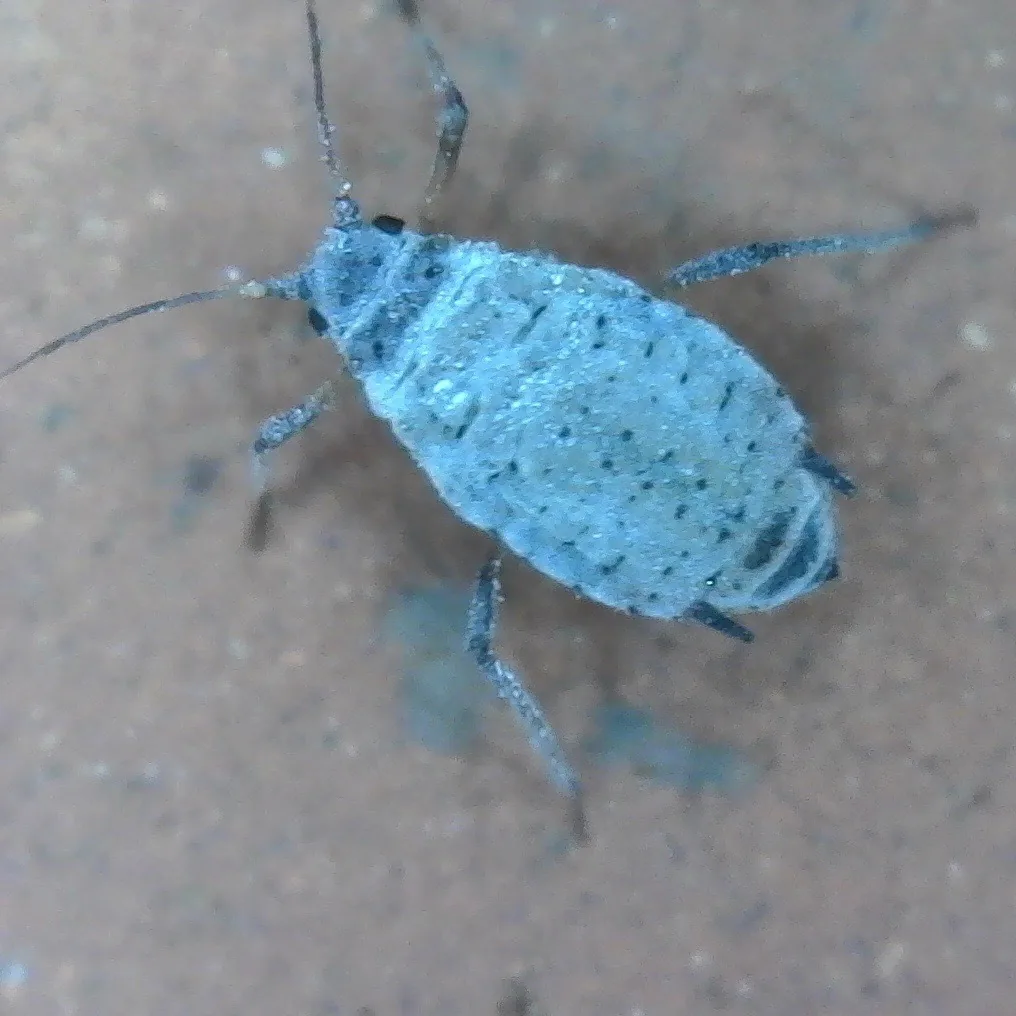
- A small, typical-looking aphid, pale to dark green, with moderately long, dark cornicles, the tube-like structures on the abdomen.[1][3]
- Colonies include both wingless and winged adults along with their young.[1]
- Look for it on stored bulbs and corms, at the bases of growing plants, and under the leaf sheaths of garden irises.[1]
- Other common names are tulip aphid and iris root aphid.[1][2]
Look-alikes
| Look-alike | How to tell them apart |
|---|---|
| Tuliptree aphid | Despite the similar name, the tuliptree aphid is a different insect: a spindle-shaped, pale green to yellow aphid with antennae longer than its body that feeds on the undersides of tuliptree leaves, not on bulbs.[3] |
Where it lives
AphID describes it as nearly cosmopolitan, found around the world except in South America. NC State Extension describes it as a pest of bulbs both in storage and in the field.[2][1]
Biology and life cycle
It feeds mostly on monocots and has been recorded from at least six plant families. It is most important on lilies, tulips, crocuses, gladiolus and irises, and also attacks arums, bananas and plants in the carrot family.[2]
In storage it infests glory-of-the-snow, crocus, gladiolus corms, iris bulbs, lily, narcissus, scilla, snowdrop and tulip. After planting it moves onto the leaves, shoots, buds and flowers, and it also turns up on the roots of carrot, parsley and celery.[1]
For much of the year females give birth to live young that mature into wingless or winged adults. Little else has been published on its life history.[1]
Damage and signs
- Infested bulbs, once planted, can produce distorted and stunted new growth.[1]
- It transmits tulip breaking virus to tulips and what NC State calls narcissus yellows streak virus to narcissus in the landscape, and it has been shown to transmit other plant viruses as well.[1]
- The narcissus virus is carried in a non-persistent way, so an infested plant has to be nearby for the aphid to spread it.[1]
Health risk
NC State and AphID treat it only as a plant pest and vector of plant viruses; neither mentions any risk to people or pets.[1][2]
Control
Sanitation
Dip infested bulbs in a solution of insecticidal soap; NC State says this should give adequate control.[1]
Pesticides
On growing plants, NC State suggests insecticidal soap, a pyrethroid labeled for landscape use, or a systemic insecticide such as imidacloprid. Pyrethroids are very toxic to fish, so don't use them around pools, ponds or streams.[1]
Common questions
- Why are my tulips coming up stunted and twisted?
- One cause is tulip bulb aphids: bulbs that were infested in storage can produce distorted, stunted new growth after planting.[1]
- Can tulip bulb aphids spread plant viruses?
- Yes. They transmit tulip breaking virus to tulips and a streak virus to narcissus, and NC State says they have been shown to spread other plant viruses too.[1]
- How do I clean aphids off stored bulbs?
- NC State recommends immersing infested bulbs in a solution of insecticidal soap.[1]
Sources
- NC State Extension, “Tulip Aphid (J. Baker, PDIC factsheet).” content.ces.ncsu.edu/tulip-aphid (accessed 2026-11-09)
- USDA APHIS PPQ Identification Technology Program (idtools.org), “Dysaphis tulipae fact sheet, AphID: Identification guide for cosmopolitan and polyphagous aphid species (C. Favret and G. Miller).” www.aphid.aphidnet.org/Dysaphis_tulipae.php (accessed 2026-11-09)
- NC State Extension, “Tuliptree Aphid (PDIC factsheet).” content.ces.ncsu.edu/tuliptree-aphid (accessed 2026-11-09)
- iNaturalist, “Dysaphis tulipae taxon page (order and family).” www.inaturalist.org/taxa/388808 (accessed 2026-11-09)