On this page
How to identify it
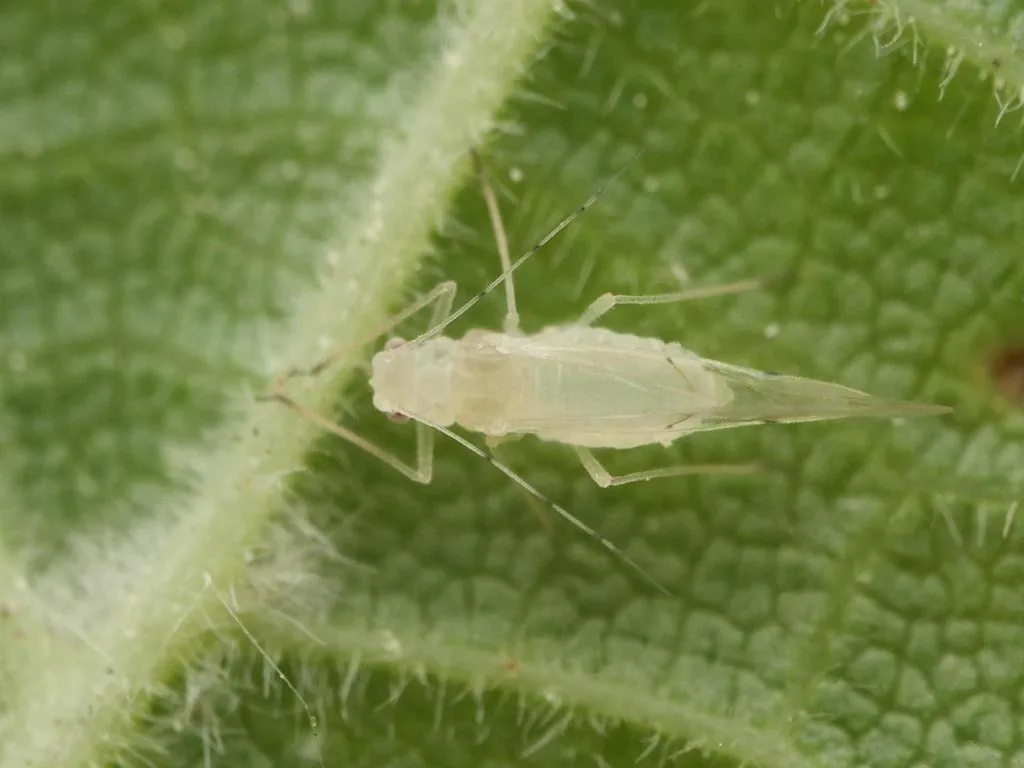
- A small to medium aphid that is light green or pale yellow.[1]
- It lacks well-developed cornicles, the tube-like projections that stick out from the rear of most aphids.[1]
- It stays on the undersides of leaves all season, feeding along the small veins near the leaf margins.[1]
- Overwintering eggs on twigs, buds and bark crevices are green when first laid and turn black as they mature.[1]
Look-alikes
| Look-alike | How to tell them apart |
|---|---|
| Hazelnut aphid | Also lives only on hazelnut, but has well-developed cornicles and longer legs, is darker green and sometimes reddish, and moves onto stems, nut stalks and husks as the nut clusters develop.[1] |
Where it lives
A serious pest of hazelnut in North America, Italy, Spain and Turkey. In the Pacific Northwest it is managed in Oregon's Willamette Valley orchards, where its parasitic wasp is well established.[2][1]
Biology and life cycle
Eggs hatch around the time of bud swell, and the tiny nymphs move to the green buds to feed, then to the undersides of the developing leaves.[1]
The first generation develops into winged 'stem mothers' that can disperse by flight. They and their offspring give birth to live young without mating, and there are 8 to 10 of these generations a year.[1]
Numbers usually peak by June and fall substantially by July whatever is done, then often rise again late in the season as the weather cools. After nut drop, filbert aphids may persist on green leaves of suckers.[1]
In the fall, winged males and wingless egg-laying females appear and mate. The females lay the overwintering eggs, and the aphids become very active, roaming over the branches, during this period.[1]
The species feeds only on hazelnut; outside orchards it is found only on wild or ornamental hazelnuts.[1]
Damage and signs
Health risk
The sources describe it only as a hazelnut pest; neither mentions any risk to people or pets.[1][2]
Control
Prevention
From April 1 to September 30, check three leaves on each of three terminal branches per tree and count aphids per leaf. The PNW handbook's treatment thresholds are 20 per leaf in April, 30 in May, 40 in June, and 40 in July if the population is still increasing.[1]
Avoid excess nitrogen fertilizer, which produces the succulent growth aphids favor. Research in Turkey found some hazelnut cultivars less favorable to the aphid, suggesting resistant cultivars as a future IPM tool.[1][2]
Traps and physical control
In home orchards, wash aphids off with a strong stream of water or wipe them off by hand, and control ants, which tend aphids for honeydew and protect them from predators.[1]
Biological control
The introduced parasitic wasp Trioxys pallidus attacks both hazelnut aphids and makes aphid sprays unnecessary in many orchards. Learn to recognize the swollen, rounded, darker aphid mummies it leaves, and avoid broad-spectrum and pyrethroid sprays, which can free the aphids from control and make the problem worse.[1]
The wasp emerges about two weeks after the aphids, so expect a lag before it catches up. If mummies are present, hold off on treatment and recheck in a week. Lady beetles, syrphid fly larvae, bigeyed bugs, minute pirate bugs, lacewing larvae, yellowjackets and paper wasps also eat the aphids.[1]
Pesticides
Honeydew attracts pollinators, so use caution if insecticides are needed against a severe infestation, and follow the label.[1]
Common questions
- Will filbert aphids spread to my other trees?
- No. Filbert aphids feed only on hazelnuts, including wild and ornamental ones.[1]
- How do I tell the filbert aphid from the hazelnut aphid?
- The filbert aphid is pale green or yellow without well-developed cornicles and stays on leaf undersides; the hazelnut aphid is darker green or reddish with obvious cornicles and longer legs and moves onto stems and husks.[1]
- Why did the aphids disappear in July?
- Populations typically peak by June and fall substantially by July regardless of management, though they often increase again late in the season.[1]
Sources
- Pacific Northwest Pest Management Handbooks (Oregon State University, Washington State University and University of Idaho Extension), “Hazelnut-Aphids, Pacific Northwest Insect Management Handbook.” pnwhandbooks.org/insect/nut/hazelnut/hazelnut-aphids (accessed 2026-11-09)
- Entomological Society of America (Journal of Economic Entomology), “Güncan A, Gümüş E. Influence of different hazelnut cultivars on some demographic characteristics of the filbert aphid (Hemiptera: Aphididae). Journal of Economic Entomology 110(4):1856-1862 (2017) (abstract).” doi.org/10.1093/jee/tox087 (accessed 2026-11-09)
- iNaturalist, “Myzocallis coryli taxon page (order and family).” www.inaturalist.org/taxa/393051 (accessed 2026-11-09)