On this page
How to identify it
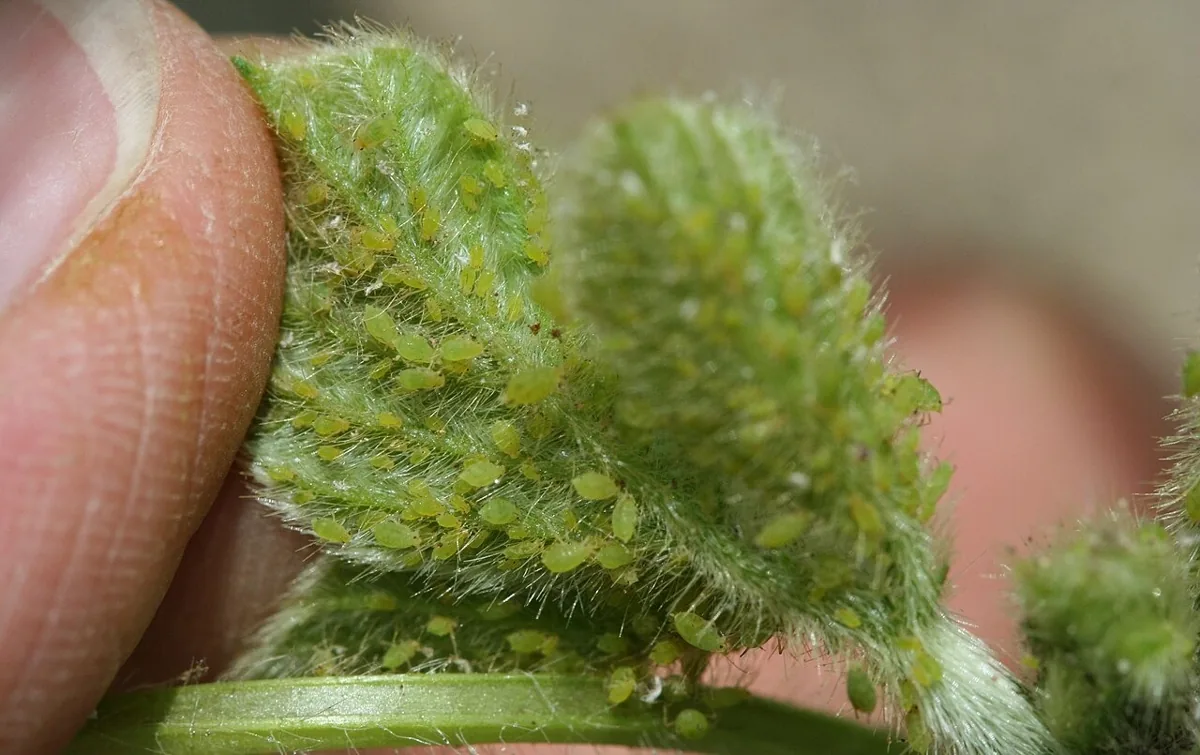
- Adults are about 1/16 inch long, pear-shaped and generally yellow, with black cornicles, the 'tailpipes' at the end of the abdomen.[2][1]
- Both winged and wingless adults occur on soybean, and nymphs look like smaller wingless adults. White flakes near a colony are cast skins.[2][1]
- It is the only aphid in the United States that builds large colonies on soybean plants.[1]
- No eggs are found on soybean; the eggs are laid on buckthorn.[2][1]
Look-alikes
| Look-alike | How to tell them apart |
|---|---|
| Cotton (melon) aphid | The cotton aphid is a close relative familiar to many farmers, but the soybean aphid is the only U.S. aphid that forms large colonies on soybean.[1] |
Where it lives
Native to eastern Asia, from China and Japan to Malaysia and Indonesia, and introduced to Australia. In the United States it was first found in Minnesota in 2000, the same year it turned up in Wisconsin, Michigan, Indiana and Iowa, and it has since spread to all major soybean-growing states, south to Mississippi and Georgia.[1]
Biology and life cycle
Eggs spend the winter on buckthorn in wooded areas. In spring they hatch, and several generations are produced there without mating before winged aphids fly to soybean fields.[2][1]
On soybean, females bear live young without mating, generation after generation. New aphids can start reproducing in 3 to 7 days, depending on temperature, and under good conditions a colony can double every 5 days.[1][2]
Late in the season, changes in the plants and in day length trigger winged forms and males. They fly back to buckthorn, where they mate and lay the overwintering eggs.[1][2]
The North American population seems to come from northern latitudes, since it depends on buckthorn as a winter host. Where buckthorn is scarce, as in North Carolina, few aphids survive the winter, and infestations there depend on aphids arriving on air currents.[1]
Early in the season colonies sit on new growth; later they spread through the canopy. Lady beetles or ants on soybean plants often point to early colonies.[2]
Damage and signs
- Aphids suck sap from the plant's phloem and stress it. Their sugary honeydew grows black sooty mold, which discolors leaves and can reduce yield further.[1][2]
- Vegetative soybeans are threatened only by very high numbers. Plants in the reproductive stages, especially early ones (R1 to R3), are more sensitive: very heavy infestations reduce growth, distort leaves and lower seed yield and quality.[1][2]
- NC State cites a study in which seriously infested plants lost 27.8% of their yield and grew about 8 inches shorter; insecticide tests have shown yield gains of 10 to 20%.[1]
- It transmits plant viruses, including alfalfa mosaic, soybean mosaic and bean yellow mosaic viruses.[1][2]
Health risk
It feeds only on plants; NC State and the University of Minnesota describe it as a crop pest and mention no risk to people or animals.[1][2]
Control
Prevention
Scout early in fields near abundant buckthorn, small fields with wooded borders and early-planted fields. Check at least 20 to 30 plants per field every 7 to 10 days, more often when numbers are climbing, and keep going until R6.5, when pods and leaves begin to yellow. Count winged and wingless aphids, but not dead aphids or look-alikes.[2]
Aphid-resistant soybean varieties can work, but well-adapted varieties are still limited.[2]
Biological control
Parasitic wasps, predatory bugs and beetles, and fungal diseases help keep aphids in check. Avoid spraying at the wrong time: NC State notes that early sprays may lead to more aphids, and sticking to thresholds helps conserve these beneficial organisms.[1][2]
Pesticides
From the vegetative stages through R5, the University of Minnesota threshold is an average above 250 aphids per plant, with more than 80% of plants infested and numbers still rising. Losses can happen in early R6, but only with larger populations.[2][1]
When the threshold is reached, labeled foliar insecticides can be used; spray only when needed, to slow resistance. Neonicotinoid seed treatments usually wear off before aphids arrive, though they may be considered for high-risk early infestations or late-planted fields.[2]
Common questions
- What is the treatment threshold for soybean aphid?
- Through R5, consider treating when counts average more than 250 aphids per plant, more than 80% of plants are infested and the population is increasing.[2]
- Where do soybean aphids spend the winter?
- As eggs on buckthorn. In spring, winged aphids produced on buckthorn fly to soybean fields, and in fall the aphids return to buckthorn to mate and lay eggs.[2][1]
- Do seed treatments control soybean aphid?
- Usually not. Aphids typically colonize fields after insecticide from neonicotinoid seed treatments has dropped to ineffective levels.[2]
Sources
- NC State Extension, “Soybean Aphid in Soybean (Soybean Insect Factsheets, D. Reisig).” content.ces.ncsu.edu/soybean-aphid-in-soybean (accessed 2026-11-09)
- University of Minnesota Extension, “Soybean aphid (R. Koch and S. Wold-Burkness; reviewed 2019).” extension.umn.edu/soybean-pest-management/soybean-aphid (accessed 2026-11-09)
- iNaturalist, “Aphis glycines taxon page (order and family).” www.inaturalist.org/taxa/119158 (accessed 2026-11-09)