On this page
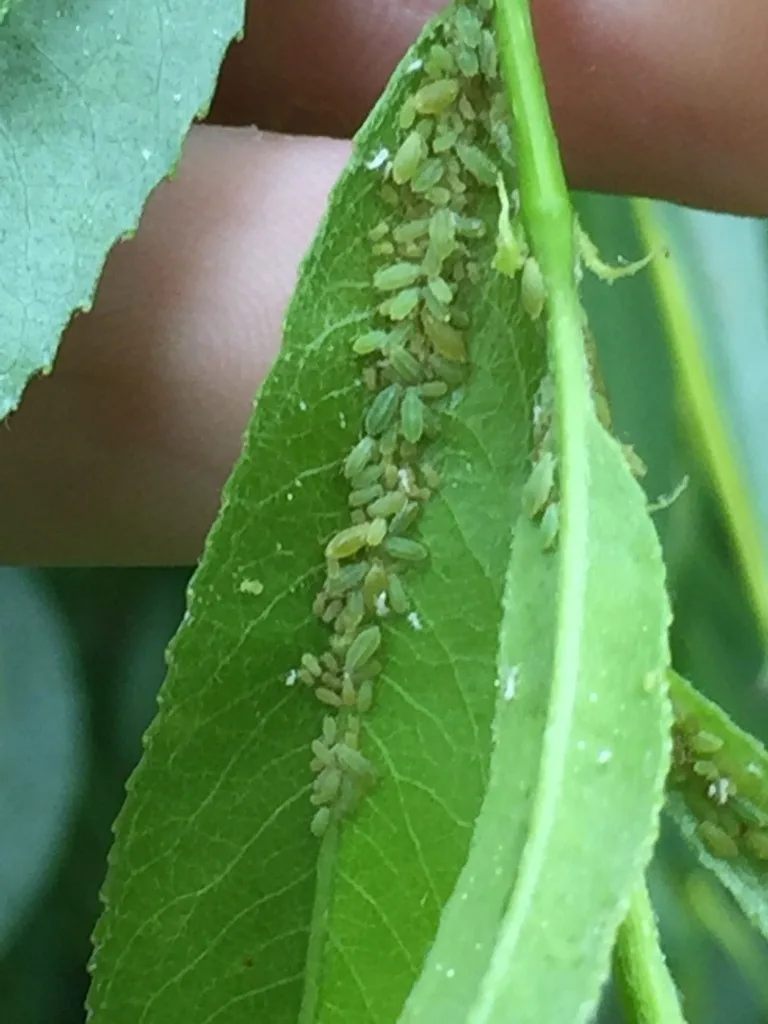
How to identify it
Look-alikes
| Look-alike | How to tell them apart |
|---|---|
| Green peach aphid | Another carrot and celery aphid; slender and dark green to yellow with no waxy coating, and winged adults have a black head and thorax.[1] |
| Bean aphid | Dark olive green to black with light-colored legs, and usually an early-season pest on carrots.[1] |
Where it lives
Found in temperate and warm temperate regions around the world. In the United States it is a carrot and celery pest covered by the Pacific Northwest handbook.[3][1][2]
Biology and life cycle
It alternates hosts: the sexual phase of its life cycle takes place on willows, and it moves to plants in the carrot family (Apiaceae) as summer hosts.[3][4][1]
Like most aphids it goes through several generations each season, and the generations differ greatly in adult size.[4]
Its summer hosts span nearly 10 plant families but are mainly carrot-family plants: carrot, dill, parsley, celery, fennel and wild relatives.[3]
It has been implicated in spreading at least 15 plant viruses.[3]
Damage and signs
Health risk
The sources describe it only as a plant pest; none mentions any risk to people or pets.[1][3]
Control
Prevention
Check plantings often after seedlings emerge, especially in April and May. Aphids tend to collect in hot spots and along field edges, and flights are most common at moderate temperatures of 60 to 80 F.[1][2]
Sanitation
Destroy infested crops right after harvest, destroy weed hosts late in the year, and rogue out virus-infected plants early to slow the spread of aphid-borne diseases. Avoid heavy nitrogen fertilizer, which favors aphids.[1][2]
Traps and physical control
Home gardeners can often control aphids effectively by washing them off with a strong stream of water.[1]
Biological control
Lady beetles, lacewing larvae and syrphid fly larvae often bring aphids under control later in the season. If aphid mummies or predators are increasing and the aphids are not yet damaging, skip sprays, since most aphid insecticides are highly disruptive to natural enemies.[1]
Pesticides
Home-garden options listed by the PNW handbook include insecticidal soap, kaolin, plant-derived essential oils and pyrethrins, along with conventional insecticides. Follow the label.[1]
Common questions
- Why is it called the willow-carrot aphid?
- It spends part of its life cycle on willows, where its sexual phase takes place, and the summer on carrots and related plants.[3][1]
- Is the willow-carrot aphid a problem on herbs?
- Yes. Besides carrots and celery, it is particularly important on dill, parsley and fennel.[3]
- Do aphids hurt carrots directly?
- Heavy feeding curls and stunts leaves, but the bigger concern is virus diseases such as motley dwarf that aphids spread.[1]
Sources
- Pacific Northwest Pest Management Handbooks (Oregon State University, Washington State University and University of Idaho Extension), “Carrot-Aphid, Pacific Northwest Insect Management Handbook.” pnwhandbooks.org/insect/vegetable/vegetable-pests/hosts-pests/carrot-aphid (accessed 2026-11-09)
- Pacific Northwest Pest Management Handbooks (Oregon State University, Washington State University and University of Idaho Extension), “Celery-Aphid, Pacific Northwest Insect Management Handbook.” pnwhandbooks.org/insect/vegetable/vegetable-pests/hosts-pests/celery-aphid (accessed 2026-11-09)
- USDA APHIS PPQ Identification Technology Program (idtools.org), “Cavariella aegopodii fact sheet, AphID: Identification guide for cosmopolitan and polyphagous aphid species (C. Favret and G. Miller).” www.aphid.aphidnet.org/Cavariella_aegopodii.php (accessed 2026-11-09)
- Springer (Oecologia), “Dixon AF, Kundu R. Resource tracking in aphids: programmed reproductive strategies anticipate seasonal trends in habitat quality. Oecologia 114(1):73-78 (1998) (abstract).” doi.org/10.1007/s004420050422 (accessed 2026-11-09)
- iNaturalist, “Cavariella aegopodii taxon page (order and family).” www.inaturalist.org/taxa/326912 (accessed 2026-11-09)