On this page
How to identify it
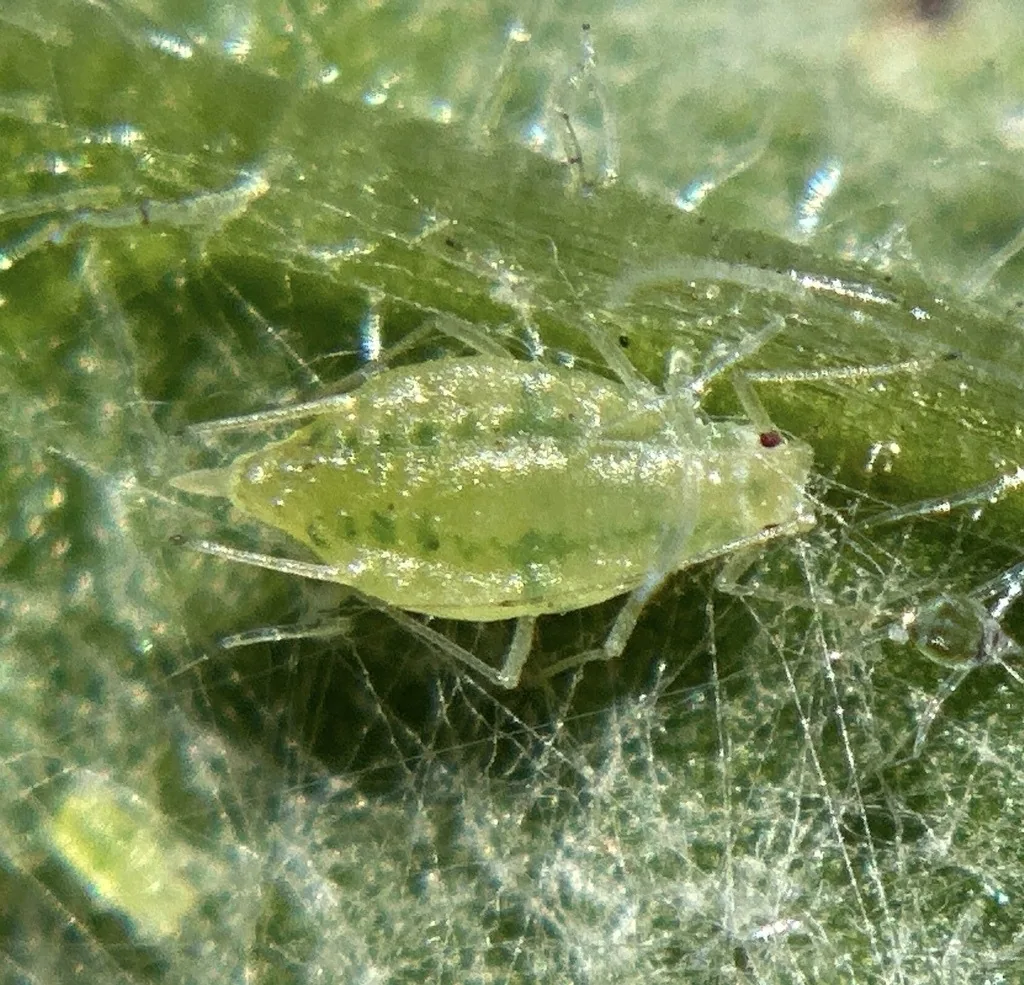
- Pale greenish white to yellowish green and almost translucent, with pale legs and antennae.[1]
- The cornicles, the two tubes at the rear, are very long, with distinctly dusky tips.[1]
- Winged adults have an almost rectangular, solid black spot on the abdomen. Wingless adults have long, knobbed hairs on some abdominal segments.[1]
- The bumps at the base of the antennae point outward, away from each other.[1]
Look-alikes
| Look-alike | How to tell them apart |
|---|---|
| Green peach aphid | The bumps at the base of its antennae point toward each other; on the artichoke aphid they diverge.[1] |
Where it lives
Found in temperate regions around the world. In California it is a serious summer pest of perennial artichokes but not of annual artichoke fields in southern California.[2][1]
Biology and life cycle
It overwinters on Elaeagnus shrubs such as Russian olive and silverberry, where its sexual generation develops, then moves in summer to thistles (Cirsium and Carduus) and to artichokes. It has also been recorded on Polygonum.[1][2]
Outbreaks are most likely when high daily temperatures combine with very high relative humidity, conditions that generally last from June to September.[1]
While numbers are low the aphids stay on the undersides of older leaves; as populations grow they spread quickly over the whole plant.[1]
Damage and signs
- Heavy feeding curls and yellows artichoke leaves and slows plant growth, so buds come out undersized or deformed. Bud stalks weaken and droop under the weight of the buds, and buds close to harvest get contaminated with aphid bodies.[1]
- It produces large amounts of honeydew that make lower leaves and buds look wet and shiny. Sooty mold then grows over the leaves and interferes with photosynthesis.[1]
- UC IPM estimates that 10% to 15% of the artichokes harvested in August and September are lost to poor quality from aphid damage, and the fall harvest can be delayed by several weeks.[1]
- It is particularly important on thistles, artichoke (Cynara), milk thistle (Silybum) and gerbera. It has not been implicated in spreading any plant virus.[2]
Health risk
The sources describe it only as a plant pest; none mentions any risk to people or pets.[1][2]
Control
Prevention
Check fields weekly from June to September. UC IPM's treatment threshold is an average of 3 aphids per leaflet, the level at which isolated plants start to show sooty mold.[1]
Sanitation
Destroy artichoke crop residue right after harvest.[1]
Biological control
Parasitic wasps (Diaeretiella and Lysiphlebus species), lady beetles, syrphid flies, lacewings and the fungus Entomophthora aphidis all attack it, but they rarely give timely control because their numbers lag behind the aphids'. Avoid unnecessary insecticide sprays and provide habitat for these natural enemies.[1]
Pesticides
Neem oil is acceptable on organically certified artichokes. UC IPM's treatment table also lists spirotetramat, thiamethoxam, imidacloprid and bifenthrin; consider the effect of any insecticide on natural enemies.[1]
Common questions
- Why are my artichoke leaves black and sticky?
- Artichoke aphids produce heavy honeydew on the lower leaves and buds, and sooty mold grows on it and turns the leaves black.[1]
- Where do artichoke aphids come from?
- They overwinter on Russian olive, silverberry and other Elaeagnus shrubs and move to thistles and artichokes in summer.[1][2]
- When are artichoke aphids worst?
- During hot, very humid weather, generally from June to September, on perennial artichokes.[1]
Sources
- University of California Statewide IPM Program, “Artichoke Aphid, UC IPM Pest Management Guidelines: Artichoke.” ipm.ucanr.edu/agriculture/artichoke/artichoke-aphid/ (accessed 2026-11-09)
- USDA APHIS PPQ Identification Technology Program (AphID), “AphID: Capitophorus elaeagni fact sheet.” www.aphid.aphidnet.org/Capitophorus_elaeagni.php (accessed 2026-11-09)
- iNaturalist, “Capitophorus elaeagni taxon page (order and family).” www.inaturalist.org/taxa/387145 (accessed 2026-11-09)