On this page
How to identify it
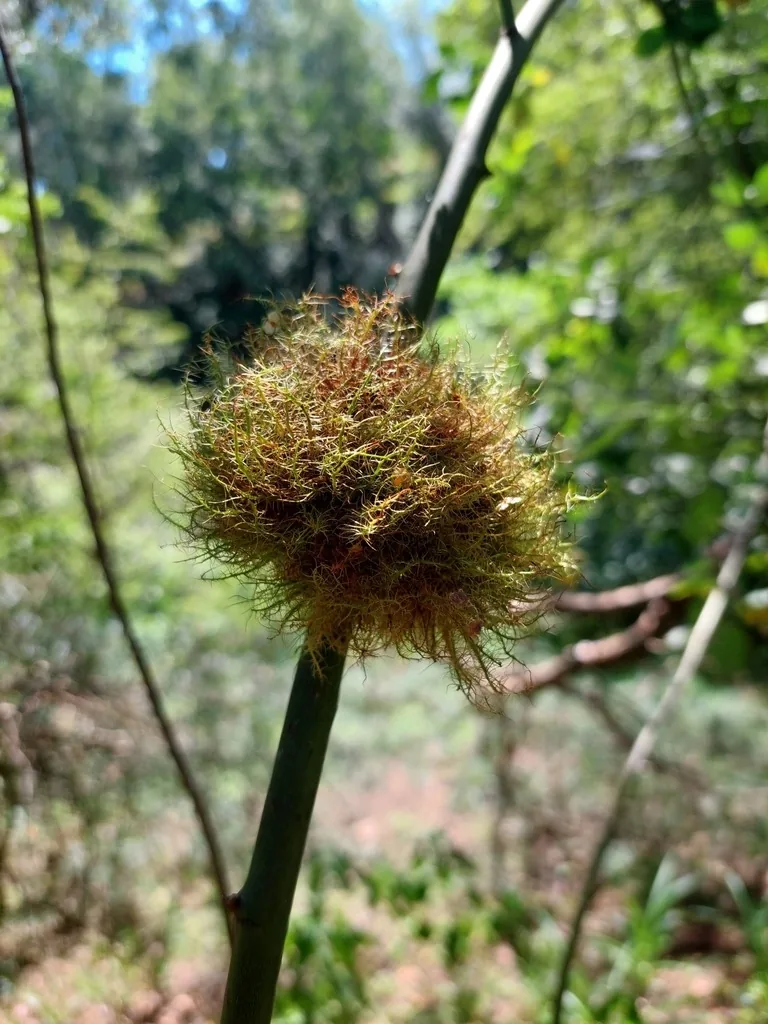
- Mossy rose gall: a cluster of hard, kernel-like cells on a rose stem or leaf, covered all over with moss-like filaments; the spongy, filamentous mass can exceed golf-ball size and holds many chambers, each with a wasp larva.[1][2]
- Spiny rose gall: a hard, spherical gall with many stout, sharp spines on the outside and small chambers inside, usually on the upper surface of leaves and sometimes on stems.[1][2]
- Galls range from about 2 to 4 inches across and can form on leaves, stems, buds or roots; other Diplolepis species make buds swell and harden.[1]
- The adults are very tiny wasps that are seldom seen; the grub-like larvae are found only inside the galls, and each species makes its own distinctive gall.[4][1]
- Old galls turn brown and matted and show small round emergence holes.[1]
Look-alikes
| Look-alike | How to tell them apart |
|---|---|
| Oak gall wasps | Related cynipid wasps whose galls (oak apples, bullet galls, horned galls) form on oaks, not roses.[4] |
| Rose stem girdler and other rose borers | Borers tunnel inside canes and cause swellings or dieback without the external moss or spines of a wasp gall.[1] |
| Horned oak gall wasp | Makes golf-ball-sized woody twig galls with short horns on oaks; rose galls are mossy or spiny and sit on rose stems and leaves.[1][2] |
Where it lives
The Pacific Northwest handbook and WSU report both galls on roses in Oregon, Washington and Idaho; Iowa State describes mossy rose gall in Iowa and Utah State lists rose gall wasps among Utah's ornamental pests.[1][2][3][4]
Biology and life cycle
The wasp overwinters as a larva inside the gall. In early spring the adult matures, chews its way out and looks for expanding leaf tissue on which to lay eggs. The larvae hatch and their feeding induces the rose to grow a gall around them. There is one generation a year.[1][4]
Utah State puts adult emergence in April and May, coinciding with budbreak; Iowa State notes that new adults can emerge in summer or the following spring. Pupation takes place inside the gall or in the soil.[4][3]
The gall shelters the larva from weather, predators and parasites and is rich in proteins and carbohydrates, so the larva develops surrounded by its food.[3]
Spiny rose gall develops exclusively on wild roses, while mossy rose gall occurs only on domestic (cultivated) roses.[2]
Parasitic wasps attack the gall makers, and WSU recommends letting them control the population.[2]
Damage and signs
- The galls do not appear to harm the plant, and mossy rose galls on leaves are harmless; the main complaint is appearance.[2][3]
- Occasionally a heavy or prolonged infestation of mossy galls on stems weakens or kills the portion of the cane above the gall, and excessive galling of branches and twigs can stunt a plant or cause dieback.[3][4]
Health risk
The sources treat rose gall wasps only as gall makers on roses; the adults are tiny and seldom seen, and none of the sources report any effect on people or pets.[1][4]
Control
Prevention
In late winter, place a few galls in a bag outdoors in a protected spot and check it regularly for the first emerging wasps; then confirm emergence holes on the plants. Preventive sprays before galls form may work but are not usually practical.[1][3]
Traps and physical control
Cut out galls while they are still green and fresh, before the wasps emerge and fly off; late summer and winter removal works best. Prune out stem galls if they are weakening a cane or if looks matter.[1][3][2]
Biological control
Allow parasitic wasps to control the gall wasp population.[2]
Pesticides
Galls cannot be cured after they form; spraying or treating does not make them go away, and WSU recommends no chemical control for rose galls.[3][2]
Common questions
- What is the mossy green ball growing on my rose?
- A mossy rose gall, caused by a tiny cynipid wasp (Diplolepis rosae). The rose grows a cluster of hard cells covered with moss-like filaments around the wasp larvae; it can get bigger than a golf ball and is harmless to a healthy plant.[1][2][3]
- Can I spray to get rid of rose galls?
- No. Once a gall has formed nothing makes it go away, and WSU recommends no chemical control. Prune off galls in late summer or winter before the wasps emerge in spring.[3][2][1]
- Why are the spiny galls only on the wild roses along my fence?
- WSU reports that spiny rose gall develops exclusively on wild roses, while mossy rose gall occurs only on domestic roses.[2]
Sources
- Pacific Northwest Pest Management Handbooks (Oregon State University, Washington State University and University of Idaho), “Rose (Rosa)-Gall wasp: Mossy rose gall wasp (Diplolepis rosae) and spiny rose gall wasp (Diplolepis bicolor), Pacific Northwest Insect Management Handbook.” pnwhandbooks.org/insect/hort/landscape/hosts-pests-landscape-plants/rose-rosa-gall-wasp (accessed 2026-11-10)
- Washington State University Extension, “Rose: Rose galls (Hortsense fact sheet, reviewed July 2025).” hortsense.cahnrs.wsu.edu/fact-sheet/rose-rose-galls/ (accessed 2026-11-10)
- Iowa State University Extension and Outreach, “Mossy Rose Gall (Yard and Garden, June 2023).” yardandgarden.extension.iastate.edu/encyclopedia/mossy-rose-gall (accessed 2026-11-10)
- Utah State University Extension, “Rose Gall Wasps, Diplolepis spp. (Ornamental Pest Guide).” extension.usu.edu/planthealth/ipm/ornamental-pest-guide/arthopods/gall-wasps/rose-gall-wasps.php (accessed 2026-11-10)
- iNaturalist, “Diplolepis taxon page (order and family).” www.inaturalist.org/taxa/71003 (accessed 2026-11-10)