On this page
How to identify it
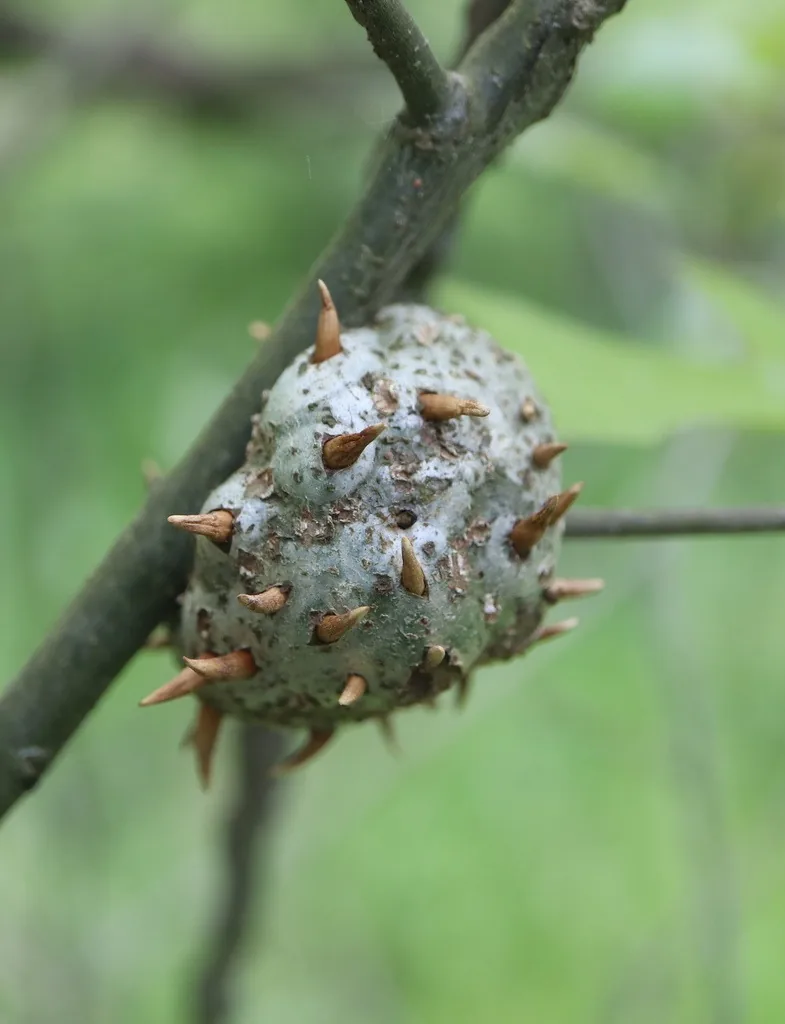
- Solid, woody, golf-ball-sized galls on oak twigs and branches that can grow to more than 2 inches across; small horns protrude around the circumference, and one adult wasp emerges from each horn.[1][2][3]
- Horns appear about 22 to 24 months after the gall starts forming; each wasp larva develops in a chamber at the base of a horn, and adults leave through the horn tips in spring. The empty gall stays on the tree, dries out and may crack open.[1]
- An earlier generation makes oblong, blister-like galls in the larger veins on the undersides of oak leaves, noticeable from late May through June.[1][3]
- Hosts are pin, scrub (bear), black, blackjack and water oaks.[1][2][3]
- The adults are tiny wasps; the females that emerge from the twig galls appear in May and June.[1]
Look-alikes
| Look-alike | How to tell them apart |
|---|---|
| Gouty oak gall | Made by the closely related Callirhytis quercuspunctata on pin, scarlet, red and black oaks; its woody twig galls look similar but stay smooth, without the horns.[2][3] |
| Other oak gall wasps | Most oak galls are leaf galls (oak apples, roly-poly galls, jumping galls) that rarely affect tree health; the horned oak gall is a woody twig gall that can girdle branches.[3][2] |
| Wool sower gall | A cluster of small hairy galls on white oak twigs in early summer that looks like a toasted marshmallow and can be pulled apart, not a hard woody mass.[3] |
Where it lives
Penn State reports both the horned and gouty oak gall wasps from southern Canada to Georgia. UMass lists it for Massachusetts landscapes, and the detailed life-history work was done in Kentucky.[2][1]
Biology and life cycle
The life cycle alternates between an all-female (agamic) generation and a sexual generation and takes two or more years. Tiny female wasps emerge from fully developed twig galls in May and June and lay eggs in the larger veins on the undersides of oak leaves. The larvae cause oblong blister-like vein galls, and by early July a new generation of both males and females emerges; this leaf gall stage takes about three months.[1][2][3]
Those adults mate, and the females lay fertilized eggs in young oak twigs. The woody galls form the following spring and take two or more seasons to mature; in Kentucky the stem gall stage was observed to last about 33 months. The number of wasps in a gall depends on its size and ranged from 1 to 160.[1][3]
Once a gall has formed, it stops growing and the insect inside feeds only on gall tissue; the gall no longer draws nutrients from the tree.[2]
Natural enemies kill most of the leaf-galling generation: 70 to 80 percent of those larvae were parasitized by small chalcid wasps (Aprostocetus, Pentastichus, Sycophila, Eurytoma, Ormyrus labotus and Brasema species). Ormyrus labotus and Sycophila also attack the stem-gall generation, emerging from 2- to 3-year-old twig galls in April and May, and clerid beetles and spiders prey on various stages. Parasitism is common in smaller stem galls and lower in large ones.[1]
Old stem galls host many other insects that do not harm the gall wasp, and 12 to 15 percent of 2- to 3-year-old galls may contain dogwood borer larvae.[1]
Damage and signs
- The woody stem galls are unsightly and easy to notice after leaf drop. In large numbers they disfigure the tree, weigh branches down until they droop, and can girdle branches and cause crown dieback; a heavily infested tree can be injured or killed.[1][2][3]
- The leaf-vein galls of the first generation do little harm and are usually missed during monitoring. Some individual trees are more susceptible than others in the same area.[1]
- Dead galls stay on the tree for several years, so it is hard to judge whether a treatment worked.[1]
Health risk
None of the sources report any risk to people or pets; this is a tiny gall-forming wasp of oak twigs and leaves.[1][2][3]
Control
Prevention
Watch oak twigs and branches for developing woody galls; they are visible at any point in the growing season and stand out after leaf drop. Acting while the population is still low is what makes pruning worthwhile.[1]
Traps and physical control
On smaller trees, where safe and practical, prune out stem galls before the adults have emerged and destroy them; this reduces further infestation, especially while numbers are low. Prune when galls are small and have just started to develop. On large or heavily infested trees this is usually impractical, and an arborist may be able to help with valuable plantings.[1][2][3]
Biological control
Parasitoid wasps, predatory beetles and spiders already remove most of each leaf-galling generation (about 70 percent on untreated trees in Kentucky). Sprays tested against this pest also killed these natural enemies without reducing the number of stem galls.[1]
Pesticides
Insecticides are generally unsatisfactory: the wasps are protected inside the galls, control has to happen before the galls form, and timing against the alternating leaf and stem generations is very difficult. Kentucky researchers reduced leaf gall density with sprays at bud swell and with systemic injections or translaminar sprays, but these treatments severely reduced the parasitoids and did not cut stem gall numbers; they call for critical evaluation before committing to multi-year programs. UMass lists carbaryl, emamectin benzoate and pyrethrins plus piperonyl butoxide for cynipid gall wasps on landscape trees; apply after bloom to protect pollinators and follow the label.[1][2][3]
Common questions
- How do I tell horned oak gall from gouty oak gall?
- Both are woody twig galls on oaks that look much alike, but the horned oak gall has small horns sticking out around it, one adult wasp emerging from each horn, while gouty oak galls stay smooth.[2][3]
- Will the galls go away if I spray the tree?
- No. Once a gall has started it is almost impossible to stop, insecticides offer little unless they catch the adults in flight, and dead galls stay on the tree for several years. Sprays tested in Kentucky also killed the parasitoids that normally control the leaf-gall generation.[2][1]
- Will horned oak galls kill my oak?
- Leaf galls on oak rarely matter, but woody twig galls can girdle branches, make them droop under the weight and cause crown dieback, and a heavily infested tree may be injured or killed. Pruning out galls early on lightly infested trees is the recommended response.[3][2][1]
Sources
- UMass Extension Landscape, Nursery and Urban Forestry Program, “Callirhytis quercuscornigera (horned oak gall wasp), Professional Insect & Mite Management Guide for Woody Plants.” www.umass.edu/agriculture-food-environment/landscape/publications-resources/insect-mite-guide/callirhytis-quercuscornigera (accessed 2026-11-10)
- Penn State Extension, “Galls on Oak (G. A. Hoover, revised June 2013).” extension.psu.edu/galls-on-oak (accessed 2026-11-10)
- University of Kentucky Entomology, “ENTFACT-408: Common Oak Galls (L. Townsend and E. Eliason).” entomology.ca.uky.edu/ef408 (accessed 2026-11-10)
- iNaturalist, “Callirhytis quercuscornigera taxon page (order and family).” www.inaturalist.org/taxa/1142061 (accessed 2026-11-10)