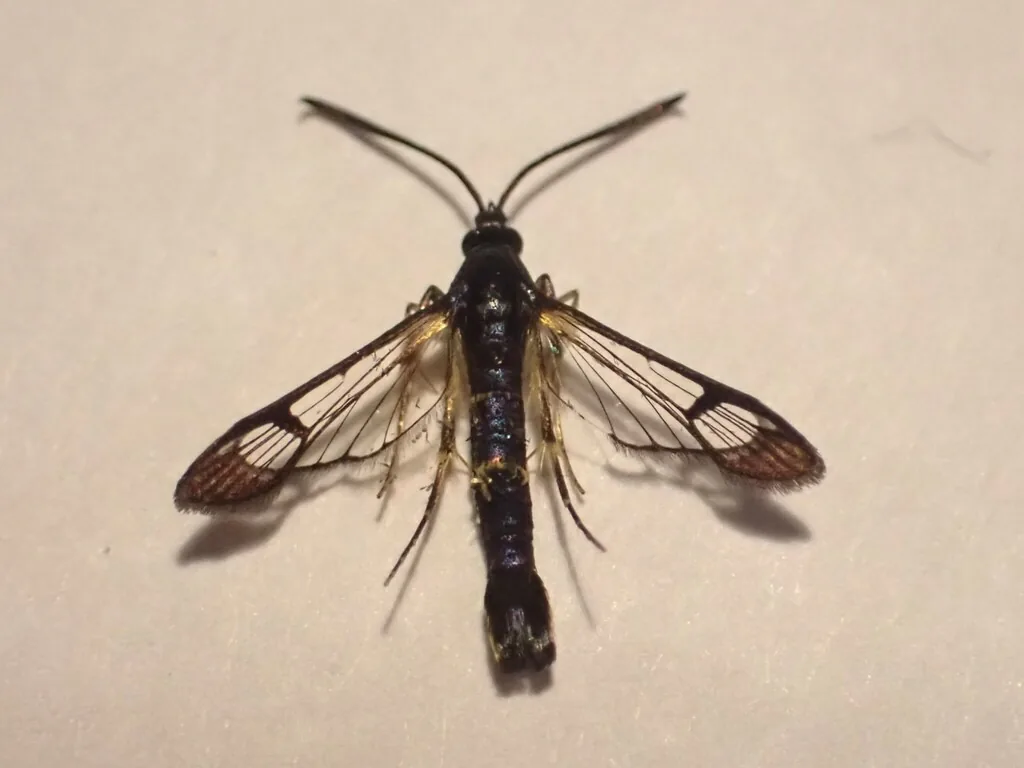
How to identify it
Look-alikes
| Look-alike | How to tell them apart |
|---|---|
| Ash/lilac borer | Another clearwing moth borer, in ash and lilac.[2] |
Where it lives
It attacks many ornamental, fruit and nut trees and has caused growing problems in northeastern apple orchards since the 1980s.[1]
Biology and life cycle
Adults emerge in spring and lay eggs singly on bark, preferring injured areas and apple burr knots.[1]
Eggs hatch in eight to nine days; larvae take about a year through seven instars and overwinter under bark.[1]
Damage and signs
- Larvae bore into the cambium, making infested areas swollen, knotty or gall-like.[1]
Health risk
It feeds in trees; UF/IFAS mentions no risk to people.[1]
Control
Prevention
Avoid physical injury, especially from lawn mowers; brace new trees and remove dead or cankered branches.[1]
Vinyl tree wraps on young dogwoods have increased infestations in some cases.[1]
When to call a professional
For insecticide options, contact your local Extension office.[1]
Common questions
Sources
- University of Florida IFAS Extension (Featured Creatures), “Dogwood Borer, Synanthedon scitula (EENY-374).” edis.ifas.ufl.edu/publication/IN671 (accessed 2026-10-06)
- University of California Statewide IPM Program, “Pest Notes: Clearwing Moths (Publication 7477).” ipm.ucanr.edu/PMG/PESTNOTES/pn7477.html (accessed 2026-10-06)
- iNaturalist, “Synanthedon scitula taxon page (order and family).” www.inaturalist.org/taxa/232126 (accessed 2026-10-06)