The short answer
- What they are: abnormal plant growth triggered when certain insects or mites feed or lay eggs in new tissue. The insect lives and feeds inside, protected.[3][5][9]
- Harm: insect and mite galls rarely affect tree health, and control usually isn't needed. Gall numbers rise and fall from year to year.[3][5][1]
- The exceptions are woody twig galls on oak, such as horned oak gall and gouty oak gall, which can injure or kill heavily infested trees, and heavy galling on young or newly planted trees.[7][9][13][3]
- Sprays after galls form don't work: the gall shields the insect and keeps growing even if the insect dies. Any spray has to go on before galls start, usually around bud break, and timing is hard to get right.[3][7][6]
- Pruning helps only on small trees and only while the gall is still green or developing, before the adults leave. Clipping old, dry, empty spruce galls does nothing for next year.[1][8][6]
Gall makers to know
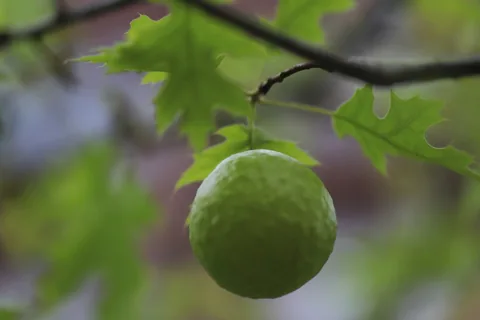 Oak Gall Wasps
Cynipidae (shown: Amphibolips confluenta, oak apple gall)
Round oak apples, woody bullets and leaf galls on oaks are homes for the larvae of tiny gall wasps. Leaf galls rarely threaten the tree; heavy infestations of woody twig galls can kill branches.
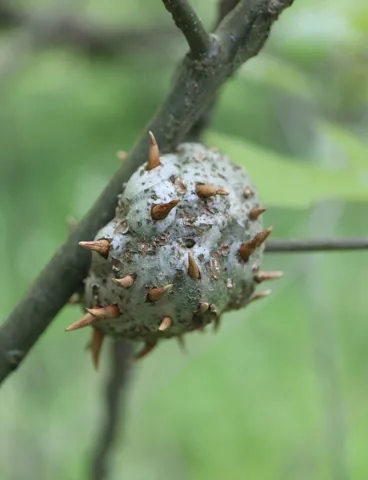 Horned oak gall wasp
Callirhytis quercuscornigera
The horned oak gall wasp is a tiny cynipid wasp whose woody twig galls on pin, black, scrub, blackjack and water oaks grow to golf-ball size and sprout short horns, one wasp emerging from the tip of each. The galls are easy to spot after leaf drop; the earlier generation, which forms small blister galls along leaf veins, is usually missed. Heavy infestations make branches droop, disfigure trees and can cause dieback. Both Penn State and Kentucky report that insecticides give little control once galls form, and pruning out young galls on lightly infested trees is the practical option.
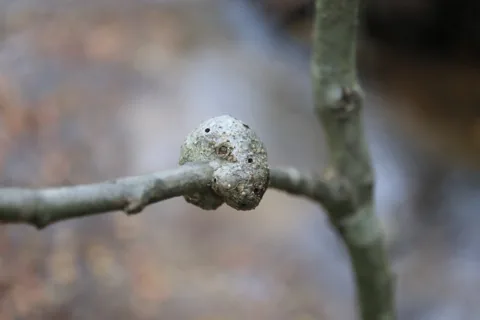 Gouty Oak Gall Wasp
Callirhytis quercuspunctata
The gouty oak gall is a woody twig gall caused by a tiny wasp, Callirhytis quercuspunctata, on pin and other red-group oaks.
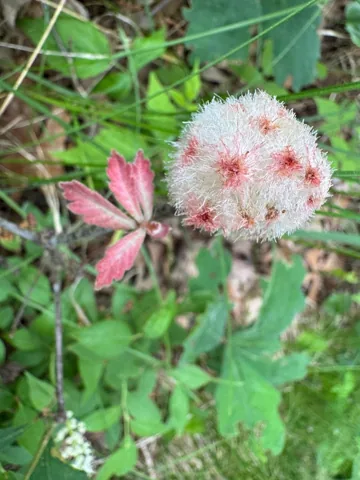 Wool Sower Gall Wasp
Callirhytis seminator
The wool sower gall wasp is a tiny gall wasp whose larvae make white oak twigs grow fluffy, cotton-ball galls in spring. The galls look odd but rarely harm the tree, and the wasps can't sting people.
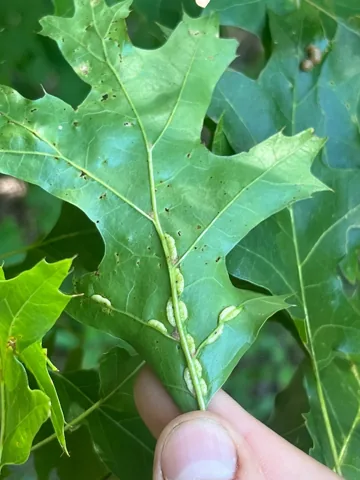 Oak Vein Pocket Gall Midge
Macrodiplosis qoruca (often written M. quercusoruca)
The oak vein pocket gall midge is a tiny fly whose maggots cause pocket-like swellings along the veins of pin oak and other red oak leaves.
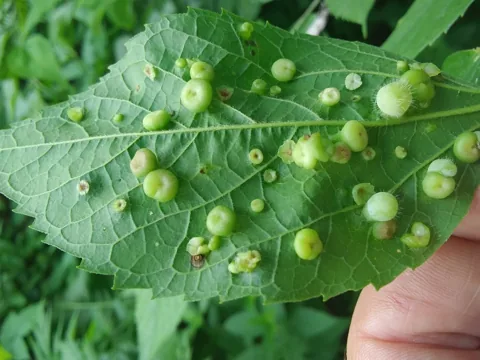 Hackberry Psyllids
Pachypsylla species (e.g., P. celtidismamma, the hackberry nipple gall maker)
Hackberry psyllids are tiny insects that spend the summer inside galls on hackberry leaves. In fall the adults leave the galls looking for winter shelter, gather on windows and screens, and are small enough to squeeze through most window screening.
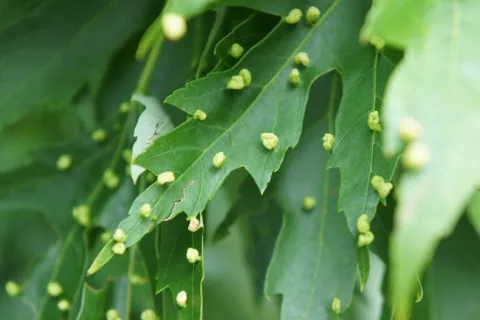 Maple bladdergall mite
Vasates quadripedes
The maple bladdergall mite is a microscopic eriophyid mite that makes small, wart-like galls on the upper side of maple leaves, especially silver maple. The galls look alarming but probably do no measurable harm to the tree.
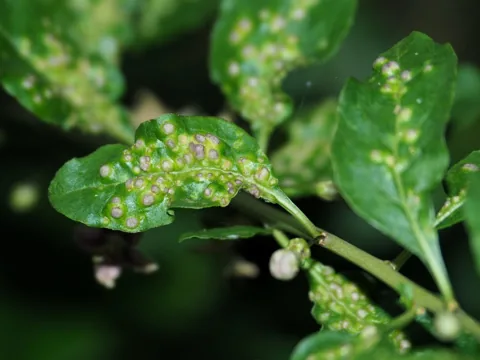 Gall and Bud Mites
Eriophyidae (eriophyid mites)
Bladder galls on maple leaves, felty patches on viburnum and swollen ash flowers are made by eriophyid mites too small to see without magnification. The galls look alarming but rarely hurt the plant.
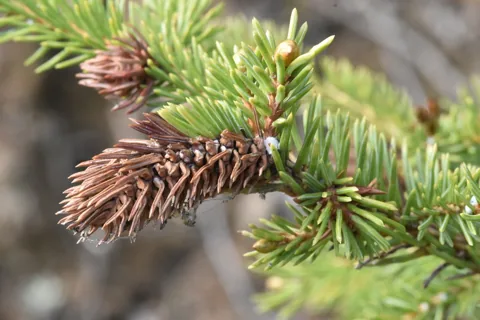 Cooley Spruce Gall Adelgid
Adelges cooleyi
Pineapple- or cone-shaped galls on spruce shoot tips are made by the Cooley spruce gall adelgid, which alternates between spruce and Douglas-fir.
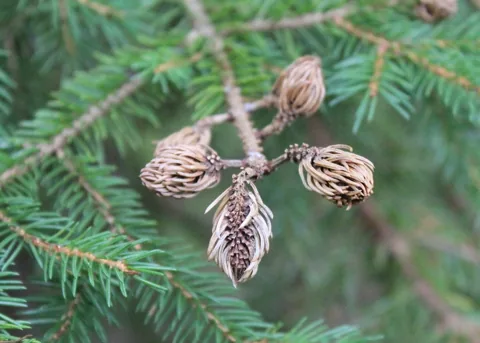 Eastern Spruce Gall Adelgid
Adelges abietis
The eastern spruce gall adelgid is a key pest of Norway spruce in the Northeast, forming galls at the base of new growth.
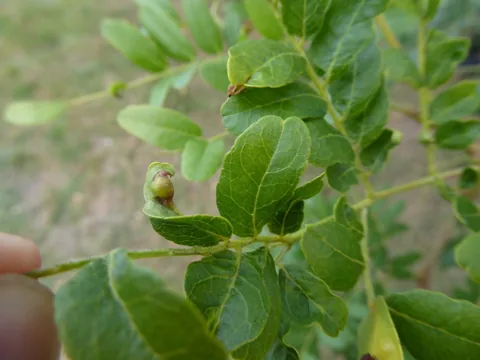 Honeylocust Podgall Midge
Dasineura gleditchiae
Honeylocust podgall midge larvae make new honeylocust leaflets curl and thicken into swollen, finger-like pod galls.
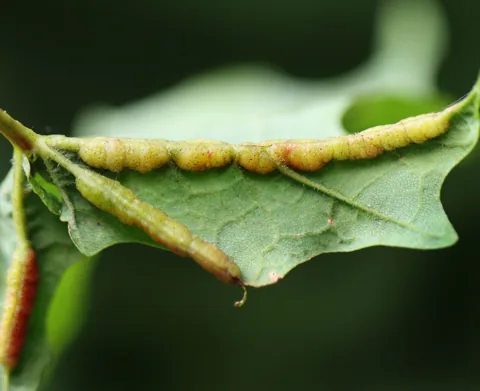 Gouty vein gall midge
Dasineura communis
The gouty vein gall midge is a tiny, gnat-like fly whose larvae make the veins on the undersides of maple leaves swell into knobby, light green to red galls; the damage is mostly cosmetic.
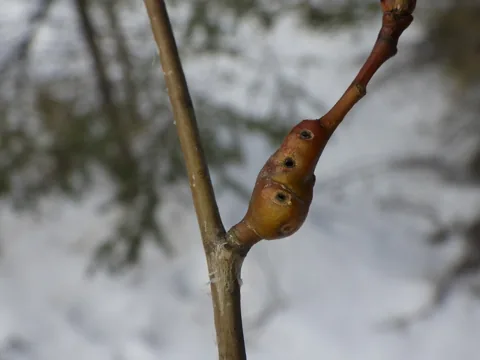 Poplar Twiggall Fly
Hexomyza schineri
Poplar twiggall fly larvae cause smooth, knot-like galls on aspen twigs that keep growing for years.
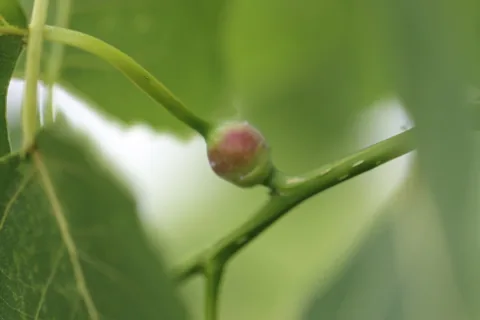 Poplar petiolegall aphid
Pemphigus populitransversus
The poplar petiolegall aphid is a small, pale green, waxy aphid that forms round galls on the leaf stems (petioles) of cottonwoods, poplars and aspens. Around midsummer the aphids leave the galls for the roots of cabbage-family plants, and they return to poplars in late summer or fall. On trees the galls are mostly a cosmetic problem.
What a gall is
A gall is plant tissue growing abnormally. With insects and mites, the trigger is their feeding or egg-laying in young tissue: their saliva or other secretions push the plant's own growth hormones up, so cells grow larger or multiply. The gall forms around the insect, which then feeds on the inner gall tissue.[3][5][9][13]
Timing matters. Galls usually start during the burst of new leaf, shoot and flower growth in late spring, around bud break. Mature plant tissue usually can't be made to form a gall, and once one starts it keeps forming even if the insect dies.[3][9][5]
Galls often stay on the plant long after the insects have left, and many are noticed only after they're fully formed. That's why a tree can look covered in galls in late summer with nothing left inside to treat.[5][3]
Shapes vary a lot. Leaf galls, the most common kind, show up as curls, blisters, nipples or felt-like patches on the leaf blade or stalk. Stem and twig galls range from a slight swelling to a large woody knot. Bud and flower galls deform the bud or flower.[3][1]
Not every gall comes from an insect. UC IPM lists root knot and other nematodes, mistletoes, crown gall, olive knot, oleander gall and western gall rust among other causes. This guide covers the insect and mite galls homeowners find on shade trees.[1]
Do galls hurt the tree?
Usually not. UC IPM says most gall-making insects and mites aren't known to seriously harm trees and shrubs, and that their galls usually don't threaten plant health. Minnesota Extension says galls are rarely numerous enough to harm a plant; Colorado State says they rarely affect plant health even though their appearance may cause concern.[1][3][5]
Galls do draw nutrients as they grow. Minnesota Extension says that becomes a problem when galls are numerous on very young plants, or when branches carry many galls for several years in a row. Wisconsin Extension makes the same point about maple galls: little effect on established trees, but on newly planted trees with less foliage they can be a significant stress.[3][13]
Heavy infestations of some leaf galls can make leaves drop early or distort them enough to cut into photosynthesis.[7][13][10]
Woody twig galls on oak are the main exception. Penn State says twig or branch galls may cause injury or even death to a heavily infested tree, and Kentucky's oak gall fact sheet says these solid, woody masses can girdle branches or make them droop from sheer weight.[7][9]
Oak galls
Oak galls come in many shapes. Most are made by tiny cynipid gall wasps, the most common gall-producing insects, which also gall roses.[3][5][7]
Leaf galls are the most common kind, and most do the tree no harm. Penn State says most leaf galls on oak don't affect tree health, and chemical control is seldom suggested.[7][9]
- Oak apple galls: large rounded galls 1 to 2 inches across, filled with spongy tissue around a single larva, usually on the leaf stalk or midrib. They dry to a brown, paper-thin shell. Kentucky Extension says they cause no measurable harm.[9]
- Roly poly galls: about the size and look of hollow green grapes, with a loose seedlike cell inside holding one wasp larva. They don't affect tree health.[9]
- Wool sower galls: on white oak in early summer, looking like toasted marshmallows; each is a cluster of small hairy galls with seedlike cells inside.[9]
- Jumping oak galls: tiny seedlike galls that drop from the leaves, mainly on valley oak and California white oak in Kentucky's description. The wasp moving inside can make a gall hop several inches off the ground.[9][3]
- Vein pocket and leaf pocket galls: made by tiny midge maggots, not wasps. Vein pocket galls are elongated swellings along leaf veins of scrub and pin oaks; the larvae drop to the ground and spend the winter there.[9]
- Oak rough bulletgall: rounded galls on bur oak twigs that start soft and pale brown, then darken and harden. Heavy infestations can cover much of a twig and slow the tree's growth.[5]
Horned oak and gouty oak galls: the ones worth watching
These two woody twig galls are the oak galls that can actually hurt trees. Horned oak gall attacks pin, scrub, black, blackjack and water oaks. Gouty oak gall develops on pin, scarlet, red and black oaks. Both look similar, but horned oak gall has small horns around it, each the exit point of one adult wasp; gouty oak galls are smooth.[7][9]
They take a long time to develop. The horned oak gall wasp alternates between a tiny blister-like gall on leaf veins and the woody twig gall. UMass says the woody stage takes 2 or more seasons, and that a Kentucky study measured about 33 months. Kentucky Extension says the galls can grow to more than 2 inches in diameter; UMass describes them as golf-ball sized.[11][9][14]
One gall can hold anywhere from 1 to 160 wasps depending on its size, and heavily galled branches may droop. The leaf-gall stage is easy to miss. The woody galls are easiest to see after leaf drop, and they stay on the tree for years after the wasps leave.[11][9]
Hackberry nipple and blister galls
The bumps on almost every hackberry leaf in many areas are made by hackberry psyllids (Pachypsylla), small jumping insects that look like miniature cicadas. Hackberry nipple galls form on the underside of the leaf; smaller, more numerous blister galls form on the upper surface. These psyllids gall only hackberry and its close relatives.[3][4][5]
Adults lay eggs as new leaves unfold in spring. Nymphs develop inside the galls through summer and the adults come out in late summer to spend the winter in bark cracks and other shelter, including houses. Colorado State says both common species likely have one generation a year, and that gall numbers can vary a lot between nearby leaves.[4][5][10]
The tree isn't hurt. Minnesota Extension says the galls don't harm a healthy mature tree even when numbers are large, and Kentucky Extension says infested hackberries don't seem to be harmed, though severe infestations may cause early leaf drop. Birds pick the nymphs out of the galls.[4][10][5]
The real annoyance is in fall, when swarms of adults come to the house. They are small enough to pass through most window screens and may give a brief pinprick by probing the skin, but they don't feed on people or pets and are otherwise harmless. Minnesota Extension suggests 18 mesh screens and turning off or switching outdoor lights.[4][10][3]
Spraying the tree is not encouraged. Kentucky Extension says it would take several applications to keep residue on expanding leaves for the weeks eggs are hatching, and large trees are hard to cover. Minnesota Extension says cutting down your hackberry isn't recommended either, because psyllids still fly in from neighborhood trees.[10][4]
Maple bladder galls and other mite galls
The little red-to-black bumps standing up on the tops of maple leaves are maple bladder galls, made by Vasates quadripedes, a microscopic eriophyid mite with only two pairs of legs. Each hollow gall is 1/16 to 1/8 inch, starts green, turns pink to red and then black, and holds a single mite. Silver maple gets them more than red maple, and the mite infests only maples.[13][12]
Related mites make spindle galls on sugar maple and linden and velvety, felt-like erineum patches on maple, birch, viburnum and linden. Other eriophyid mites cause ash flower gall and, together with a powdery mildew fungus, hackberry witches'-broom.[13][3]
The mites spend the winter on the bark and bud scales and move to the opening buds in early spring. Galls form only while leaves are still expanding. Galls tend to be thickest on leaves nearest the trunk and larger branches, and numbers swing widely from year to year and tree to tree.[12][13]
NC State says the galls, although alarming, probably do no measurable harm. Wisconsin Extension calls them primarily cosmetic, with very little effect on plant health even in severe infestations, though heavy galling can make leaves cup, yellow and drop early.[12][13]
Spruce galls: Cooley and eastern spruce gall adelgids
The cone-like growths at spruce branch tips are made by adelgids, small aphid-like insects of conifers. Two species account for most of them, and their differences matter for what (if anything) you do.[3][2]
- Cooley spruce gall adelgid: galls at the tips of new growth, common on Colorado blue spruce. Colorado State and Minnesota Extension describe them as 2 to 4 inches long; UC IPM gives 1/2 to 3 inches. They're light green to purple, dry and turn brown from about midsummer, and are often mistaken for seed cones.[6][3][2]
- Eastern spruce gall adelgid: smaller, pineapple-shaped galls at the base of new shoots, mainly on Norway spruce (also white spruce, and occasionally red and Colorado blue spruce). Penn State says they are usually less than 25 mm long; Minnesota Extension gives 1/2 to 1 inch. The whole life cycle is on spruce, with one generation a year in Pennsylvania.[8][3]
How much spruce galls matter
Cooley spruce galls do little or no harm. Colorado State says even heavy infestations may only slightly slow growth and distort shoots, and old galls are usually covered by new growth and become almost unnoticeable a few years later. Minnesota Extension says damage is very rare and happens only when young trees are heavily galled year after year.[6][3]
Eastern spruce galls are more of a structural concern. Minnesota Extension says they can weaken stems, making breakage more likely under heavy snow or wind, though tree health suffers only when galls are numerous every year. Penn State says infested trees are seldom killed but can look much worse.[3][8]
The Cooley spruce gall adelgid normally needs a second host, Douglas-fir, where it causes yellow spotted, bent needles and white cottony tufts but no galls. Sources differ on how strict that is: UC IPM says galls form on spruce only when Douglas-fir is nearby, while Colorado State says observations in Colorado suggest spruce-to-spruce movement may also occur.[6][2][3]
Other common gall makers on trees and shrubs
Many other insects and mites gall shade trees and shrubs. Each kind usually attacks one plant or a few related ones.[5]
- Gall midges: tiny mosquito-like flies whose maggots gall leaves and buds. Examples include honeylocust pod gall, gouty vein gall on maple, willow pine cone gall and oak vein pocket gall. Colorado State says thornless honeylocust varieties are more susceptible to the honeylocust pod gall midge, and heavy infestations can brown and drop foliage.[3][5][9]
- Gall aphids: poplar and cottonwood stem and leaf-stalk galls, such as the marble-sized poplar petiole gall. The winged aphids leave the gall in summer for the roots of cabbage-family plants.[3][5]
- Poplar twiggall fly: smooth, round twig galls on aspen, cottonwood and poplar, most noticed in fall as leaves drop. Colorado State says limiting irrigation and fertilizer can slow gall production on succulent aspen.[5]
- Gall wasps on roses, and Pineus adelgids that make smaller galls on spruce.[3][5][2]
When pruning helps, and when it's pointless
Pruning is the main hands-on option, and it only works if the insects are still inside. UC IPM says pruning and disposing of galls may control some species if it's done while the immatures are in the plant tissue and before adults begin to emerge.[1][7]
- Spruce: clip green galls before they open. Penn State says pruning green eastern spruce galls in June or July is practical for light infestations on a few small trees; UC IPM gives the same advice for adelgid galls in general. Colorado State says removing old, brown Cooley galls does nothing, because the insects have already left and the old galls aren't reused.[8][2][6]
- Woody oak galls: on smaller trees, prune horned and gouty oak galls while they're small and still developing, before adults leave. On large or heavily infested trees this usually isn't practical.[7][9][11]
- Oak leaf galls: raking up and destroying fallen leaves may help, since some gall makers spend part of their life in leaf litter. Removing oak apple galls before they dry and the wasp exits may also reduce them.[7][9]
- Maple leaf galls: on a small tree, galled leaves can be hand-picked to lower mite numbers.[13]
- Watch the timing on wasp and fly galls. Colorado State warns that removing galls in late winter or spring, after the gall makers have left, can kill the parasitoid wasps still developing inside, which are the natural enemies keeping gall makers down.[5]
Why sprays usually don't work
Once a gall has started, it's too late. Minnesota Extension and Penn State both say a forming gall can't be stopped or reversed, and the gall protects the insects or mites inside from sprays. Colorado State says the same for Cooley spruce galls.[3][7][6][13]
Preventive sprays depend on precise timing, around bud break or before, and for many gall makers the life cycle details needed to time them aren't known. Penn State says the lack of serious damage from oak leaf galls plus the difficulty of timing sprays makes a strong argument against insecticides for oak galls. Spraying a large tree well also takes equipment most homeowners don't have.[3][9][7][10]
Even well-timed sprays may not pay off. In a Kentucky study on pin oak, parasitoid wasps killed about 70% of horned oak gall wasp larvae in the leaf-gall stage on untreated trees. Sprays and trunk injections killed gall wasps, but they also killed the parasitoids, and neither canopy sprays nor injections significantly reduced new twig galls. The authors concluded outbreaks are unlikely to be controlled by a single treatment.[14][11]
Broad-spectrum sprays can also backfire on conifers. Penn State and UC IPM warn that some insecticides used for adelgids can set off spider mite outbreaks by killing mite predators.[8][2]
If you do treat: the narrow windows
For most galls, extension services recommend doing nothing. Where a young tree is heavily galled year after year, these are the timings they give. Read the label to make sure the tree and pest are listed.[3][5][13]
- Cooley spruce gall: in fall after overwintering females settle, or in spring before they swell with eggs (usually by late April in Colorado). Aim at the underside of branch tips. Horticultural oil works well but can temporarily dull blue spruce color; insecticidal soap is only moderately effective on spruce.[6][2]
- Eastern spruce gall: a dormant horticultural oil before new growth starts, or a registered insecticide from mid-September through early October or in April before budbreak. Penn State notes oil removes the blue bloom from Colorado blue spruce.[8]
- Maple mite galls: a dormant oil before bud break, since the mites winter on the tree. Wisconsin Extension warns not to use oil on sugar maple, Japanese maple, birch, hickory or walnut because of plant injury, and says pesticides have limited impact on these mites.[13]
- Avoid spraying when bees are active. Colorado State notes some insecticides used against gall mites, such as carbaryl, are highly toxic to pollinators.[5][11]
What to do instead
For the great majority of galls, the best plan is to leave them alone and look after the tree. Minnesota Extension says control is generally not suggested.[3][1]
- Water and fertilize as needed to keep the tree vigorous; Wisconsin Extension says effort is better spent on good care than on spraying for maple galls. UC IPM says excess or quick-release fertilizer can promote adelgids.[13][2]
- When planting, keep Douglas-fir and spruce apart to break the Cooley adelgid's cycle.[6][2]
- Expect ups and downs. Heavy galling one year doesn't mean the same next year.[6][3][13]
- For a valuable oak with heavy twig galls, Kentucky Extension suggests a commercial arborist.[9]
Common questions
- Will galls kill my tree?
- Almost never. Most insect and mite galls are cosmetic. The exceptions are heavy, repeated woody twig galls on oak (horned and gouty oak galls) and heavy galling on very young trees.[1][3][7]
- Can I spray to get rid of galls already on my tree?
- No. Once a gall forms, the insect is protected inside and the gall keeps developing. Any spray has to go on before galls start, usually around bud break.[3][7][6]
- Should I cut off the galls?
- Only on small trees and only while the galls are green or still developing. Old, brown, empty galls can be left; removing them doesn't affect next year.[8][6][1]
- What are the bumps on my hackberry leaves?
- Nipple or blister galls from hackberry psyllids. They don't harm a healthy tree; the main nuisance is adults coming indoors in fall.[4][5][10]
- What are the red bumps on my maple leaves?
- Maple bladder galls from a microscopic eriophyid mite, most often on silver maple. They look alarming but are primarily cosmetic.[13][12]
- Are the cones on my blue spruce galls?
- Light green to purple, cucumber- or cone-shaped growths at branch tips that turn brown in summer are usually Cooley spruce galls, often mistaken for seed cones. They do little or no harm.[6][2]
Photo credits
- Oak Gall Wasps: (c) Steven Bodzin, some rights reserved (CC BY) — via iNaturalist, CC BY 4.0
- Horned oak gall wasp: (c) Jeff Clark, some rights reserved (CC BY) — via iNaturalist, CC BY 4.0
- Gouty Oak Gall Wasp: (c) Jeff Clark, some rights reserved (CC BY) — via iNaturalist, CC BY 4.0
- Wool Sower Gall Wasp: (c) Elizabeth Axley, some rights reserved (CC BY) — via iNaturalist, CC BY 4.0
- Oak Vein Pocket Gall Midge: (c) Nico Carl, some rights reserved (CC BY) — via iNaturalist, CC BY 4.0
- Hackberry Psyllids: Ira Gershenhorn, public domain (CC0), via iNaturalist
- Maple bladdergall mite: (c) Alex Press, some rights reserved (CC BY) — via iNaturalist, CC BY 4.0
- Gall and Bud Mites: (c) Katja Schulz, some rights reserved (CC BY) — via iNaturalist, CC BY 4.0
- Cooley Spruce Gall Adelgid: Braden J. Judson, public domain (CC0), via iNaturalist
- Eastern Spruce Gall Adelgid: (c) Steven Lamonde, some rights reserved (CC BY) — via iNaturalist, CC BY 4.0
- Honeylocust Podgall Midge: (c) jamie-aa, some rights reserved (CC BY) — via iNaturalist, CC BY 4.0
- Gouty vein gall midge: (c) Christine Young, some rights reserved (CC BY) — via iNaturalist, CC BY 4.0
- Poplar Twiggall Fly: Jonny Tostenson, public domain (CC0), via iNaturalist
- Poplar petiolegall aphid: (c) Rich Sommer, some rights reserved (CC BY) — via iNaturalist, CC BY 4.0
Sources
- UC Statewide IPM Program, “Gall Makers (Pests of Landscape Trees and Shrubs).” ipm.ucanr.edu/PMG/GARDEN/PLANTS/INVERT/gallmakers.html (accessed 2026-11-10)
- UC Statewide IPM Program, “Adelgids (Pests of Landscape Trees and Shrubs).” ipm.ucanr.edu/PMG/GARDEN/PLANTS/INVERT/adelgids.html (accessed 2026-11-10)
- University of Minnesota Extension, “Insect and mite galls (Jeffrey Hahn and Mark Ascerno).” extension.umn.edu/yard-and-garden-insects/insect-and-mite-galls (accessed 2026-11-10)
- University of Minnesota Extension, “Western conifer seed bug and hackberry psyllids.” extension.umn.edu/nuisance-insects/western-conifer-seed-bug-and-hackberry-psyllids (accessed 2026-11-10)
- Colorado State University, Department of Agricultural Biology, “Insect and mite galls.” agsci.colostate.edu/agbio/ipm-pests/insect-and-mite-galls/ (accessed 2026-11-10)
- Colorado State University Extension, “Cooley Spruce Galls.” extension.colostate.edu/resource/cooley-spruce-gall/ (accessed 2026-11-10)
- Penn State Extension, “Galls on Oak (Gregory A. Hoover).” extension.psu.edu/galls-on-oak (accessed 2026-11-10)
- Penn State Extension, “Eastern Spruce Gall Adelgid.” extension.psu.edu/eastern-spruce-gall-adelgid (accessed 2026-11-10)
- University of Kentucky Entomology, “ENTFACT-408: Common Oak Galls (Lee Townsend and Eileen Eliason).” entomology.ca.uky.edu/ef408 (accessed 2026-11-10)
- University of Kentucky Entomology, “ENTFACT-413: Hackberry Psyllids and Other Jumping Plant Lice (Lee Townsend).” entomology.ca.uky.edu/files/ef413.pdf (accessed 2026-11-10)
- UMass Amherst Center for Agriculture, Food, and the Environment, “Horned oak gall wasp, Callirhytis quercuscornigera (Insect & Mite Guide).” www.umass.edu/agriculture-food-environment/landscape/publications-resources/insect-mite-guide/callirhytis-quercuscornigera (accessed 2026-11-10)
- NC State Extension, “Maple Bladdergall Mite.” content.ces.ncsu.edu/maple-bladdergall-mite (accessed 2026-11-10)
- University of Wisconsin-Madison Division of Extension, “Maple Gall Mites (Eriophyidae).” hort.extension.wisc.edu/articles/maple-gall-mites-eriophyidae/ (accessed 2026-11-10)
- Journal of Economic Entomology, abstract via PubMed, “Eliason EA, Potter DA. 2000. Impact of whole-canopy and systemic insecticidal treatments on Callirhytis cornigera (Hymenoptera: Cynipidae) and associated parasitoids on pin oak. J Econ Entomol 93(1):165-171.” pubmed.ncbi.nlm.nih.gov/14658527/ (accessed 2026-11-10)