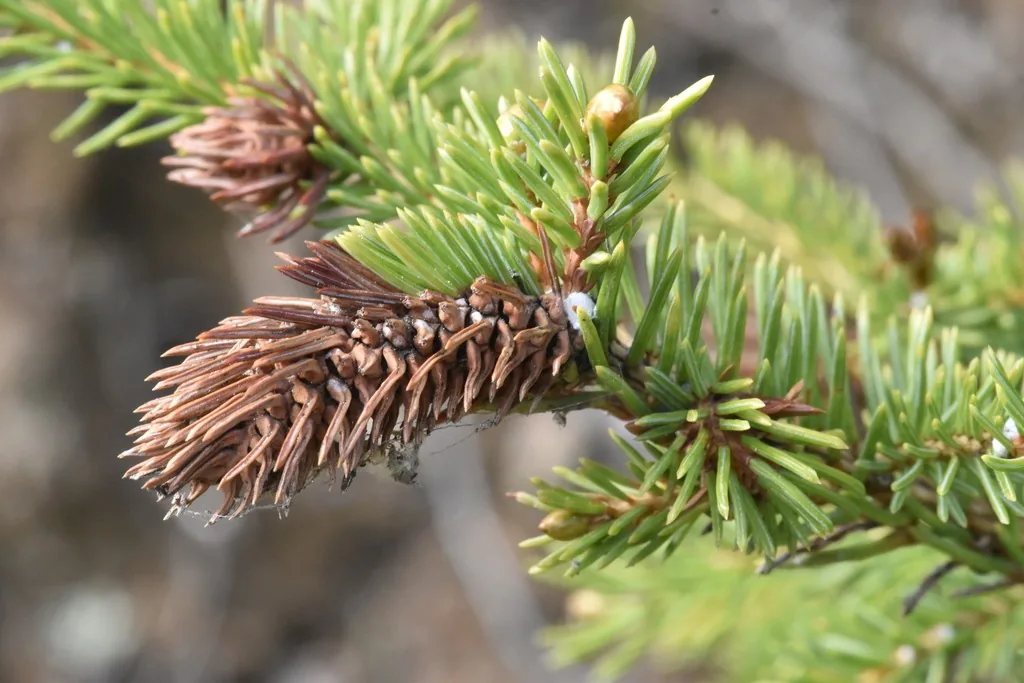
How to identify it
Look-alikes
| Look-alike | How to tell them apart |
|---|---|
| Eastern spruce gall adelgid | It makes smaller 1/2- to 1-inch, pineapple-shaped galls at the base of new shoots and lives on spruce alone.[2] |
Where it lives
It feeds on spruce and Douglas-fir; in Minnesota mainly on Colorado blue and white spruce, and in California mostly along the North Coast and in mountains where Douglas-fir is common.[1][2]
Biology and life cycle
Some populations alternate generations between spruce and Douglas-fir.[1]
Galls form on spruce only when Douglas-fir is nearby, because that host supplies the gall-forming stage.[1]
About midsummer the nymphs leave the galls and molt into winged adults.[1]
Damage and signs
Health risk
It feeds on conifers only; the sources describe no risk to people.[1][2]
Control
Prevention
Control is generally not suggested; most galls don't seriously harm plants.[2]
Traps and physical control
Prune and dispose of galls if they're annoying, before the adelgids leave.[3]
Pesticides
For galling insects that winter on the plant, horticultural oil before spring activity is the timing Minnesota Extension gives.[2]
Common questions
Sources
- University of California Statewide IPM Program, “Adelgids (Pests in Gardens and Landscapes).” ipm.ucanr.edu/PMG/GARDEN/PLANTS/INVERT/adelgids.html (accessed 2026-10-06)
- University of Minnesota Extension, “Insect and mite galls (Yard and garden insects).” extension.umn.edu/yard-and-garden-insects/insect-and-mite-galls (accessed 2026-10-06)
- University of California Statewide IPM Program, “Gall Makers (Pests in Gardens and Landscapes).” ipm.ucanr.edu/PMG/GARDEN/PLANTS/INVERT/gallmakers.html (accessed 2026-10-06)
- iNaturalist, “Adelges cooleyi taxon page (order and family).” www.inaturalist.org/taxa/334163 (accessed 2026-10-06)