On this page
How to identify it
Look-alikes
| Look-alike | How to tell them apart |
|---|---|
| Maple eyespot gall midge | Its galls are round, ringed spots in the leaf blade rather than swellings along the veins.[2] |
| Maple bladdergall mite | Bladder galls are separate globular bumps about 2.5 to 3 mm across on the upper leaf surface, not swollen veins underneath.[2] |
Where it lives
NC State and Penn State describe it on maples in North Carolina and Pennsylvania; the most frequent hosts are sugar maple, red maple and boxelder, and Penn State also lists silver and striped maple for vein galls.[1][2]
Biology and life cycle
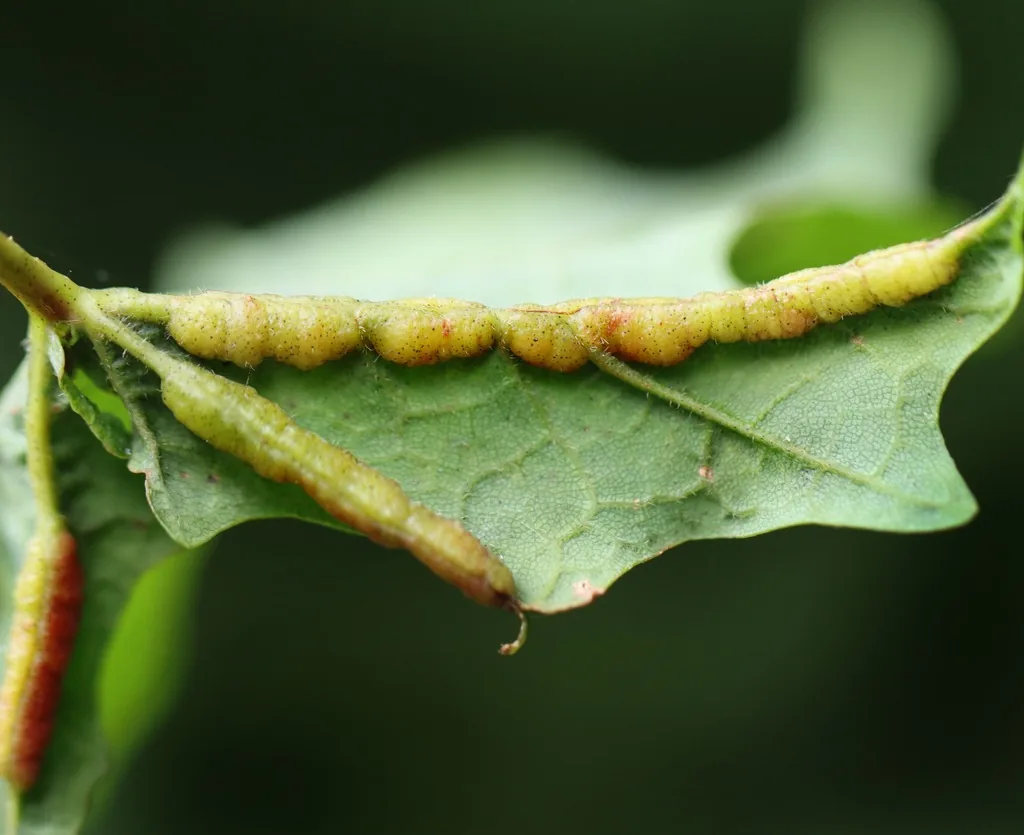
There is one generation a year. Females lay eggs on new, developing leaves in spring, and the larvae gather along the veins to feed.[1]
The leaf tissue swells around the larvae and protects them; they mature within about two months, the gall splits, and in early summer they drop to the ground.[1]
Larvae spin cocoons under leaves and debris at the base of the tree and pupate the next spring; the adults don't feed and live no more than three days.[1]
Damage and signs
- The galls are largely an aesthetic problem; severe leaf curl can reduce a tree's ability to make food, but it isn't lethal.[1]
Health risk
It feeds only on maple leaves; NC State and Penn State mention no risk to people.[1][2]
Control
Sanitation
Raking up leaf litter and debris around the base of the tree removes overwintering cocoons, and hand-picking galled leaves also helps on small trees.[1]
Pesticides
Treatment usually isn't needed. On high-value trees galled year after year, NC State notes that systemic insecticides applied as a soil drench or sprayed on new leaves have worked.[1]
Common questions
Sources
- NC State Extension, “Gouty Vein Gall Midge (Diptera: Cecidomyiidae).” content.ces.ncsu.edu/gouty-vein-gall-midge-diptera-cecidomyiidae (accessed 2026-10-19)
- Penn State Extension, “Leaf Galls on Maple.” extension.psu.edu/leaf-galls-on-maple (accessed 2026-10-19)
- iNaturalist, “Dasineura communis taxon page (order and family).” www.inaturalist.org/taxa/473389 (accessed 2026-10-06)