On this page
How to identify it
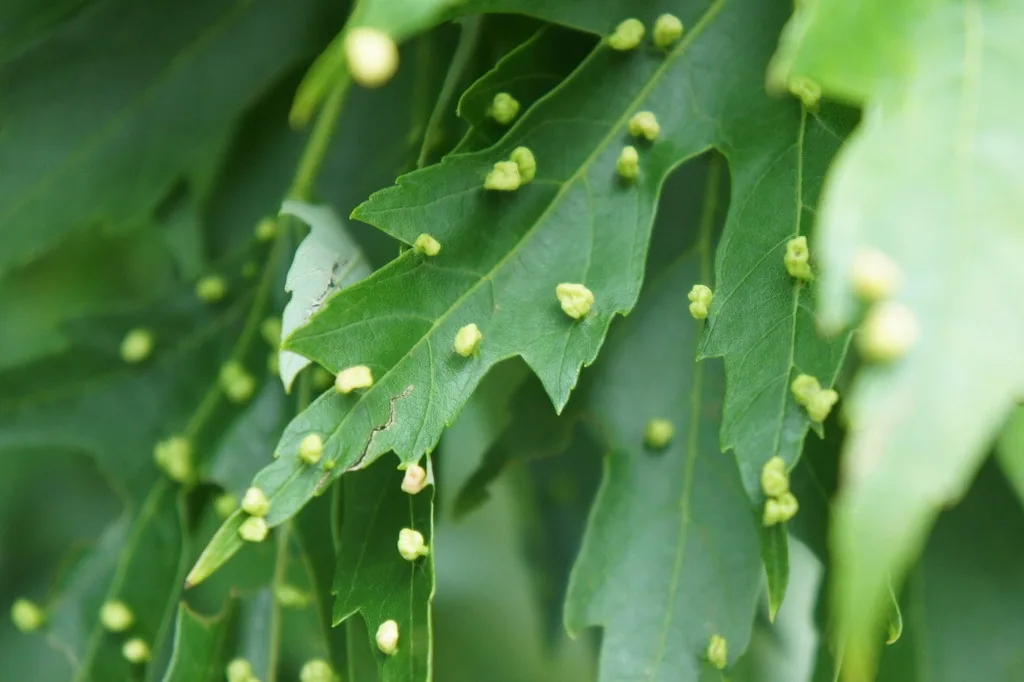
- The galls are hollow, round bumps 1/16 to 1/8 inch across on the upper leaf surface; they start pale green, turn pink to red, then brown to black as the season goes on.[3][1]
- Each gall sits on a short stalk like a tiny mushroom, and the mites leave it through a hairy opening on the underside of the leaf.[3][4]
- The mites themselves are white to clear, about 0.15 mm long and cigar-shaped, with only four legs at the front end; you need a hand lens to see them.[2][1]
Look-alikes
| Look-alike | How to tell them apart |
|---|---|
| Maple spindlegall mite | Its close relative, Vasates aceriscrumena, makes slender, spindle-shaped galls rather than round bladders, most often on sugar maple.[3][2] |
| Maple erineum mites | Other eriophyid mites make velvety, felt-like patches on the undersides of sugar, silver and red maple leaves instead of raised bladders.[3] |
Where it lives
Natural Resources Canada describes it as a native mite found across eastern Canada and in several eastern U.S. states. It attacks only maples, especially silver maple, and red maple less often.[4][1][3]
Biology and life cycle
Adult mites spend the winter in bark cracks, under bud scales and in other protected spots on the trunk and branches.[2][3][1]
As buds open in spring, the mites crawl onto the new leaves to feed; their feeding makes the leaf grow a gall around them, and inside it they feed, lay eggs and multiply.[1][4]
New mites leave the gall and start galls on fresher leaves. Once the tree stops putting out new growth, usually in early summer, they can no longer make galls and move back to the bark.[3][4]
There are several generations a year. Gall numbers vary from tree to tree, branch to branch and year to year, and leaves nearest the trunk and larger branches, where the mites overwinter, are hit hardest.[2][3]
Damage and signs
Health risk
It lives and feeds only on maples; NC State, UGA and Natural Resources Canada describe no risk to people.[1][2][4]
Control
Traps and physical control
On a small tree, picking off galled leaves reduces the mite population. Once galls have formed, the mites are sealed inside, so sprays won't reach them.[3]
Pesticides
Control is usually unnecessary in the landscape. Where it's wanted, a dormant oil spray before bud break can work well because the mites overwinter on the tree, but oil can injure sugar maple, Japanese maple, birch, hickory and walnut.[2][3]
UGA says a pyrethroid applied as the leaves first flush may prevent new galls; NC State notes the mites are susceptible to Sevin (carbaryl) and other pesticides labeled for mites, best applied in late fall after the leaves drop.[2][1]
Common questions
- Are the red bumps on my maple leaves hurting the tree?
- Almost never. They're maple bladder galls, and NC State and Wisconsin Extension both say they do little or no measurable harm to an established tree, even when leaves are covered.[1][3]
- Can I spray the galls I see now?
- It won't help: the mites are sealed inside the galls. The timings the sources give are late fall after the leaves drop, a dormant oil before bud break, or a treatment as the new leaves first unfold.[3][2][1]
Sources
- NC State Extension, “Maple Bladdergall Mite (PDIC Factsheet).” content.ces.ncsu.edu/maple-bladdergall-mite (accessed 2026-10-19)
- University of Georgia Cooperative Extension, “Maple Bladdergall Mite and Maple Spindlegall Mite (Vasates quadripedes and V. aceriscrumena).” extension.uga.edu/programs-services/landscape-pest-management/pests-ornamental/maple-bladdergall-mite-maple-spildlegall-mite-vasates-quadr.html (accessed 2026-10-19)
- University of Wisconsin-Madison Extension, Wisconsin Horticulture, “Maple Gall Mites (Eriophyidae).” hort.extension.wisc.edu/articles/maple-gall-mites-eriophyidae/ (accessed 2026-10-19)
- Natural Resources Canada, Canadian Forest Service, “Maple bladdergall mite (Trees, insects and diseases of Canada's forests, factsheet 94).” tidcf.nrcan.gc.ca/en/insects/factsheet/94 (accessed 2026-10-19)
- iNaturalist, “Vasates quadripedes taxon page (order and family).” www.inaturalist.org/taxa/120015 (accessed 2026-10-06)