On this page
How to identify it
Where it lives
Apparently native to Japan, it was probably brought to North America on Japanese maple nursery stock in the late 1800s and was first described from the United States in 1900; it has since reached Australia.[1][2]
Biology and life cycle
It spends the winter as eggs inserted under the bark near buds on the newest twig growth; the tips of the eggs sometimes show through the slit.[1]
Nymphs hatch in spring and feed on the undersides of leaves in the shadier parts of the tree, passing through five stages.[1]
In North Carolina adults are out from June through October, and there are probably at least two generations a year.[1]
Besides Japanese maples, it feeds on boxelder and Norway, red and silver maples.[1]
Damage and signs
Health risk
It feeds only on maple sap; NC State and NSW DPI mention no risk to people.[1][2]
Control
Prevention
No control is needed since it causes no visible damage; yellow sticky traps will catch adults if you want to confirm they're there.[1][2]
Common questions
- What are the little banded insects jumping off my Japanese maple?
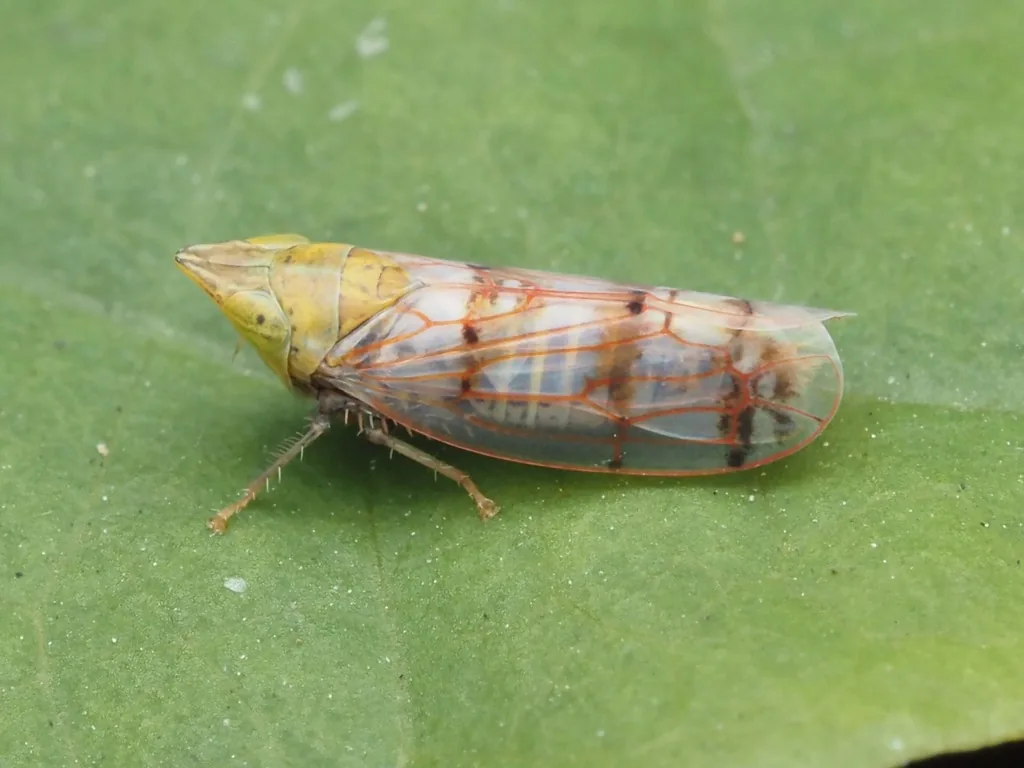
- Probably Japanese maple leafhoppers, which have a pointed greenish-yellow head and rust-banded wings and jump readily when disturbed.[1][2]
- Are Japanese maple leafhoppers hurting my tree?
- No. NC State notes they don't seem to cause any signs or symptoms on their host plants.[1]
Sources
- NC State Extension, “Japanese Maple Leafhopper.” content.ces.ncsu.edu/japanese-maple-leafhopper (accessed 2026-10-19)
- New South Wales Department of Primary Industries, “Japananus hyalinus (Osborn), Japanese maple leafhopper (leafhopper identification key).” idtools.dpi.nsw.gov.au/keys/cicadell/species/japananus.htm (accessed 2026-10-19)
- iNaturalist, “Japananus hyalinus taxon page (order and family).” www.inaturalist.org/taxa/222462 (accessed 2026-10-06)