How to identify it
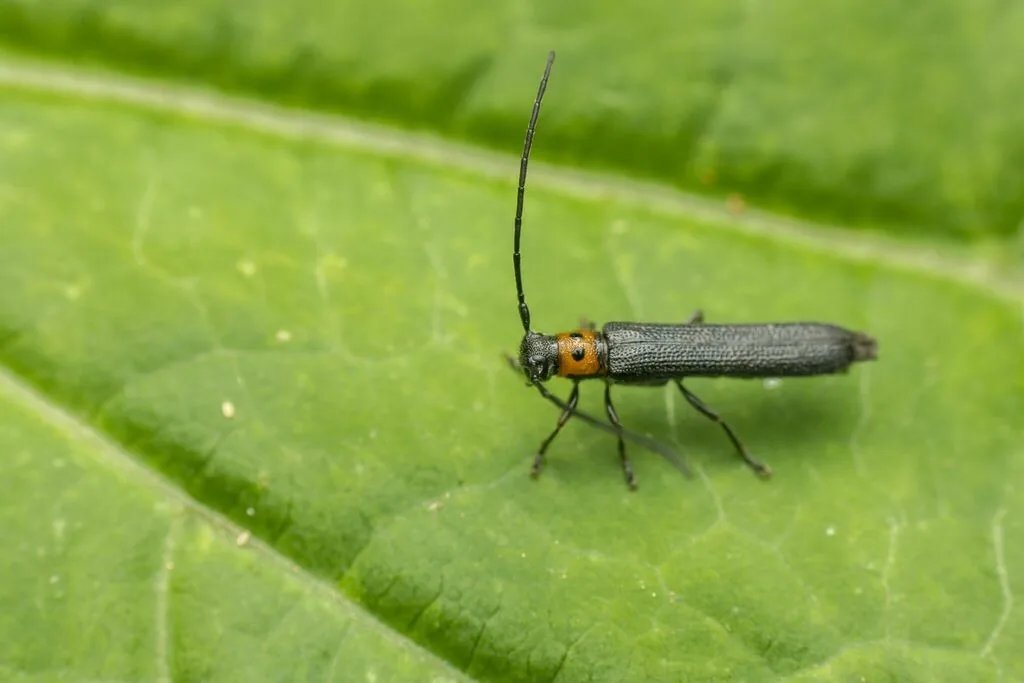
- The adult is a slender, black long-horned beetle about 1/2 inch long with a yellow-orange thorax bearing two or three black dots.[1]
- Damage is easy to recognize: two rings of punctures about 1/2 inch apart, 4 to 6 inches below the growing tip.[1]
- The larva is white, legless and cylindrical, reaching nearly 3/4 inch.[1]
Look-alikes
| Look-alike | How to tell them apart |
|---|---|
| Rednecked cane borer | A smaller metallic beetle with a coppery-red neck whose larvae make swollen galls on canes rather than girdling rings.[1] |
Where it lives
UK Extension covers it as a pest of blackberries, raspberries and roses.[1]
Biology and life cycle
Adults appear about June, puncture the two rings and lay an egg between them; eggs hatch in July.[1]
The larva bores toward the cane base, overwinters, keeps burrowing to ground level the second season, and emerges as an adult the next spring.[1]
Damage and signs
- The girdles make the tip wilt, and as the larva burrows to the base the whole cane can die before the fruit matures.[1]
Health risk
It feeds on plants; UK Extension mentions no risk to people.[1]
Control
Sanitation
Prune out infested canes a few inches below the puncture rings or below the larval tunnel.[1]
Traps and physical control
Check plantings weekly in June and July for wilting tips with the two rings of punctures.[1]
Common questions
Sources
- University of Kentucky Entomology (ENTFACT), “Rednecked and Raspberry Cane Borers (ENTFACT-209).” entomology.mgcafe.uky.edu/ef209 (accessed 2026-10-06)
- iNaturalist, “Oberea perspicillata taxon page (order and family).” www.inaturalist.org/taxa/226082 (accessed 2026-10-06)