How to identify it
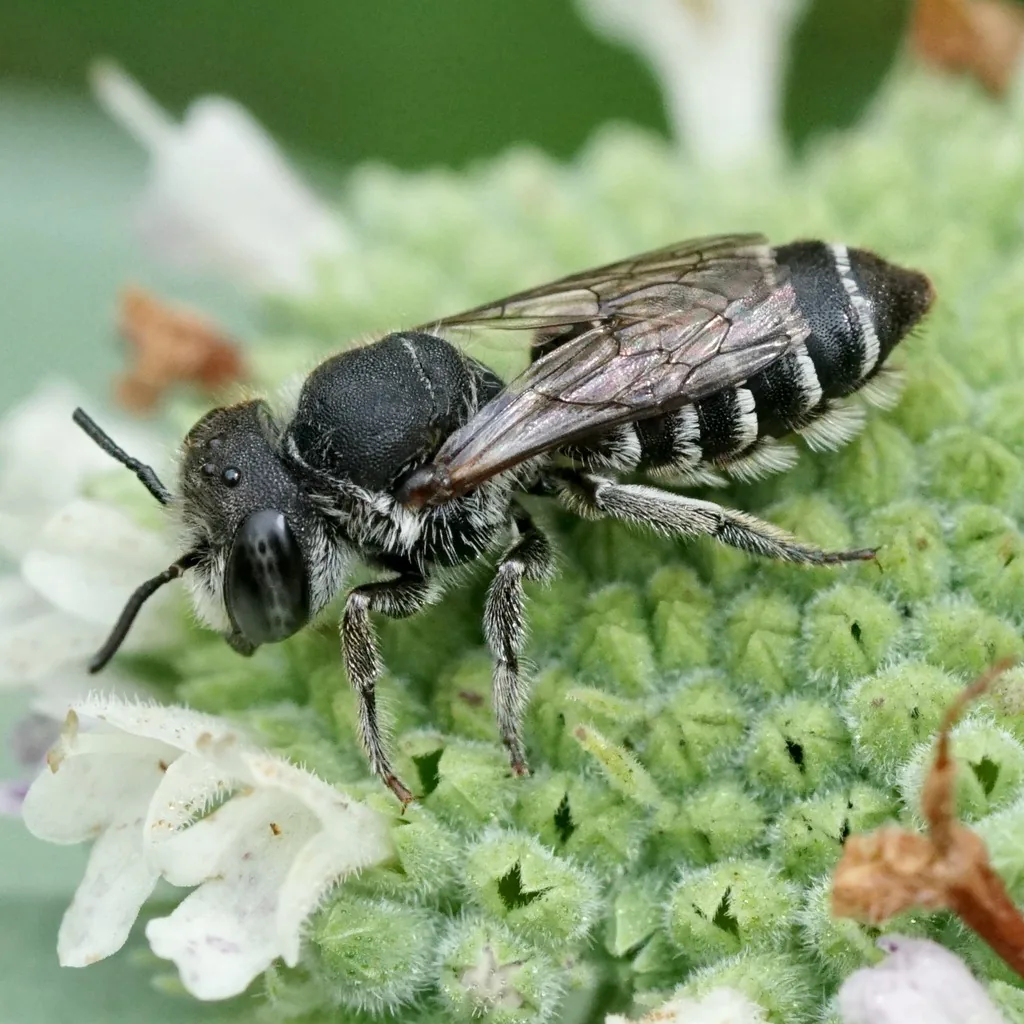
- Adults are stout, very hairy, gray to black bees with pale hair bands across the abdomen, up to about 1/2 inch long.[1][3]
- Females carry pollen on dense hairs under the abdomen, which then looks light yellow to gold.[1][2]
- The sign you're most likely to notice is circular or semicircular notches about 1/4 to 1/2 inch across, cut from leaf or petal edges.[2][1]
Look-alikes
| Look-alike | How to tell them apart |
|---|---|
| Honey bee | Honey bees carry pollen on their hind legs; leafcutter bees carry it on the underside of the abdomen.[1] |
| Mason bees | Mason bees in the related genus Osmia are mostly metallic blue or green and line nests with chewed leaf pulp, mud or sand.[1] |
Where it lives
Leafcutter bees are common in North America; California has at least 75 Megachile species and Florida about 63 leafcutting bee species.[2][1]
Biology and life cycle
Females nest in holes in wood, hollow stems and other cavities, making a row of leaf-lined cells.[1][2]
Each cell gets a ball of pollen and nectar and one egg; the larva eats the food and spins a cocoon.[1][2]
Most have one generation a year, and adults are active in spring and early summer.[1]
They're solitary bees and don't defend nests the way honey bees or bumble bees do.[2]
Damage and signs
Health risk
They sting only if handled, and UF describes the sting as far less painful than a honey bee's.[2]
Control
Prevention
Insecticides usually don't stop the cutting, because the bees don't eat the leaves, and these pollinators shouldn't be killed.[2][1]
Keep them out
Seal pruned rose cane ends with wax or a few drops of white glue, and fill holes 1/8 to 7/8 inch wide in soft wood.[1]
Traps and physical control
Cover a favorite small plant with cheesecloth or screening when cutting starts, and remove it by about midsummer.[1][2]
Common questions
- What's cutting perfect circles out of my rose leaves?
- Almost certainly leafcutter bees. They carry the pieces off to build nest cells and don't feed on the leaves.[1][2]
- Should I spray them?
- No. Sprays rarely stop the cutting, the damage is cosmetic, and the bees are valuable pollinators.[2][3]
- Do leafcutter bees sting?
- Only when handled, and the sting is much milder than a honey bee's.[2]
Sources
- University of California Statewide IPM Program, “Leafcutting bees (Pest Notes for home and landscape).” ipm.ucanr.edu/PMG/GARDEN/PLANTS/INVERT/leafcutbes.html (accessed 2026-10-06)
- University of Florida IFAS Extension, “Leafcutting Bees, Megachilidae (EENY-342).” edis.ifas.ufl.edu/publication/IN619 (accessed 2026-10-06)
- University of Minnesota Extension, “Leaf-cutter bees (What insect is this?).” apps.extension.umn.edu/garden/diagnose/insect/garden/flies/medium/leafcutterbee.html (accessed 2026-10-06)
- iNaturalist, “Megachile taxon page (order and family).” www.inaturalist.org/taxa/52784 (accessed 2026-10-06)