On this page
How to identify it
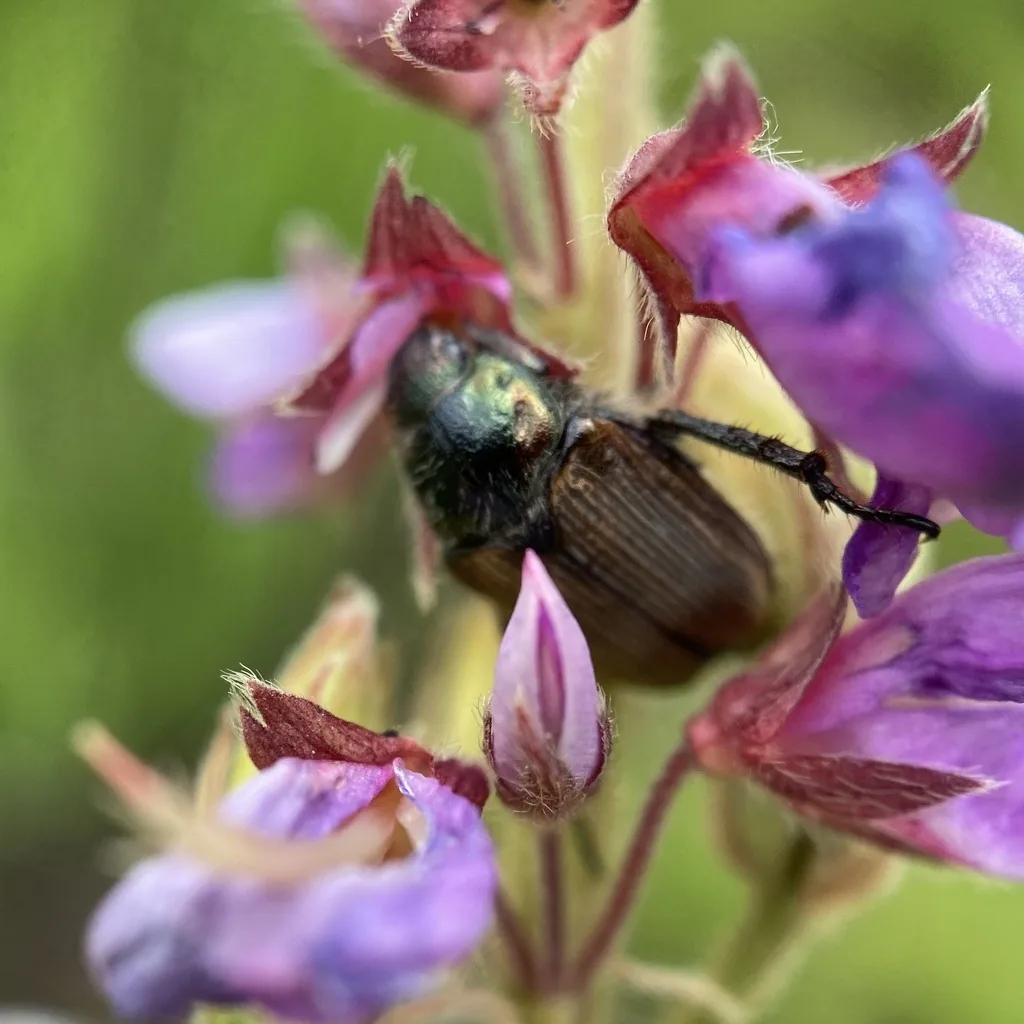
- Adults are about 3/8 to 1/2 inch long, slightly hairy, with a dull metallic green to greenish-black head and thorax and copper-brown to brownish-yellow wing covers.[1][2]
- Unlike the Japanese beetle, it lacks the tufts of white hairs along the sides of the abdomen.[1][2]
- The larvae are typical C-shaped white grubs in the soil.[1]
Look-alikes
| Look-alike | How to tell them apart |
|---|---|
| Japanese beetle | Very similar, but the Japanese beetle has white hair tufts along its sides and appears about a month later.[1][2] |
| Rose chafer | Another sandy-soil beetle that feeds on rose blossoms.[2] |
Where it lives
Found in sandy-soil areas from the Southeast north to Minnesota.[1][2]
Biology and life cycle
It overwinters as a grub about 7 inches deep in the soil and pupates in spring in an earthen cell.[1]
Adults emerge in mid-May to early June in Virginia and late June or early July in Minnesota, feed for a few weeks and live about 17 days on average.[1][2]
Damage and signs
Health risk
Control
Prevention
Avoid spraying or dusting flowers for this beetle because it harms pollinators.[1]
Keep them out
Protect prized blooms with light netting.[1]
Biological control
A parasitic nematode, Steinernema glaseri, infects the grubs.[1]
Common questions
Sources
- NC State Extension, “Spring Rose Beetle (PDIC Factsheet).” content.ces.ncsu.edu/spring-rose-beetle (accessed 2026-10-16)
- University of Minnesota Extension (What insect is this? diagnostic pages), “False Japanese beetle.” apps.extension.umn.edu/garden/diagnose/insect/garden/beetles/medium/fjapbeetle.html (accessed 2026-10-16)
- iNaturalist, “Strigoderma arbicola taxon page (order and family).” www.inaturalist.org/taxa/359532 (accessed 2026-10-06)