The short answer
- Confirm it first. Check leaf undersides for the insects and their pale cast skins: spider mites, thrips, lace bugs and plant bugs leave similar pale spotting.[1]
- If you only see light stippling on ornamentals, roses or vines, you can usually leave them alone. UC IPM says leafhoppers rarely threaten plant survival, and grapevines tolerate fairly high numbers.[1][13]
- Protect young beans, potatoes and eggplant from potato leafhopper, which can cut yield before damage shows. Row cover protects young eggplant and delays it on snap beans until flowering, when they are less susceptible.[4][3]
- Against curly top and aster yellows, keep the insect off the plant: row cover or fine netting while plants are young, some shade for tomatoes and peppers in the West, weed control, and pull out infected plants. Insecticides generally don't prevent these diseases.[6][8][9][1]
- If nymphs are abundant early in the season, thoroughly spraying shoots and leaf undersides with insecticidal soap, horticultural oil or neem oil gives some control.[1][13]
Leafhoppers on our site
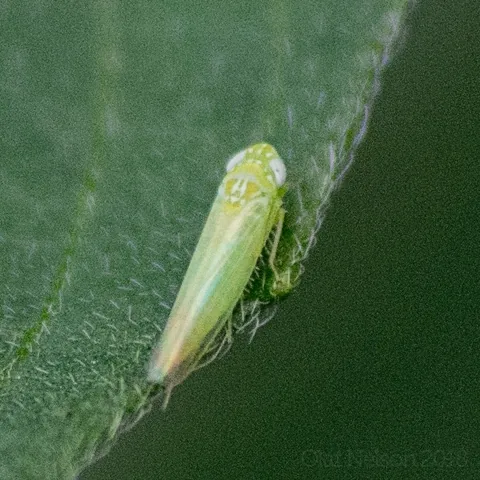 Leafhoppers
Empoasca fabae
Leafhoppers are small, wedge-shaped sap feeders found on flowers, vegetables, fruit and woody ornamentals. Most just speckle leaves and need no control, but a few, like the potato leafhopper, injure crops or spread plant diseases.
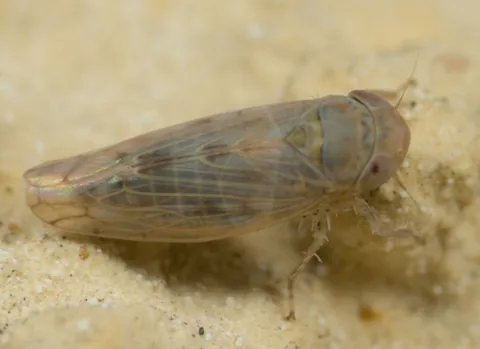 Beet leafhopper
Neoaliturus tenellus (formerly Circulifer tenellus)
The beet leafhopper is a small, pale, wedge-shaped leafhopper whose feeding spreads curly top virus, which leaves tomatoes, peppers, beets and beans curled, yellowed and stunted. It is the only insect known to carry the virus, and an infected leafhopper can pass it on within minutes of feeding.
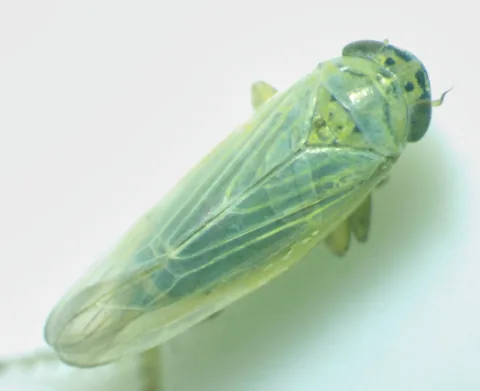 Aster Leafhopper
Macrosteles quadrilineatus
The aster leafhopper, also called the sixspotted leafhopper, is a small leafhopper whose own feeding does little harm but which is the main carrier of aster yellows, a plant disease caused by a phytoplasma (Candidatus Phytoplasma asteris).
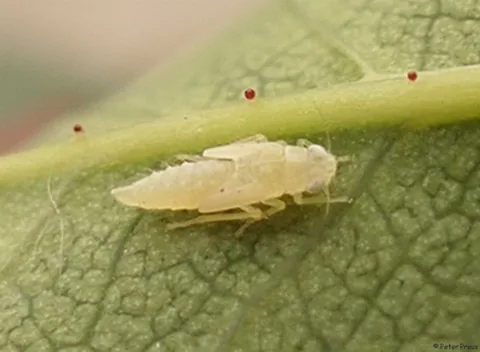 Rose Leafhopper
Edwardsiana rosae
The rose leafhopper is a small, pale, whitish-green leafhopper from Europe. It lays its overwintering eggs in rose and bramble canes, breeds on roses in spring and spends the summer on apple, dogwood, oak, maple and other trees, where its feeding leaves pale stippling on the leaves.
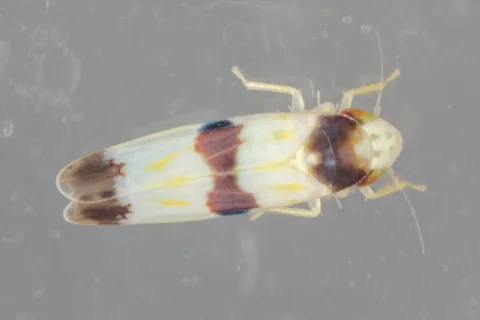 Grape leafhoppers
Erythroneura species (eastern grape leafhopper E. comes, threebanded leafhopper E. tricincta and relatives)
Grape leafhoppers are tiny, active insects that feed on the undersides of grape leaves, emptying leaf cells and leaving pale stippled spots. Heavy feeding turns whole leaves pale and can make them drop early.
No photo yet
White apple leafhopper
Zonocyba pomaria (long known as Typhlocyba pomaria)
The white apple leafhopper is the most common leafhopper on apple and other tree fruits; its nymphs feed under the leaves, leaving white speckling on top, and their excrement can spot the fruit.
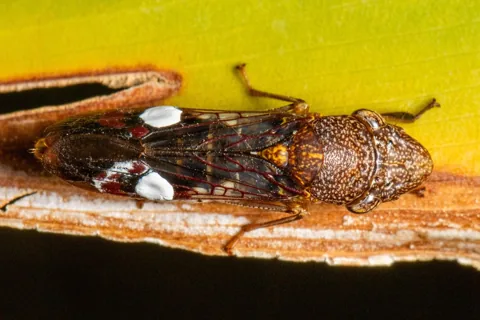 Glassy-winged Sharpshooter
Homalodisca vitripennis (formerly H. coagulata)
The glassy-winged sharpshooter itself rarely causes much feeding damage. The problem is that it spreads Xylella fastidiosa, the bacterium behind Pierce's disease of grape, oleander leaf scorch and other plant diseases that can't be cured.
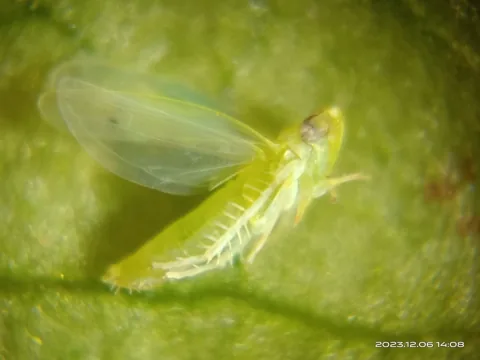 Two-Spotted Cotton Leafhopper
Amrasca biguttula
The two-spotted cotton leafhopper is an Asian leafhopper first found on the US mainland in Florida in December 2024; it injures cotton, okra, eggplant, hibiscus and other plants.
Is it leafhoppers?
Adult leafhoppers are long for their width and wedge-shaped. UC IPM says they are commonly less than 1/4 inch long, with larger kinds called sharpshooters reaching about 1/2 inch; Missouri's Department of Conservation puts most species under about 1/2 inch, with a few reaching 1 1/4 inches. They come in brown, gray, green, yellow or mottled colors, and some are brightly striped. Adults and nymphs walk quickly sideways or jump when disturbed, and you usually find them, along with their pale cast skins, on leaf undersides or green shoots.[1][2]
The sure sign is on the hind legs: leafhoppers have one or more long rows of small spines along the hind leg. Spittlebugs have only one or two stout spines there, and their young live in bubbly froth on stems. Treehoppers have a shield behind the head that extends back over the body, often shaped like a thorn. Planthoppers often have angled or pointed heads with antennae set below the eyes.[1][2]
Nymphs look like small wingless adults, though their color may differ. Missouri's Department of Conservation notes that some females carry a white patch or line on the wings made of waxy granules they use when laying eggs; it isn't a body color, so don't use it to identify the species.[1][2]
Pale specks on leaves have other causes too. Lace bugs, plant bugs, spider mites and thrips all bleach or spot leaves, so look for the insects themselves on the underside before treating.[1]
Three kinds of damage: stippling, hopperburn and disease
Stippling. Most leafhoppers suck out leaf cells and leave pale specks. Heavily fed leaves and shoot tips may turn yellow, then brown, curl and die. Leafhoppers also excrete honeydew, on which black sooty mold grows on leaves, fruit and anything underneath. On grapes, the small dark spots of excrement and sooty mold on berries matter most for table grapes.[1][13]
Hopperburn. Potato leafhopper does more than drain sap: its saliva is toxic and plugs the plant's food-conducting tissue. Leaf veins pale and leaves curl, then a triangle of yellow or brown forms at the leaf tip and spreads inward from the edges until whole leaves die. Symptoms develop fastest in hot, dry weather. On eggplant it usually stops at yellowing and curled margins, but potato and pea leaves can turn brown and brittle. It is easy to mistake for disease, and the plant may have been fed on for weeks before it shows.[3][4]
Disease. A few leafhoppers carry plant pathogens. The beet leafhopper spreads curly top virus to beans, beets, melons, peppers, potatoes, tomatoes and many other plants. The aster leafhopper and some others spread aster yellows, which in California damages carrots, celery, lettuce, potatoes and many herbaceous ornamentals. Sharpshooters, including the glassy-winged sharpshooter, carry the bacterium Xylella fastidiosa, which causes Pierce's disease of grape and leaf scorch in oleander, almond and other hosts.[1][8][9]
When to leave leafhoppers alone
In most gardens and landscapes leafhoppers are an annoyance or a curiosity. UC IPM says they don't threaten plant survival in most situations and generally need no control.[1]
Grapevines are a good example. UC IPM says leafhoppers infest most California vineyards but vines tolerate fairly high numbers, and predators and parasites often hold them below damaging levels. Its commercial guidelines say treating the first generation isn't necessary at 20 or fewer nymphs per leaf (table grapes, which need cleaner fruit, have lower limits), and vigorous vines support more.[13]
Rose leafhopper leaves yellow feeding spots on rose leaves, and Penn State calls it a minor pest on apples. UMass notes one real risk on roses: feeding can let canker fungi into the canes, which may kill them.[12][11]
Sprays won't stop the diseases leafhoppers spread, so finding a few leafhoppers on plants with curly top or aster yellows isn't by itself a reason to spray. UC IPM says insecticides in gardens and landscapes generally don't prevent leafhopper-borne diseases, because the insect passes on the pathogen before the spray kills it.[1][9]
Potato leafhopper on beans, potatoes and eggplant
Potato leafhopper is the one that causes hopperburn. The adult is bright to light yellow-green and wedge-shaped, widest at the head, with six white spots usually visible along the front edge of the thorax. Sources differ on size: the University of Wisconsin says 1/8 inch long and UMass about 1/4 inch. Nymphs are smaller and wingless, pale green to yellow in the University of Wisconsin's description and bright green in UMass's, and run sideways like crabs on leaf undersides. When you shake the plant, adults fly up like tiny green sparks.[3][4]
It doesn't survive northern winters. It winters in the southern United States and rides storm winds north each spring, arriving in Wisconsin in mid to late May and in New England from early to mid-June. Females lay eggs in stems and large leaf veins, nymphs hatch after 7 to 10 days, and there are two or more generations until frost. Numbers can jump overnight in June and early July when nearby alfalfa is cut and the adults move into gardens.[3][4]
Its host list is long, from beans, potatoes, eggplant, rhubarb, strawberry and dahlia to raspberries, apples and many bedding plants, and weeds such as smartweed and pigweed carry it too. Damage is worst on early and red potato varieties, young snap beans (especially before flowering), eggplant and raspberries. UMass notes that potato yield drops even before symptoms are obvious.[3][4]
- Check: look at the undersides of lower and middle leaves for nymphs, and shake plants to see how many adults fly up. Nymphs mean the population has settled in.[4][3]
- Potatoes: UMass treats at 1 adult per sweep of a net (about one adult per plant when you shake the foliage) or 15 nymphs per 30 leaves.[4]
- Beans: 2 adults per row foot on seedlings; 5 adults per row foot or 1 nymph per leaflet from the third-leaf stage to bud.[4]
- Eggplant: 1.5 adults or large nymphs per leaf.[4]
- Cultural help: don't put sensitive crops next to alfalfa, keep plants watered and fed so they withstand feeding, and control weeds. Long-season potato varieties hold up better, and the University of Wisconsin notes that hairier-leaved varieties seem less attractive and that Blue Lake snap beans are more susceptible than Tendercrop lines.[3][4]
Beet leafhopper and curly top on tomatoes and peppers
The beet leafhopper is a small (about 3 mm) pale green, gray or tan leafhopper adapted to desert conditions. It is the only insect that carries beet curly top virus, a disease of semiarid western North America from Canada to Mexico that infects over 300 plant species, among them tomatoes, peppers, beans, potatoes, spinach, beets, Swiss chard, squash, melons and cucumbers. New Mexico State says the disease is particularly troublesome in home gardens.[5][7][8][6]
Tomato and pepper leaves turn thick and stiff and roll upward while the leaf stalks curl down; the plant yellows, veins turn purple, and growth is stunted. Young plants usually die. Plants infected later survive but stay small, and the fruit ripens early, dull and wrinkled, sometimes beside normal fruit on the same stem. Symptoms show about 7 to 14 days after infection in a tomato, says Utah State; New Mexico State says as early as 24 hours in summer heat, 12 to 14 days at average temperatures and up to 30 days in cool weather.[8][6]
The insect winters on weeds in uncultivated land, such as Russian thistle, kochia, and mustards like London rocket and flixweed. When those dry out in spring or early summer, leafhoppers move into gardens. Tomato isn't a preferred host, but the insects stay long enough to infect it. NMSU and Utah State say feeding for one minute is enough and an infected leafhopper can transmit for the rest of its life; the University of Idaho says the insect must wait four hours after picking up the virus, then stays infective for more than three months and transmits in a few minutes of feeding.[6][8][7][5]
Infected plants can't be cured; pull them out. Because the leafhopper flies in from wild land and transmits so fast, insecticides in the garden are of limited help, and treating the surrounding rangeland is costly and not recommended in most situations.[6][5][8]
- Shade: leafhoppers prefer to feed in sun. NMSU suggests planting tomatoes and peppers in a slightly shaded part of the garden, and Utah State says shade cloth over tomato plants may help.[8][6]
- Cover: a row cover over young plants with the sides and ends buried keeps the leafhoppers off until the vines outgrow it, which can be hard in windy areas. NMSU suggests a netted cage over young plants, with holes small enough to block the insects and the netting not touching the leaves.[6][8][5]
- Plant extra: Utah State suggests planting more densely than normal, or two plants where one would go, so the odds that leafhoppers reach every plant drop; infected plants die out and the healthy ones fill the space.[5][6]
- Weeds: keep weeds and volunteer plants down in and around the garden; they host both the insect and the virus.[5][8]
- Varieties: a Utah State vegetable guide says the resistant-labeled tomatoes 'Rowpac', 'Roza', 'Salad Master' and 'Colombian' did well in trials in St. George, but another Utah State sheet reports curly top symptoms on Row Pac and Columbian, and NMSU says true resistance isn't known. Growing several varieties may help, since some may be somewhat tolerant.[5][6][8]
Aster leafhopper and aster yellows
Aster yellows is caused by a phytoplasma, a pathogen that lives only inside plants and inside the aster leafhopper that carries it. Infected plants yellow and stunt, grow many thin stems close together (a witches' broom), and make small, malformed flowers that often stay green. Leaves may turn yellow, white, or red to purple. Carrot roots become thin, hairy and bitter.[9][10]
The aster leafhopper is gray to green with six dark spots on top of the head. Minnesota says most of the population winters in southern states and moves north, and only a small share of the insects carry the pathogen. After feeding on an infected plant it can't pass the pathogen on right away: at least two weeks, says Minnesota, or up to 18 days according to Utah State. After that it infects plants whenever it feeds, for the rest of its life.[9][10]
- Remove infected plants. There is no cure, and leaving them gives leafhoppers a source. The pathogen dies with the plant, so Minnesota says you can bury infected plants in a compost pile or in the ground, fully covered so insects can't feed on them.[9][10]
- Remove perennial weeds, which can carry the pathogen from one season to the next.[9][10]
- Use light-colored or reflective mulch, which disorients aster leafhoppers and cuts feeding.[9]
- Cover the crop. Floating row cover kept on for the entire season prevents leafhoppers from reaching the crop; Minnesota suggests this for protecting a seed crop.[9]
- Minnesota says leafhoppers are quick and sturdy, insecticides are hard to use well against them, and few effective products are available to home gardeners.[9]
Rose and grape leafhoppers
Rose leafhopper came from Europe and feeds on roses, brambles, apples and several woody plants. Females lay eggs in rose, raspberry and blackberry canes in fall, and the egg sites show as dark, raised or purple spots. UMass says at least three generations a year are possible. Look for nymphs on roses in spring and adults by May.[11][12]
If you see many egg spots on a cane, UMass suggests cutting out and destroying that cane before the eggs hatch in spring, as long as it doesn't disfigure the plant. A tiny wasp, Anagrus armatus, parasitizes the eggs, and past reports suggest it can bring numbers down so far that nothing else is needed. Lacewings prey on them, and jumping spiders and running crab spiders fed on them in laboratory tests.[11]
On grapes, UC IPM says removing basal leaves or side shoots during berry set and the two weeks after, before the first-generation adults appear, usually cuts peak leafhopper numbers by 30 to 50%. Removing weeds around the vines before budbreak also helps. Anagrus wasps parasitize grape leafhopper eggs, which turn red or brown instead of staying clear.[13][1]
Row covers, cages and reflective mulch
Since sprays don't stop curly top or aster yellows, keeping the insects from feeding at all is the main defense against them. Covers also protect young beans and eggplant from potato leafhopper.[1][6][9][4]
UMass uses row cover on snap beans until flowering, when the plants become less susceptible, and recommends it on young eggplant, where it also keeps out flea beetles and Colorado potato beetle. Utah State buries the sides and ends of row cover over young tomatoes to keep beet leafhoppers out. Minnesota says leaving it on for the entire season prevents aster yellows.[4][6][9]
Light-colored or reflective mulch disorients aster leafhoppers, and Minnesota says light reflecting off the plastic of low or high tunnels has the same effect.[9]
Soaps, oils, neem and pyrethrin
Aim at the nymphs. They can't fly, they sit on leaf undersides and green shoots, and they are easiest to hit while small. UC IPM says if nymphs are abundant early in the growing season, a thorough spray of insecticidal soap, horticultural oil or neem oil on green shoots and leaf undersides gives some control; for grapes, it lists oils, neem, soap, pyrethrins and kaolin clay as giving partial control when nymphs are small. Soap can spot table grapes, so use it only before bloom on them.[1][13]
UMass says pyrethrin has proven the most effective organic option against potato leafhopper. It works only on contact, so cover leaf undersides well; it breaks down quickly in sunlight, and spraying late in the day or evening may work better than early morning. Products with azadirachtin, from neem, have also shown effect, especially in fruit, and can be rotated with pyrethrin.[4]
Conventional insecticides, including neonicotinoids, carbamates, pyrethroids and organophosphates, are registered against potato leafhopper on potato, eggplant and beans, and the University of Wisconsin calls chemical control the most effective option for that species. Many of them are highly toxic to bees. Use only products whose label lists the crop and leafhoppers, avoid drift onto flowering plants, and on roses spray after bloom.[4][3][11]
Remember that none of these prevent curly top or aster yellows reliably. Minnesota notes some infection still occurs even with insecticides.[9][1]
Natural enemies
Assassin bugs, brown and green lacewings, damsel bugs, lady beetles, minute pirate bugs and spiders all eat leafhoppers, and tiny Anagrus wasps that develop inside leafhopper eggs are important on grapes and roses. Avoiding broad-spectrum sprays helps keep them working.[1][13][11]
They don't control every species. The University of Wisconsin says several predators, fungi and parasites attack potato leafhopper but none has been shown to control it. Utah State says few natural enemies of the beet leafhopper are known. UC IPM adds that releasing lacewings against grape leafhoppers has not given control in university field trials.[3][5][13]
Common questions
- What do leafhoppers look like?
- Small, wedge-shaped insects, most under 1/4 inch, in green, yellow, brown, gray or bright stripes, that walk sideways or jump when disturbed. Rows of small spines along the hind legs set them apart from similar hoppers.[1][2]
- What is hopperburn?
- Yellow to brown, triangle-shaped burning at leaf tips and margins caused by potato leafhopper's toxic saliva. Leaves curl and can die, and it is easily mistaken for disease.[3][4]
- Do I need to spray leafhoppers?
- Usually not. UC IPM says most garden and landscape leafhoppers need no control. Exceptions are potato leafhopper on young beans, potatoes and eggplant, and the leafhoppers that spread curly top and aster yellows, where barriers and removing infected plants matter more than sprays.[1][4][6][9]
- Does insecticidal soap kill leafhoppers?
- It gives some control of nymphs when sprayed thoroughly on leaf undersides and shoots early in the season. It has to hit them, and it won't stop virus spread.[1][13]
- How do I protect tomatoes from curly top?
- Cover young plants with row cover or a fine netted cage, give them some shade, control weeds, plant extra and pull out infected plants. There is no cure once a plant is infected.[6][8][5]
- Can a plant recover from aster yellows?
- No. Remove and destroy infected plants and control perennial weeds that harbor the pathogen.[9][10]
Photo credits
- Leafhoppers: (c) moxostoma, some rights reserved (CC BY) — via iNaturalist, CC BY 4.0
- Beet leafhopper: Jesse Rorabaugh, public domain (CC0), via iNaturalist
- Aster Leafhopper: Ken Kneidel, public domain (CC0), via iNaturalist
- Rose Leafhopper: (c) Peter Preus, some rights reserved (CC BY) — via iNaturalist, CC BY 4.0
- Grape leafhoppers: (c) Victor Engel, some rights reserved (CC BY) — via iNaturalist, CC BY 4.0
- Glassy-winged Sharpshooter: (c) cesar stastny, some rights reserved (CC BY) — via iNaturalist, CC BY 4.0
- Two-Spotted Cotton Leafhopper: 余世文, public domain (CC0), via iNaturalist
Sources
- University of California Statewide IPM Program, “Leafhoppers (Home and Landscape).” ipm.ucanr.edu/home-and-landscape/leafhoppers/ (accessed 2026-11-10)
- Missouri Department of Conservation, “Leafhoppers (Field Guide).” mdc.mo.gov/discover-nature/field-guide/leafhoppers (accessed 2026-11-10)
- University of Wisconsin-Madison Division of Extension, Wisconsin Horticulture, “Potato Leafhopper.” hort.extension.wisc.edu/articles/potato-leafhopper/ (accessed 2026-11-10)
- UMass Amherst Center for Agriculture, Food, and the Environment, “Potato Leafhopper (Vegetable fact sheet).” www.umass.edu/agriculture-food-environment/vegetable/fact-sheets/potato-leafhopper (accessed 2026-11-10)
- Utah State University Extension, “Beet Leafhopper (Vegetable Guide: tomato, pepper, eggplant).” extension.usu.edu/vegetableguide/tomato-pepper-eggplant/beet-leafhopper (accessed 2026-11-10)
- Utah State University Extension, “Curly Top Virus in Tomato.” extension.usu.edu/planthealth/research/curly-top-tomato (accessed 2026-11-10)
- University of Idaho Extension, “Beet curly top virus.” www.uidaho.edu/extension/food/ipm/ag-pests/beet-curly-top (accessed 2026-11-10)
- New Mexico State University College of ACES, “Curly Top Virus (Guide H-106).” pubs.nmsu.edu/_h/H106/ (accessed 2026-11-10)
- University of Minnesota Extension, “Aster yellows.” extension.umn.edu/plant-diseases/aster-yellows (accessed 2026-11-10)
- Utah State University Extension, “Aster Leafhopper.” extension.usu.edu/planthealth/ipm/notes_ag/veg-aster-leafhopper.php (accessed 2026-11-10)
- UMass Amherst Center for Agriculture, Food, and the Environment, “Edwardsiana rosae (rose leafhopper), Insect and Mite Guide.” www.umass.edu/agriculture-food-environment/landscape/publications-resources/insect-mite-guide/edwardsiana-rosae-l (accessed 2026-11-10)
- Penn State Extension, “Tree Fruit Insect Pest: Rose Leafhopper.” extension.psu.edu/tree-fruit-insect-pest-rose-leafhopper (accessed 2026-11-10)
- University of California Statewide IPM Program, “Leafhoppers (Grape Pest Management Guidelines).” ipm.ucanr.edu/agriculture/grape/leafhoppers/ (accessed 2026-11-10)