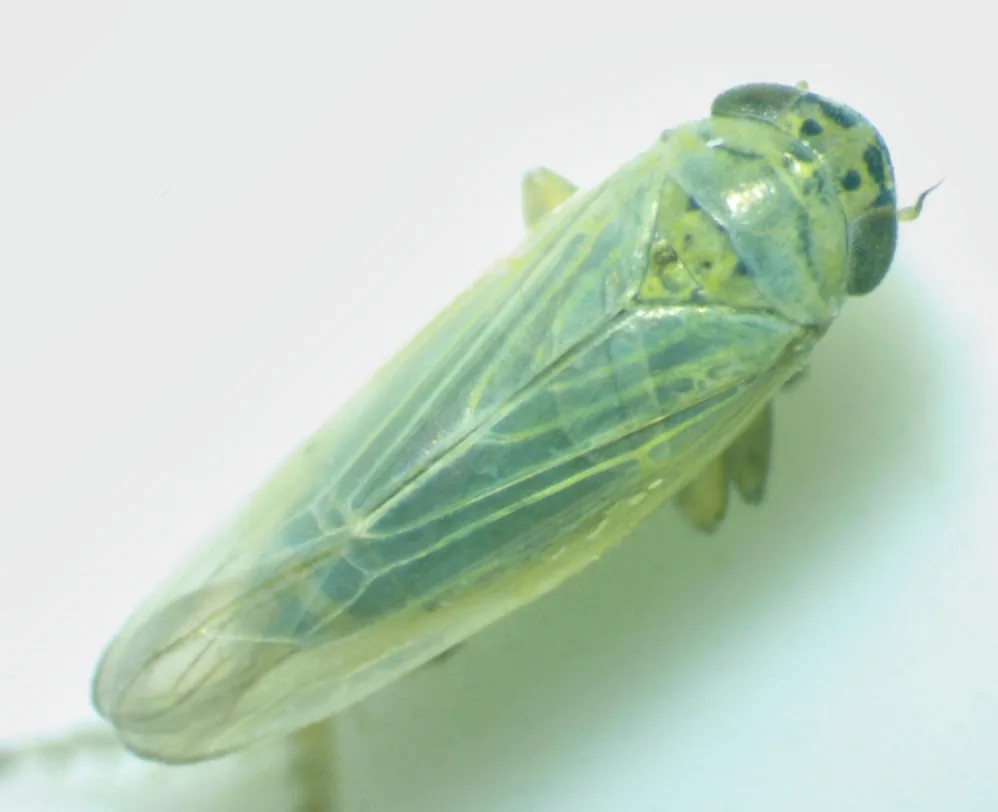
How to identify it
Look-alikes
| Look-alike | How to tell them apart |
|---|---|
| Other leafhoppers | Look for the six black spots arranged in three rows on the head.[1] |
Where it lives
The PNW Insect Management Handbook covers it on carrots and other vegetables in the Pacific Northwest.[1]
Biology and life cycle
It overwinters as eggs in the north and as adults in warmer areas.[1]
Each generation takes 27 to 34 days through five nymph stages, with three to four generations a year.[1]
Damage and signs
Health risk
It feeds on plants; the PNW Insect Management Handbook mentions no risk to people.[1]
Control
Prevention
Yellow sticky traps help detect leafhoppers.[1]
Keep them out
Row covers protect valuable crops, and aluminum foil or straw mulches can reduce aster yellows.[1]
Sanitation
Destroy weeds known to harbor aster yellows.[1]
Pesticides
Home-use options listed include insecticidal soap, neem oil, pyrethrins and spinosad, among others.[1]
Common questions
Sources
- Pacific Northwest Pest Management Handbooks (OSU, WSU, University of Idaho), “Carrot: Sixspotted leafhopper (Insect Management Handbook).” pnwhandbooks.org/insect/vegetable/vegetable-pests/hosts-pests/carrot-sixspotted-leafhopper (accessed 2026-10-06)
- iNaturalist, “Macrosteles quadrilineatus taxon page (order and family).” www.inaturalist.org/taxa/224357 (accessed 2026-10-06)