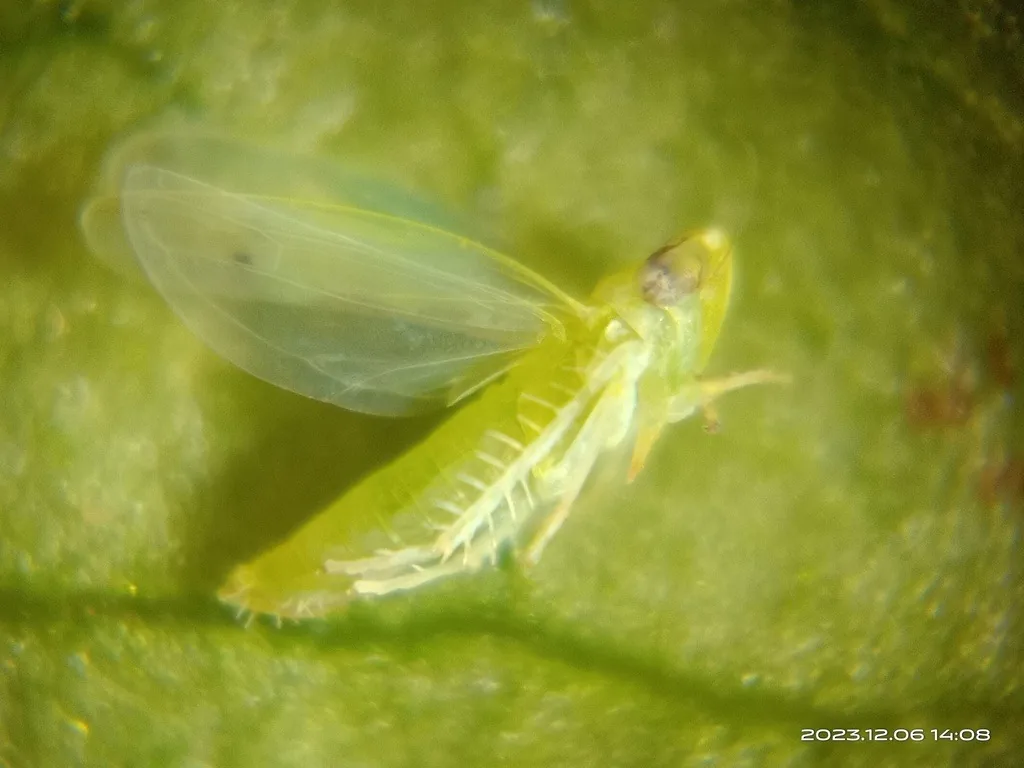
How to identify it
Look-alikes
| Look-alike | How to tell them apart |
|---|---|
| Potato leafhopper | About the same size; check for the two dark wing spots and have the ID confirmed by your Extension office.[1] |
Where it lives
By August 2025 it was confirmed in 101 counties in Florida, Georgia, South Carolina and Alabama, with more finds in Texas, Louisiana, Mississippi, North Carolina and Tennessee.[1]
Biology and life cycle
It's native to Asia from Iran to Japan and invasive in Africa; the first US record came from Puerto Rico in 2023.[1]
Up to 11 generations a year are possible, with egg to adult taking 15 to 46 days depending on temperature and humidity.[1]
Females insert eggs into the leaf midrib, about 20 to 25 a season, and adults live two to three weeks.[1]
Hosts that support full development include cotton, okra, eggplant, cucumber, watermelon, potato, sunflower, grape and tropical hibiscus.[1]
Storms carry adults long distances, and shipments of ornamentals and vegetable transplants spread it too.[1]
Damage and signs
- Leaves yellow along the margins first, then brown and die in patches; they may curl and distort, and plants lose vigor.[1]
Health risk
It feeds on plants; Penn State Extension mentions no risk to people.[1]
Control
Prevention
Buy plants from reputable nurseries and inspect new plants, including leaf undersides, before bringing them home.[1]
Yellow sticky cards, about one per 1,000 square feet, help detect adults.[1]
Biological control
Commercially available green lacewings and minute pirate bugs may help suppress it.[1]
Pesticides
In University of Florida lab tests on adults, tolfenpyrad, flonicamid, acephate, imidacloprid, bifenthrin and neem oil were among products showing activity; these were not field trials.[1]
When to call a professional
In Pennsylvania, report suspected finds to Penn State Extension or the state Department of Agriculture at badbug@pa.gov.[1]
Common questions
- What damage does the two-spotted cotton leafhopper cause?
- Yellowing along leaf margins, then browning and dead patches, curled and distorted leaves, and weaker plants.[1]
- How do I tell it from other small green leafhoppers?
- Look for two distinct dark spots on the wings, and have the ID confirmed by your Extension office.[1]
Sources
- Penn State Extension, “Invasive Insect: Two-Spotted Cotton Leafhopper.” extension.psu.edu/invasive-insect-two-spotted-cotton-leafhopper (accessed 2026-10-06)
- iNaturalist, “Amrasca biguttula taxon page (order and family).” www.inaturalist.org/taxa/737379 (accessed 2026-10-06)