On this page
How to identify it
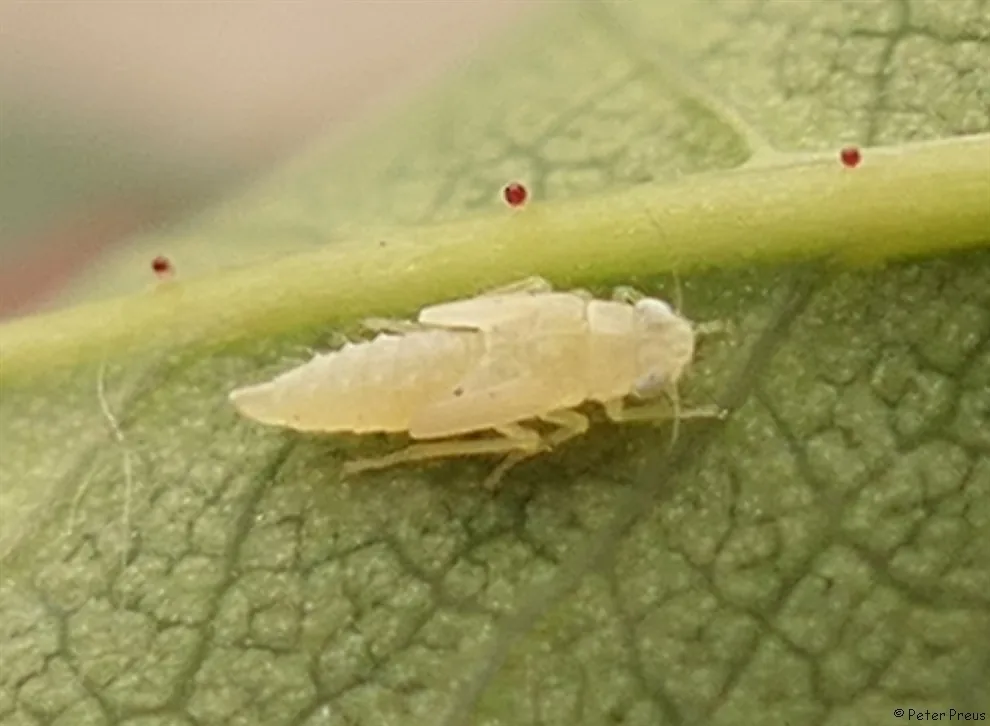
- Young nymphs are white with red eyes; the red is gone by the fourth instar.[1]
- Nymphs carry small black spots on the thorax and wing pads, which separate them from the similar white apple leafhopper.[2]
- Adults look so much like the white apple leafhopper that they cannot be told apart in the field.[1][2]
Look-alikes
Where it lives
A European leafhopper now found on rose-family plants throughout the United States and southern Canada.[1]
Biology and life cycle
Eggs laid in rose and bramble canes in fall hatch in spring, and the first generation develops on rose; egg sites show as dark, raised or purplish spots.[1][2]
There are about three generations a year; first-generation adults move to apple and other trees in early June, and adults appear again in August.[1][2]
Summer generations lay eggs in the undersides of leaves of apple, cherry, dogwood, elm, hawthorn, maple, oak and poplar.[1]
Damage and signs
Health risk
Control
Sanitation
Removing wild roses, the fall egg-laying sites, near apple trees may reduce local numbers.[1][2]
Traps and physical control
If rose canes carry many egg spots, prune out and destroy them before eggs hatch in spring, where that won't disfigure the plant.[1]
Biological control
An egg-parasitoid wasp, Anagrus armatus, has at times cut numbers enough that no treatment was needed; lacewings and spiders also eat leafhoppers.[1]
Pesticides
Penn State notes that insecticides used for aphids also control leafhoppers, timed for young nymphs.[2]
Common questions
Sources
- UMass Extension Landscape, Nursery and Urban Forestry Program (Landscape Insect & Mite Guide), “Edwardsiana rosae (Rose Leafhopper).” www.umass.edu/agriculture-food-environment/landscape/publications-resources/insect-mite-guide/edwardsiana-rosae-l (accessed 2026-10-16)
- Penn State Extension, “Tree Fruit Insect Pest - Rose Leafhopper (updated Oct. 12, 2026).” extension.psu.edu/tree-fruit-insect-pest-rose-leafhopper (accessed 2026-10-16)
- iNaturalist, “Edwardsiana rosae taxon page (order and family).” www.inaturalist.org/taxa/127622 (accessed 2026-10-06)