On this page
How to identify it
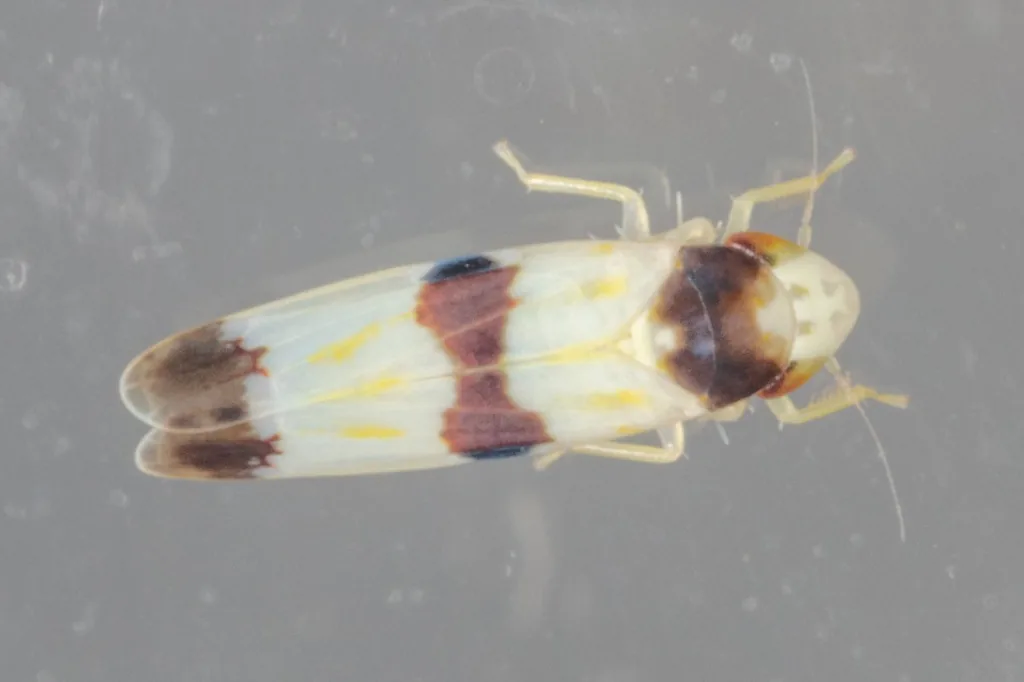
- Adults are about 1/8 inch (3 mm) long. The eastern grape leafhopper is pale yellow in summer, with three black spots and zigzag lines of deeper yellow on the forewings, and turns salmon-colored with red eyes before winter.[1][2]
- Eastern grape leafhopper nymphs hatch nearly transparent with red eyes and grow wing pads as they molt; all stages and their cast skins collect on the undersides of leaves.[1]
- Nymphs and adults are very active and easily disturbed, especially on hot, dry days.[1]
- In California, UC IPM separates the grape leafhopper (light to pale yellow with dark brown and reddish markings) from the darker variegated leafhopper, mottled brown, green and white, and the Virginia creeper leafhopper, which has reddish brown zigzag wing markings and eyes.[2]
Look-alikes
| Look-alike | How to tell them apart |
|---|---|
| Potato leafhopper | The potato leafhopper (Empoasca fabae) also feeds on grapes in the Northeast, but it does not overwinter there; it arrives from the south around mid-June and in some years does more damage than the grape leafhopper.[1] |
Where it lives
In the Northeast the eastern grape leafhopper is the dominant species on grapes, with the threebanded leafhopper also present. In California the grape leafhopper is the main one north of the Tehachapi Mountains, and the variegated leafhopper in southern California and much of the Central Valley.[1][2]
Biology and life cycle
They spend the winter as adults, in dry, sheltered spots with plant debris near the vines, and turn up in spring on weeds and the lowest grape leaves.[1][2]
In New York, adults come out in May once temperatures reach the mid-60s F, feed on plants such as strawberry, Virginia creeper and sugar maple without breeding there, and move to grapes from late May through mid-July.[1]
Eggs are laid one at a time under the skin of the leaf underside, each making a slight blister; in New York egg laying starts in mid- to late June.[1][2]
The eastern grape leafhopper has 1 1/2 to 2 generations a year in New York: first nymphs appear in late June and become adults by late July, and second-generation nymphs and adults show up in late August. Adults leave for winter sites from late October into December.[1]
Numbers swing widely from place to place and year to year; cold, wet springs and falls and wet winters hurt populations.[1]
Damage and signs
- Feeding empties leaf cells, leaving pale yellow to white stippling that shows first along the veins and on the lower leaves; at high numbers the whole leaf turns pale.[1][2]
- Heavy feeding can cause early leaf drop, lower sugar and higher acid in the fruit, poor color and sunburned fruit, and badly infested vines may grow less the next season; Cornell warned that damage becomes serious if heavy infestations go unchecked for two or more years.[1][2]
- Sticky droplets of excrement spot the berries and grow sooty mold, and large numbers of adults bother people picking at harvest.[1][2]
- Vines tolerate a fair number: Cornell put it at up to 15 leafhoppers per leaf with little or no economic damage.[1]
Health risk
They are plant feeders. The only effect on people that UC IPM notes is that large numbers of adults at harvest are a nuisance to the people picking.[1][2]
Control
Sanitation
In fall, clean up weedy, debris-filled ground next to the vines to take away overwintering sites.[1]
Traps and physical control
Removing basal leaves or lateral shoots during berry set and the two weeks after, before first-generation adults appear, cut peak leafhopper numbers by 30 to 50 percent in California and improves spray coverage. Don't strip so many leaves that fruit sunburns, and avoid pushing overly vigorous vine growth.[2]
Biological control
Tiny Anagrus wasps parasitize the eggs, which turn red when parasitized. In California, 10 to 30 percent parasitism of first-generation eggs can hold the grape leafhopper in check later in the season, though the wasps do less against the variegated leafhopper, and sulfur sprays for disease may harm them.[2]
Pesticides
While nymphs are small, narrow range oil, neem oil, insecticidal soap, pyrethrins or kaolin clay may give partial control; soap can spot table grapes and should be used on them only before bloom.[2]
If an insecticide is needed, cover the undersides of the leaves thoroughly. For the first generation on wine and raisin grapes, UC IPM skips treatment at 20 or fewer nymphs per leaf and otherwise waits until more than half the nymphs are in the third stage, so most eggs have hatched.[1][2]
Common questions
- What causes white speckles all over my grape leaves?
- Leafhopper feeding is one cause: the insects suck the contents out of leaf cells from below, leaving pale stippling that starts along the veins. Turn a leaf over and look for the small yellowish adults, nymphs and their cast skins.[1][2]
- How many leafhoppers can a grapevine handle?
- A fair number. Cornell found vines tolerate up to 15 per leaf with little or no economic damage, and UC IPM does not treat the first generation on wine and raisin grapes at 20 or fewer nymphs per leaf.[1][2]
- What are the sticky dark spots on my grapes?
- They may be leafhopper excrement: the insects drop sticky droplets on the berries, and sooty mold grows on them.[1][2]
Sources
- New York State Agricultural Experiment Station, Cornell University (eCommons), “Grape Insect IPM Insect Identification Sheet No. 4: Grape Leafhopper, Erythroneura comes (J. Van Kirk, H. Riedl and E. F. Taschenberg, 1984).” ecommons.cornell.edu/server/api/core/bitstreams/90460598-bf15-495b-994b-c4df079c9682/content (accessed 2026-11-08)
- University of California Statewide IPM Program, “UC IPM Pest Management Guidelines: Grape, Leafhoppers (L. G. Varela and D. R. Haviland; UC ANR Publication 3448).” ipm.ucanr.edu/agriculture/grape/leafhoppers/ (accessed 2026-11-08)
- iNaturalist, “Erythroneura comes taxon page (order and family).” www.inaturalist.org/taxa/219535 (accessed 2026-11-08)