On this page
How to identify it
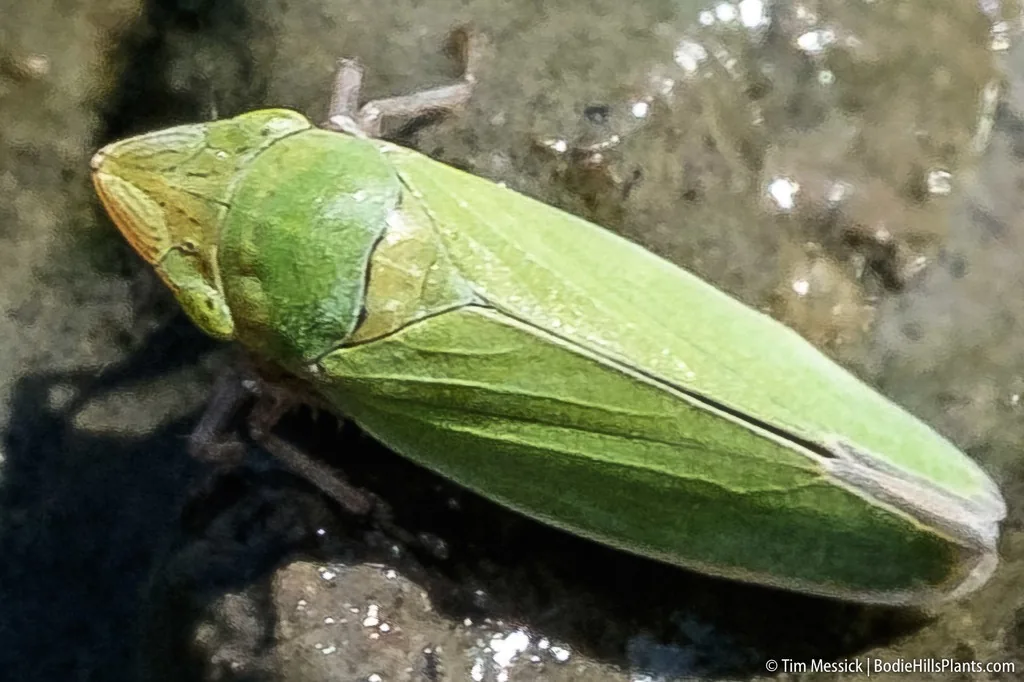
- A wedge-shaped leafhopper 1/8 to 1/4 inch long that jumps a short distance when disturbed. UC's lawn guide lists it among turf leafhoppers that are speckled or mottled and range from whitish green to yellow or brownish gray; nymphs look like wingless adults and scuttle sideways or backwards.[4]
- A xylem feeder and sharpshooter, grouped with the blue-green and red-headed sharpshooters as a Pierce's disease vector, and found on grasses and sedges rather than on woody plants.[2][5]
- Habitat is the best clue: lush, continually irrigated grass such as dairy pastures, permanent pasture, hayfields with grass weeds, ditch banks and roadsides, especially the wetter parts of a field. It favors watergrass, bermudagrass, Italian and perennial ryegrass and fescue.[1][5][2]
- Unlike the blue-green and glassy-winged sharpshooters, it is not attracted to yellow sticky traps, so it is monitored by sweep-netting the grass.[1]
Look-alikes
| Look-alike | How to tell them apart |
|---|---|
| Blue-green sharpshooter | The main Pierce's disease vector in coastal California, with green to bright blue wings and a yellow underside, about 0.4 inch long. It breeds on woody and perennial plants along streams and prefers grapevines, while the green sharpshooter breeds in grass and visits grape only by accident.[1][5] |
| Red-headed sharpshooter (Xyphon fulgida, formerly Carneocephala fulgida) | Shares the green sharpshooter's grass habitat and three-generation cycle, but it feeds and breeds only where bermudagrass grows and tolerates thinner stands on somewhat drier soil; the green sharpshooter is much more abundant in wetter pasture.[1][5][2][6] |
| Glassy-winged sharpshooter | The primary Pierce's disease vector in the Coachella Valley, Temecula and the southern San Joaquin Valley; it is caught on yellow sticky traps, which the green sharpshooter ignores.[1] |
| Grape leafhoppers | Unlike the leafhoppers managed as grape pests in their own right, the green sharpshooter causes no feeding damage to grape; its only importance in vineyards is as a disease vector.[1] |
Where it lives
A very common and often abundant leafhopper in California. It is a year-round resident in and near almond orchards in the Sacramento Valley, abundant in irrigated pastures of the San Joaquin Valley but rare inside its vineyards, and also present in coastal areas, where the blue-green sharpshooter matters more as a vector.[7][6][2]
Biology and life cycle
It feeds and reproduces on grasses and sedges and needs succulent growth, so populations depend on habitat stability and adequate soil moisture. Grapes and almonds are incidental hosts.[5][1]
There are three generations a year. Adults overwinter and lay eggs from late February to early March. Overwintering adults do not live long, so it is probably the second generation that moves into vineyards. Populations peak in summer, the period when bacterial titers rise in infected almond trees.[1][7][6]
Eggs are laid inside protective leaf tissue of grass hosts and are present continuously from February through fall because generations overlap.[1]
In central California the insects usually move east of pastures and weedy hayfields, downwind at dusk, and in almond surveys they were collected most often along orchard margins.[1][6]
Surveys in three almond regions from 2003 to 2005 found it the most abundant xylem-feeding vector, with 1.1 percent of sharpshooters collected near orchards and 4.5 percent collected in pastures carrying Xylella fastidiosa.[6]
Damage and signs
- Feeding itself does not damage grapevines. The harm is transmission of Xylella fastidiosa, the cause of Pierce's disease in grapes and almond leaf scorch in almonds; the bacterium multiplies in the plant's water-conducting tissue and causes water stress.[1][3]
- In Pierce's disease, vines infected the previous year show delayed or absent budbreak, leaf scorch from early summer increasing into fall, and drying clusters; the bacterium can kill vines in one to three years. Early-season infections (March to May) are the ones most likely to become chronic, and vines infected in June or later by green, red-headed or blue-green sharpshooters have the best chance of recovering.[1][2]
- In almonds the sharpshooters are the most probable vectors of leaf scorch, but they are not believed to carry the disease from an infected tree to a healthy one; the slow spread of almond leaf scorch in the San Joaquin Valley is thought to be partly their work.[3][7]
- On lawns it is one of several leafhoppers that suck sap and can bleach or yellow grass, but UC says they rarely cause serious damage.[4]
Health risk
None of the sources mentions any bite, sting or other effect on people or pets; the insect's significance is as a plant disease vector.[1][4]
Control
Prevention
Manage the grass, not the vineyard. Eliminate weedy grasses in and around alfalfa, orchards and field crops wherever possible, and do not let bermudagrass persist around vine bases or in the vine row, where it can support year-round sharpshooter populations.[1][5]
Clean-cultivating an almond orchard for about six weeks at any time of year, for example at harvest, prevents in-orchard populations from establishing, because grass-feeding sharpshooters need year-round access to host plants. Mowed or cultivated cover crops are therefore seldom a source; continuously mowed, near-pure bermudagrass stands are.[3][5]
When siting a vineyard, consider neighboring irrigated pastures and weedy hayfields, since sharpshooters move downwind out of them. UC notes that about all that can be done otherwise is to purchase or lease adjacent land and manage it so populations do not build.[1]
In lawns, UC says leafhopper damage rarely warrants treatment.[4]
Traps and physical control
Monitor grassy areas next to the vineyard that cannot be removed with a sweep net; yellow sticky traps do not attract this species. An average of two or more sharpshooters per 50 sweeps in a total of 400 sweeps is cause for concern.[1]
Pesticides
In the Central Valley, insecticides against green and red-headed sharpshooters are of little value overall: generations overlap, eggs sit inside grass leaf tissue from February through fall, and sprays do not kill eggs.[1]
Common questions
- Is the green sharpshooter hurting my grapevines directly?
- No. UC IPM says sharpshooter feeding does not damage grape; the concern is the Xylella fastidiosa bacterium it can inject while feeding, which causes Pierce's disease.[1]
- Why does my vineyard next to a pasture keep getting Pierce's disease?
- Irrigated pastures and weedy hayfields are the green sharpshooter's breeding habitat, and the insects move out of them, usually downwind at dusk, into neighboring vines. Grass weeds and bermudagrass inside the vineyard can also harbor them.[1][5]
- Can I trap it with yellow sticky cards like other sharpshooters?
- No. Green and red-headed sharpshooters are not attracted to yellow sticky traps and must be monitored with a sweep net in adjacent grass.[1]
Sources
- University of California Statewide IPM Program, “Sharpshooters (Grape Pest Management Guidelines).” ipm.ucanr.edu/agriculture/grape/sharpshooters/ (accessed 2026-11-10)
- University of California Statewide IPM Program, “Pierce's Disease (Grape Pest Management Guidelines).” ipm.ucanr.edu/agriculture/grape/pierces-disease/ (accessed 2026-11-10)
- University of California Statewide IPM Program, “Almond Leaf Scorch (Almond Pest Management Guidelines).” ipm.ucanr.edu/agriculture/almond/almond-leaf-scorch/ (accessed 2026-11-10)
- University of California Statewide IPM Program, “Leafhoppers (The UC Guide to Healthy Lawns).” ipm.ucanr.edu/TOOLS/TURF/PESTS/inleaf.html (accessed 2026-11-10)
- University of California Agriculture and Natural Resources, “Role of Weeds in Insect-Transmitted Diseases of Trees and Vines (A. H. Purcell, UC ANR repository).” my.ucanr.edu/repository/fileaccess.cfm?article=161460&p=IDIBUY (accessed 2026-11-10)
- Entomological Society of America (Journal of Economic Entomology), “Seasonal abundance of Draeculacephala minerva and other Xylella fastidiosa vectors in California almond orchards and vineyards (Daane et al. 2011, Journal of Economic Entomology 104:367-374).” doi.org/10.1603/ec10226 (accessed 2026-11-10)
- Entomological Society of America (Journal of Economic Entomology), “Seasonal population dynamics of Draeculacephala minerva and transmission of Xylella fastidiosa (Cabrera-La Rosa et al. 2008, Journal of Economic Entomology 101:1105-1113).” doi.org/10.1603/0022-0493(2008)101[1105:SPDODM]2.0.CO;2 (accessed 2026-11-10)
- iNaturalist, “Draeculacephala minerva taxon page (order and family).” www.inaturalist.org/taxa/475613 (accessed 2026-11-10)