On this page
How to identify it
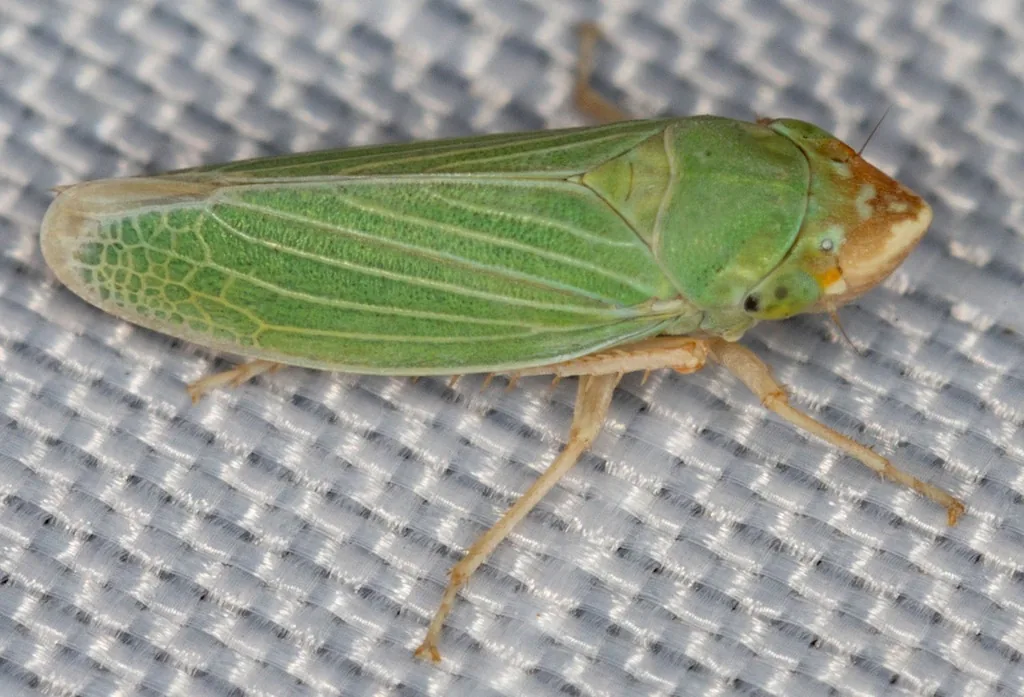
- A sharpshooter, that is a xylem-feeding leafhopper in the family Cicadellidae; UC's lawn guide describes turf leafhoppers as wedge-shaped insects 1/8 to 1/4 inch long that jump short distances when disturbed, with wingless nymphs that scuttle sideways or backwards.[1][3]
- Known under an older name, Carneocephala fulgida, in UC's weed-and-vector literature and in European plant-health lists, which now use Xyphon fulgida or X. fulgidum.[4][5]
- The surest clue is the plant: it feeds and breeds only where bermudagrass grows, and is found on bermudagrass along roads and drainage ditches even where the soil dries out after early summer.[1][4]
- Like the green sharpshooter it is not attracted to yellow sticky traps and must be monitored with a sweep net in grassy areas.[1]
Look-alikes
| Look-alike | How to tell them apart |
|---|---|
| Green sharpshooter | The other grass sharpshooter of the Central Valley; it is far more abundant and prefers lush, wet, continually irrigated grass, while the red-headed sharpshooter usually prefers thinner stands in somewhat drier soils and is tied to bermudagrass.[4][1] |
| Blue-green sharpshooter | The main coastal vector, about 0.4 inch long with green to bright blue wings; it prefers woody plants such as wild grape, blackberry and elderberry in riparian areas and does reproduce on cultivated grape.[1][4] |
| Glassy-winged sharpshooter | A much larger, dark brown sharpshooter about 1/2 inch long with an ivory-spotted head, established in southern California and the Central Valley from Bakersfield to Fresno; where it occurs it is the primary Pierce's disease vector.[1] |
Where it lives
Recorded from the United States, where UC documents it in California's Central Valley in permanent pastures beside vineyards, on weeds within them, and on bermudagrass along roads and ditches; a 2003-2005 survey in and near California almond orchards and vineyards collected only five Xyphon fulgida among more than 42,000 hoppers.[5][4][6]
Biology and life cycle
The red-headed sharpshooter feeds and reproduces on grasses and sedges and breeds only where bermudagrass grows; grape is an entirely accidental host. Two further requirements for a population are habitat stability and adequate soil moisture, which is why mowed or cultivated cover crops rarely hold sharpshooters.[4][1]
It can be found in pastures and hayfields but usually prefers thinner plant stands in somewhat drier soils, and lives on bermudagrass along roads and drainage ditches even where the soil becomes fairly dry after early summer. Densities there are usually highest in spring.[4]
There are three generations a year. Adults overwinter and lay eggs from late February to early March; the overwintering adults do not live long, so it is probably the second generation that moves into vineyards. In central California the movement is usually eastward, downwind at dusk, from pastures, weedy hay fields and other grassy areas.[1]
Nearly pure stands of bermudagrass on continuously mowed plum orchard floors, and uncontrolled bermudagrass around vine bases, can support high or perennial populations of both grass sharpshooters.[4]
European plant-health assessors list Xyphon fulgida as a Pierce's disease vector from the USA that inhabits permanent pastures alongside Californian vineyards or lives on weeds within them, and note that irrigation and weed control that create patches of preferred hosts such as bermudagrass (Cynodon dactylon) and Echinochloa crus-galli increase vector numbers.[5]
Damage and signs
- Sharpshooter feeding itself does no damage in grape. The harm comes from Xylella fastidiosa, which the insects inject as they feed; the bacterium multiplies in the vine's water-conducting system and causes water stress, delayed or absent budbreak the following spring, leaf scorch that spreads through summer and fall, dried clusters and, within one to three years, dead vines.[1]
- Where the glassy-winged sharpshooter is absent in the Central Valley, the green and red-headed sharpshooters are the primary vectors of Pierce's disease; on the coast the blue-green sharpshooter is the most important vector and the red-headed is merely present.[1][4]
- Timing matters: early-season infections (March through May) are more likely to survive the following winter and become chronic, while vines infected in June or later by the blue-green, green or red-headed sharpshooters have the greatest probability of recovery.[1][2]
Health risk
A plant-feeding leafhopper; the sources describe no risk to people or pets.[1]
Control
Prevention
When planting a vineyard, consider neighboring hay fields and permanent pastures, since sharpshooters move out of them, usually eastward and downwind at dusk in central California. About all that can be done with an adjacent source is to buy or lease the property and manage it so populations do not build up.[1]
Sanitation
Eliminate weedy grasses, especially bermudagrass, wherever possible in and around vineyards, orchards and field crops; red-headed sharpshooter populations are supported in areas with bermudagrass, and uncontrolled bermudagrass around vine bases or in the vine row can support perennial populations.[1][4]
Traps and physical control
Monitor grass weeds adjacent to the vineyard that cannot be eliminated with a sweep net; the grass sharpshooters are not attracted to yellow sticky traps. An average of two or more sharpshooters per 50 sweeps in a total of 400 sweeps is cause for concern.[1]
Pesticides
In the Central Valley insecticide treatments for these sharpshooters are of little value overall: overlapping generations keep eggs inside protective leaf tissue of host plants from February through fall, and sprays are not effective against eggs.[1]
Common questions
- Why is a bermudagrass leafhopper a problem for grapes?
- Grape is an accidental host that the red-headed sharpshooter only visits, but each feeding can inject Xylella fastidiosa, the Pierce's disease bacterium. In Central Valley areas without the glassy-winged sharpshooter, it and the green sharpshooter are the primary vectors.[1][4]
- Can I spray the vineyard to stop it?
- UC IPM says insecticide treatments for the grass sharpshooters are of little value overall, because overlapping generations keep eggs protected inside leaf tissue from February to fall. Managing bermudagrass and other grass weeds in and around the vineyard is the practical approach.[1]
- Where should I look for it?
- On bermudagrass: along roads and drainage ditches, on mowed orchard floors dominated by bermudagrass, around vine bases, and in the thinner, drier parts of pastures and hayfields. Sweep-net those areas; densities are usually highest in spring.[4][1]
Sources
- University of California Statewide IPM Program, “Sharpshooters (Grape Pest Management Guidelines).” ipm.ucanr.edu/agriculture/grape/sharpshooters/ (accessed 2026-11-10)
- University of California Statewide IPM Program, “Pierce's Disease (Grape Pest Management Guidelines).” ipm.ucanr.edu/agriculture/grape/pierces-disease/ (accessed 2026-11-10)
- University of California Statewide IPM Program, “Leafhoppers (The UC Guide to Healthy Lawns).” ipm.ucanr.edu/TOOLS/TURF/PESTS/inleaf.html (accessed 2026-11-10)
- University of California Agriculture and Natural Resources, “Role of Weeds in Insect-Transmitted Diseases of Trees and Vines (A. H. Purcell, UC ANR repository).” my.ucanr.edu/repository/fileaccess.cfm?article=161460&p=IDIBUY (accessed 2026-11-10)
- European Food Safety Authority (EFSA Journal), “Pest categorisation of non-EU Cicadomorpha vectors of Xylella spp. (EFSA Panel on Plant Health 2019, EFSA Journal 17(6):5736).” doi.org/10.2903/j.efsa.2019.5736 (accessed 2026-11-10)
- Entomological Society of America (Journal of Economic Entomology), “Seasonal abundance of Draeculacephala minerva and other Xylella fastidiosa vectors in California almond orchards and vineyards (Daane et al. 2011, Journal of Economic Entomology 104:367-374).” doi.org/10.1603/ec10226 (accessed 2026-11-10)
- iNaturalist, “Xyphon fulgidum taxon page (order and family).” www.inaturalist.org/taxa/1066027 (accessed 2026-11-10)