On this page
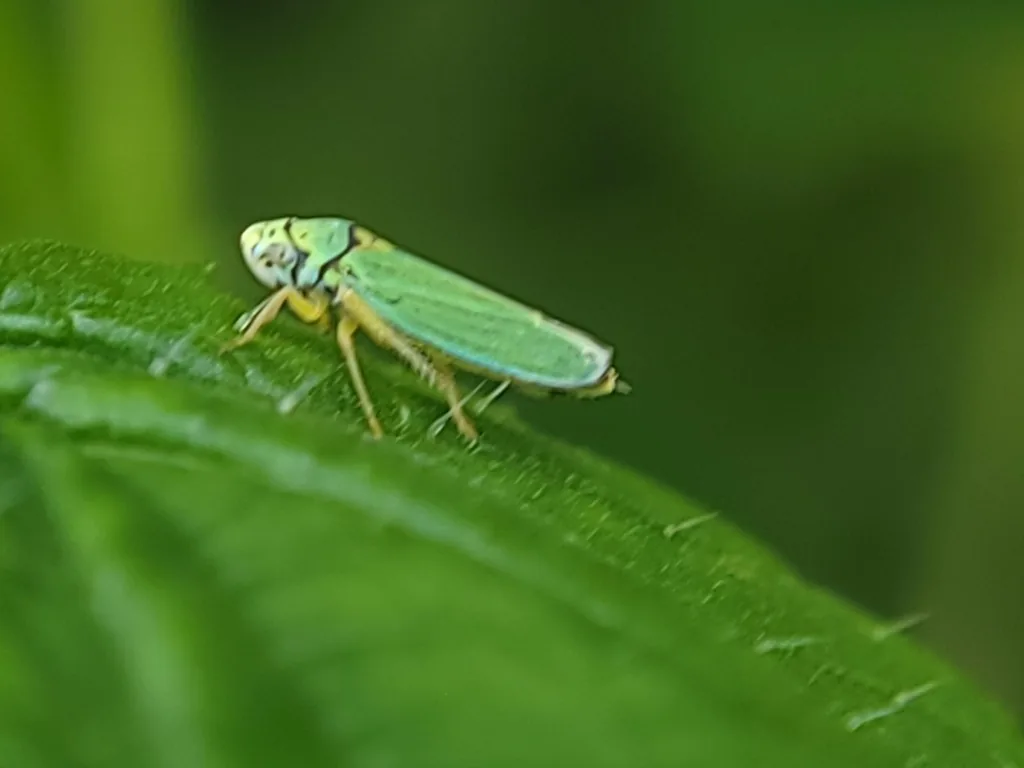
How to identify it
Look-alikes
| Look-alike | How to tell them apart |
|---|---|
| Glassy-winged sharpshooter | The glassy-winged sharpshooter is larger, about 0.5 inch, dark brown to black from the top or side, with a whitish or yellow abdomen and ivory to yellowish spots on the head.[1] |
| Grape leafhoppers | Grape leafhoppers also suck sap from vines, but UC IPM notes that they do not spread Pierce's disease.[2] |
| Green and red-headed sharpshooters | These two grass feeders breed in irrigated pastures, hay fields and grassy ditch banks, and grapes are only incidental hosts for them; they matter most as Pierce's disease vectors in the Central Valley.[1][2] |
Where it lives
Researchers describe it as a native California vector of the Pierce's disease bacterium. Within California it is found in coastal regions, near streamside (riparian) and landscaped areas.[4][1]
Biology and life cycle
It feeds and breeds on cultivated grape and on many other plants, preferring woody or perennial ones such as wild grape, blackberry, elderberry and stinging nettle. Mugwort is a major breeding host.[1]
Streamside vegetation is its main breeding habitat, though ornamental landscape plants can also hold breeding populations. It is most common along stream banks and in ravines or canyons with dense trees, vines and shrubs.[2][1]
It feeds on succulent new growth where soil moisture and shade are plentiful. It is seldom found in unshaded, dry spots, yet plants in constant deep shade don't attract it either.[1][2]
There is one generation a year in most of California and a second in some parts of the state.[1]
Adults overwinter in streamside vegetation and become active in late winter and early spring. A small share move into nearby vineyards just after budbreak, and more follow as the wild vegetation dries out.[1]
Eggs hatch from May through July, and young adults build up through July and August. In August, when grape foliage is less succulent, the sharpshooters head back to natural habitat, where their numbers are always larger than in vineyards.[1]
In field counts and cage trials it fed more on some grape cultivars than others, but those preferences did not line up with how resistant the cultivars were to Pierce's disease.[3]
Damage and signs
- Feeding by sharpshooters does not damage grapes. The harm is the bacterium Xylella fastidiosa, which they carry into the vine, where it multiplies in the water-conducting tissue and causes Pierce's disease.[1][2]
- In chronically infected vines, leaf edges turn slightly yellow or red and then dry in bands, fruit clusters shrivel, dried leaves drop and leave their stems on the cane, and new canes ripen unevenly with patches of green bark.[2]
- The bacterium can kill vines 1 to 3 years after infection.[1]
- Timing matters. Inoculations from April through June produced longer-lasting infections than those in July or early August, and vines infected in June or later are the most likely to recover.[3][2]
Health risk
It feeds on plant sap; the UC IPM guidelines discuss it only as a carrier of a grapevine disease and mention no risk to people.[1]
Control
Prevention
Pierce's disease control rests entirely on preventing infection, so the goal is to keep sharpshooters from moving into the vineyard from nearby habitat, especially in spring.[1][2]
Near areas with a history of the disease, plant less susceptible varieties. Sprays aimed at the vector do not protect very susceptible varieties such as Chardonnay and Pinot Noir, or vines younger than 3 years, well enough.[1][2]
Monitor from budbreak. In late February, hang double-sided yellow sticky traps at least 4 by 7 inches in streamside and landscape vegetation next to the vineyard and at least six per block inside it, 100 to 200 feet apart, and check them weekly until late May. From May to July, search or sweep-net that nearby vegetation.[1]
Sanitation
During the dormant season, remove vines that have shown Pierce's disease symptoms for more than one year, since they are unlikely to recover. Mark mildly affected vines and remove them if symptoms return the next season; severe pruning back to the graft union does not work.[2]
Pesticides
UC IPM considers treatment warranted when catches jump after several warm days above 70 degrees F, when traps in streamside or landscape habitat average more than 7 a week, or when inspections find more than one per vine. Treat edge vegetation where they are seen, plus the first 200 to 300 feet of vineyard if they have moved in and shoots are longer than a few inches.[1]
In organically managed vineyards, sprays of pyrethrins and kaolin clay are acceptable; check with your certifier.[1]
When to call a professional
Managing streamside vegetation has reduced spring sharpshooter numbers in North Coast vineyards, but unauthorized removal is prohibited or restricted, so contact the California Department of Fish and Wildlife before changing it.[2][1]
Common questions
- Does the blue-green sharpshooter hurt grapevines by feeding?
- No. UC IPM says sharpshooter feeding does not damage grapes; the problem is the Pierce's disease bacterium it carries.[1]
- When are infections most dangerous?
- Spring. Infections from April through June persisted more than July or early-August ones in Purcell's study, and UC IPM calls preventing infections from bud break through May critical.[3][2]
- Can I clear the streamside brush where they breed?
- Riparian vegetation management has worked in North Coast vineyards, but removing vegetation without approval is prohibited or restricted; check with the California Department of Fish and Wildlife first.[2]
Sources
- University of California Statewide IPM Program, “Grape Pest Management Guidelines: Sharpshooters (UC ANR Publication 3448).” ipm.ucanr.edu/agriculture/grape/sharpshooters/ (accessed 2026-11-08)
- University of California Statewide IPM Program, “Grape Pest Management Guidelines: Pierce's Disease (UC ANR Publication 3448).” ipm.ucanr.edu/agriculture/grape/pierces-disease/ (accessed 2026-11-08)
- American Phytopathological Society (Phytopathology), “Purcell AH. Vector preference and inoculation efficiency as components of resistance to Pierce's disease in European grape cultivars. Phytopathology 71:429-435 (abstract).” doi.org/10.1094/Phyto-71-429 (accessed 2026-11-08)
- Elsevier (Journal of Insect Physiology), “Cervantes FA, Backus EA. EPG waveform library for Graphocephala atropunctata. Journal of Insect Physiology 109:21-40 (2018) (abstract).” doi.org/10.1016/j.jinsphys.2018.05.008 (accessed 2026-11-08)
- iNaturalist, “Graphocephala atropunctata taxon page (order and family).” www.inaturalist.org/taxa/1064647 (accessed 2026-11-08)