On this page
How to identify it
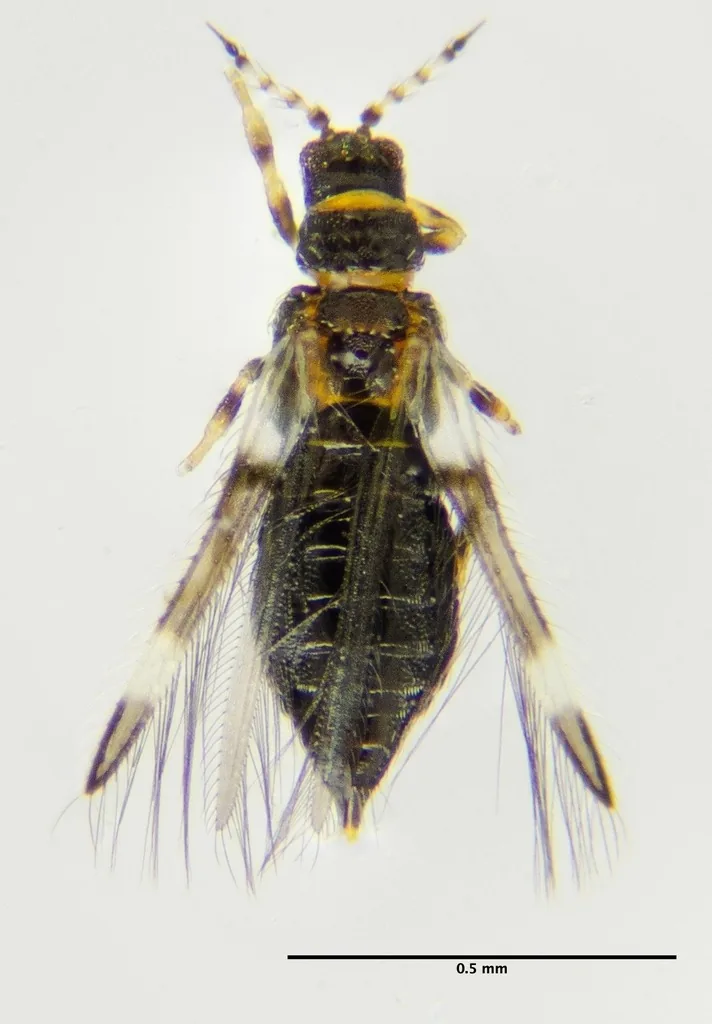
- Adults are about 1 mm long (females average 1.1 mm) and uniformly dark, grayish black to dark brown. To the naked eye they look blackish with bands.[1][2]
- The grayish brown forewings carry two white cross bands, one near the base and one near the tip, so the folded wings look banded dark and pale.[1][2]
- Under magnification the legs and antennae are also banded light and dark: the thighs are dark brown with pale tips, and the shins dark brown with yellow ends.[1][2]
- The antennae have eight segments, and the last segments are long and needle-like.[2]
Look-alikes
| Look-alike | How to tell them apart |
|---|---|
| Western flower thrips | Also found in orange navels, but usually yellowish. Its dark form is larger and hairier, with longer, darker bristles, than bean thrips.[1] |
| Citrus thrips | May also be found in the navel, but it is usually yellowish rather than blackish and banded.[1] |
Where it lives
Native to North America and western Mexico. In the United States it has been reported from Alabama, Arizona, California, Florida, Idaho, Louisiana, Nevada, South Carolina, Texas, Washington and Wyoming, and it also occurs on the west coast of Canada.[2]
Biology and life cycle
Adults overwinter and then breed on weeds such as prickly lettuce and sow thistle in spring, completing two generations from April to early June.[1][2]
In summer a generation takes about three weeks: the egg about 7 days, two feeding larval stages about 10 days, and the non-feeding prepupa and pupa about 5 days. Mature larvae drop to the ground to pupate. There are six or seven generations from April to October in California.[2]
Females insert their eggs into plant tissue. Larvae feed mostly on the undersides of leaves, while adults are more often in flowers. Unfertilized eggs produce males, and females outnumber males about two to one.[2]
When weeds dry out in early summer, adults move into crops. In September and October, as weeds die and field crops are harvested, they fly into citrus groves looking for green, sheltered places to spend the winter.[1][2]
Hosts include alfalfa, beans, peas, clover, strawberry, pear, peach, almond, apple, cabbage and other cole crops, potato, tomato, lettuce, onion, cotton, corn, grape, olive and avocado, along with many weeds.[2]
Damage and signs
- Larvae and adults suck sap from leaves, flowers, fruit and stems. Feeding shows as silvering or bronzing of the leaves and, when heavy, can lead to leaf drop and plant death. Crowds of larvae do more harm than adults.[2]
- On young fruit, feeding causes scars, and black specks of excrement can mar the surface. On pears, feeding causes sun-scald on immature fruit and lowers the tree's production the next season.[2]
- Bean thrips does not damage citrus fruit or breed on citrus. The problem is contamination: adults overwintering in the navels of oranges and some mandarins from November to March can be found in harvested fruit, which some trading partners do not accept, so fruit may have to be fumigated.[1]
- Bean thrips was a serious crop pest in California in the early 1930s but soon lost that status. In Florida it is common on beans at low numbers and only occasionally damaging.[2]
Health risk
UF/IFAS and UC IPM describe it only as a plant feeder and a fruit contaminant; neither mentions bites or any other risk to people.[1][2]
Control
Sanitation
Keep weeds down in and around fields and orchards. Filaree, malva, prickly lettuce, Russian thistle, sowthistle, tree tobacco and grasses, especially perennial grasses, carry bean thrips that later move into crops and citrus.[1][2]
Traps and physical control
Green sticky cards catch more adults than yellow, white or blue ones and help show when thrips are moving. Heavy rain suppresses populations, so overhead irrigation may help.[1][2]
Biological control
Minute pirate bugs, lady beetle larvae, hover fly larvae, lacewing larvae and predatory thrips eat bean thrips larvae, and a parasitic wasp, Thripoctenus russelli, has been recorded as its most important natural enemy in California.[2]
Pesticides
Insecticides with different modes of action can work when applied to foliage, but UF/IFAS notes that information on products registered for bean thrips is scarce. Check current labels and your local extension office before treating.[2]
When to call a professional
Growers shipping navel oranges to countries that quarantine bean thrips follow export protocols, including certified fumigation of the fruit.[1]
Common questions
- What are the tiny black specks moving in the navel of my orange?
- In California they may be bean thrips, which crawl into orange navels to spend the winter. They are about 1 mm long and look blackish with pale bands.[1]
- Do bean thrips damage oranges?
- No. UC IPM says bean thrips does not damage citrus fruit or reproduce on citrus; the concern is that the insects ride along in the navel of harvested fruit.[1]
- Why are my bean leaves turning silvery?
- Thrips feeding is one cause. Bean thrips larvae and adults suck out leaf cells, leaving silvered or bronzed leaves; heavy feeding can make leaves drop.[2]
Sources
- University of California Statewide IPM Program, “Bean Thrips, UC IPM Pest Management Guidelines: Citrus.” ipm.ucanr.edu/agriculture/citrus/bean-thrips (accessed 2026-11-09)
- University of Florida IFAS Extension (EDIS), “Bean Thrips, Caliothrips fasciatus (Pergande, 1895), Featured Creatures EENY-782 (R. A. Khan, D. R. Seal and R. Adhikari, 2022).” journals.flvc.org/edis/article/view/127591 (accessed 2026-11-09)
- iNaturalist, “Caliothrips fasciatus taxon page (order and family).” www.inaturalist.org/taxa/307191 (accessed 2026-11-09)