On this page
How to identify it
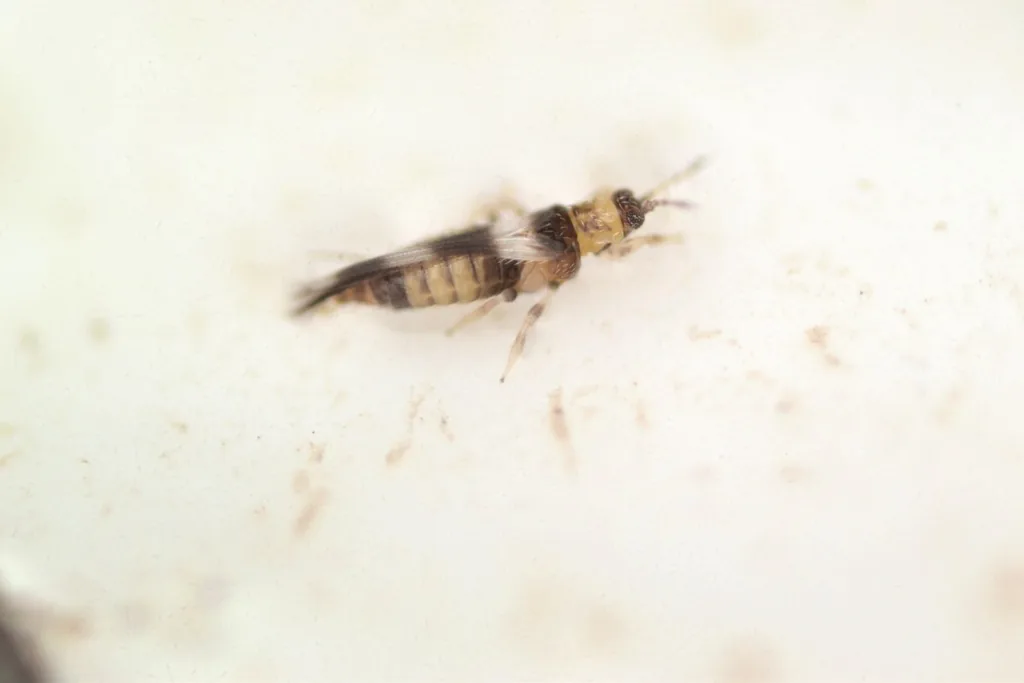
- Adults are about 1/16 inch long and slender, with a black head, fringed wings and distinct brown and cream bands across the abdomen.[1]
- Nymphs are about 1/32 inch long, slender, light green and wingless.[1]
- Look on the undersides of soybean leaves, where both nymphs and adults usually feed. A hand lens helps with counting them.[1]
Look-alikes
| Look-alike | How to tell them apart |
|---|---|
| Eastern flower thrips | Also found in soybean and also carries soybean vein necrosis virus, but it is most numerous early in the season, while soybean thrips build up later.[2][4] |
Where it lives
Found throughout the United States, in southern Canada and in Mexico, and in every US soybean-growing state where soybean vein necrosis virus has been reported.[1][3]
Biology and life cycle
Females lay their eggs inside the leaf tissue alongside the leaf veins.[3]
Females can reproduce without mating: unfertilized eggs become males and fertilized eggs become females. In lab rearing, each female laid 9 to 12 eggs that produced males in this way.[3][2]
In northern areas, soybean thrips show up later in the season than eastern flower thrips and gradually become the main thrips on soybeans late in the season. During the day they are mostly on leaves in the upper canopy.[2]
Trap catches in the Midwest suggest that noncrop host plants matter for their early-season activity, since activity began earlier in landscapes with more field edges and did not line up with soybean bloom. Their numbers were higher where it was warmer, which suggests they also migrate in.[4]
They tend to persist more in hot, dry weather.[1]
Damage and signs
- Feeding leaves tiny lengthwise scars along the leaf veins. Heavy feeding turns leaves patchy silver, yellow and bronze, and sustained feeding can make leaves crinkle and die.[1]
- Soybean thrips are the main vector of soybean vein necrosis virus. Young larvae pick up the virus while feeding on infected plants, and it multiplies in the thrips and moves to the salivary glands. They transmit it about 2.5 times as often as tobacco thrips and 10 times as often as eastern flower thrips.[2][3]
- Soybean vein necrosis was first identified in Tennessee in 2008 and was reported in all US soybean-growing states by 2013. Its effects on yield are not well known, though it can lower seed oil content and change its fatty acid makeup.[2]
Health risk
The sources describe it only as a soybean pest and plant-virus carrier; they mention no harm to people.[1][2]
Control
Traps and physical control
Scout from emergence. Pick five random areas of the field and check 10 plants in a row in each. On plants up to the V5 stage, pull the lowest trifoliate; on V6 and older plants, pull the fifth trifoliate down from the top. Count thrips on the leaf underside with a hand lens and estimate the percent of each trifoliate with scars, discoloring or crinkling.[1]
Biological control
The insidious flower bug, a minute pirate bug, may prey on soybean thrips opportunistically; in Midwest suction traps, sites with more soybean thrips also caught more flower bugs.[4]
Pesticides
Soybean thrips are rarely an economic problem, but treatment thresholds exist. One example is an average of eight thrips per leaf with 75 percent of leaves showing injury. Ask your state extension specialist about current options.[1]
Common questions
- What are the tiny silvery scars along the veins of my soybean leaves?
- They are often soybean thrips feeding damage. Thrips scrape the undersides of the leaves, leaving fine scars along the veins, and heavy feeding causes silver, yellow or bronze patches.[1]
- Do soybean thrips spread soybean vein necrosis virus?
- Yes. They are its main vector and transmit it more efficiently than the other thrips known to carry it.[2][3]
- Should I spray for soybean thrips?
- Usually not. They are rarely an economic issue; one example threshold is eight thrips per leaf with three-quarters of the leaves injured.[1]
Sources
- Crop Protection Network, “Soybean Thrips in Soybean (developed by C. Pilcher, Iowa State University, and R. Wright, University of Nebraska-Lincoln).” cropprotectionnetwork.org/encyclopedia/soybean-thrips-in-soybean (accessed 2026-11-09)
- Insects (MDPI), “The Effect of Species Soybean Vein Necrosis Orthotospovirus (SVNV) on Life Table Parameters of Its Vector, Soybean Thrips (Insects 2022).” pmc.ncbi.nlm.nih.gov/articles/PMC9324745/ (accessed 2026-11-09)
- Insects (MDPI), “Morphology of the Female Reproductive System of the Soybean Thrips, Neohydatothrips variabilis (Insects 2022).” pmc.ncbi.nlm.nih.gov/articles/PMC9317315/ (accessed 2026-11-09)
- Environmental Entomology (Entomological Society of America), “Monitoring Eastern flower thrips and soybean thrips and the generalist predator, insidious flower bug, in the American Midwest Suction Trap Network (Lagos-Kutz et al. 2025, Environmental Entomology 54:1432-1444), abstract.” pubmed.ncbi.nlm.nih.gov/41126555/ (accessed 2026-11-09)
- iNaturalist, “Neohydatothrips variabilis taxon page (order and family).” www.inaturalist.org/taxa/552027 (accessed 2026-11-09)