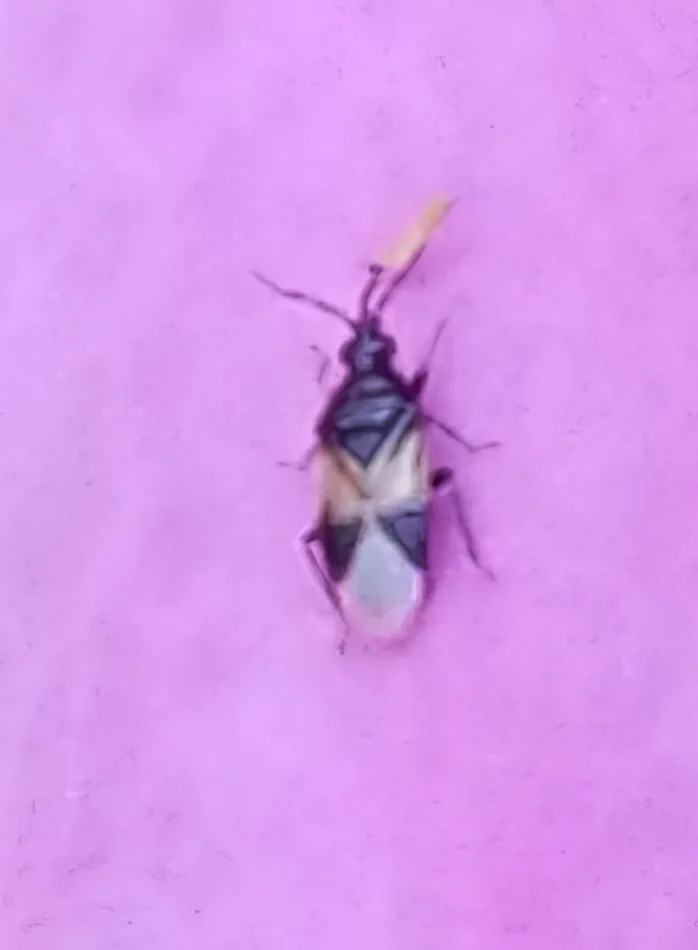
How to identify it
- Adult Orius are about 1/12 to 1/5 inch (2 to 5 mm) long, oval and somewhat flattened, and black with white wing patches.[1][2]
- Nymphs are wingless, teardrop-shaped, fast-moving and yellow-orange to brown; their eyes may show as two red spots.[2][1]
- Eggs are inserted into soft plant tissue so only a round cap shows.[1]
- Adults have no obvious veins or cells near the forewing tips, which separates them from most other true bugs.[1]
Look-alikes
| Look-alike | How to tell them apart |
|---|---|
| Damsel bugs | Damsel bugs are larger and slender, with several elongated cells around the forewing tips.[1] |
Where it lives
Orius insidiosus is the more common species in the Midwest, and O. tristicolor in western states. They live in field crops, gardens, landscapes and wildlands.[2][1]
Biology and life cycle
Females lay tiny eggs inside plant tissue 2 to 3 days after mating, and eggs hatch in 3 to 5 days.[2]
Nymphs pass through five stages with no pupal stage; egg to adult takes about three weeks in warm weather.[1][2]
Females lay about 129 eggs on average, adults live about 35 days, and several generations occur each year.[2]
When prey is scarce they feed on pollen and plant juices, so they gather where shrubs and weeds are flowering.[2][1]
Damage and signs
- They feed harmlessly on pollen and plant juices and are not plant pests. Prey includes thrips, spider mites, aphids, psyllids, whiteflies, small caterpillars and insect eggs.[1]
Health risk
In late summer they move out of fields and woods and bite people with a short, blunt beak. The bite hurts, but they don't feed on blood or inject venom or saliva.[3]
Control
Prevention
Control isn't practical: their numbers are temporary and vary from year to year, and widespread control would remove a useful predator.[3]
On warm late-summer days when they're biting, dark clothing may help; repellents generally don't work.[3]
Biological control
Keep resident pirate bugs by growing flowering plants, controlling ants and dust, and avoiding broad-spectrum insecticides and miticides.[1]
Orius are sold for greenhouse thrips control, but buying and releasing them outdoors is unlikely to control pests.[1][2]
Common questions
- What tiny black-and-white bug keeps biting me in late summer?
- Most likely a minute pirate bug. They bite out of proportion to their size in late summer, but they don't feed on blood.[3]
- How many mites can one eat?
- Both nymphs and adults can eat 30 or more spider mites a day.[2]
- Are the bites dangerous?
- Reactions vary: some bites swell like a mosquito bite, some turn red, and some people have no reaction at all.[3]
Sources
- University of California Statewide IPM Program, “Minute Pirate Bugs (Natural Enemies Gallery).” ipm.ucanr.edu/natural-enemies/minute-pirate-bugs/ (accessed 2026-10-06)
- Cornell University College of Agriculture and Life Sciences, “Biological Control: A Guide to Natural Enemies in North America: Orius species (Minute Pirate Bugs).” biocontrol.entomology.cornell.edu/predators/Orius.php (accessed 2026-10-06)
- Iowa State University Extension and Outreach, “Pirate Bugs and Insidious Flower Bugs (Yard and Garden).” yardandgarden.extension.iastate.edu/encyclopedia/pirate-bugs-and-insidious-flower-bugs (accessed 2026-10-06)
- iNaturalist, “Orius insidiosus taxon page (order and family).” www.inaturalist.org/taxa/453999 (accessed 2026-10-06)