How to identify it
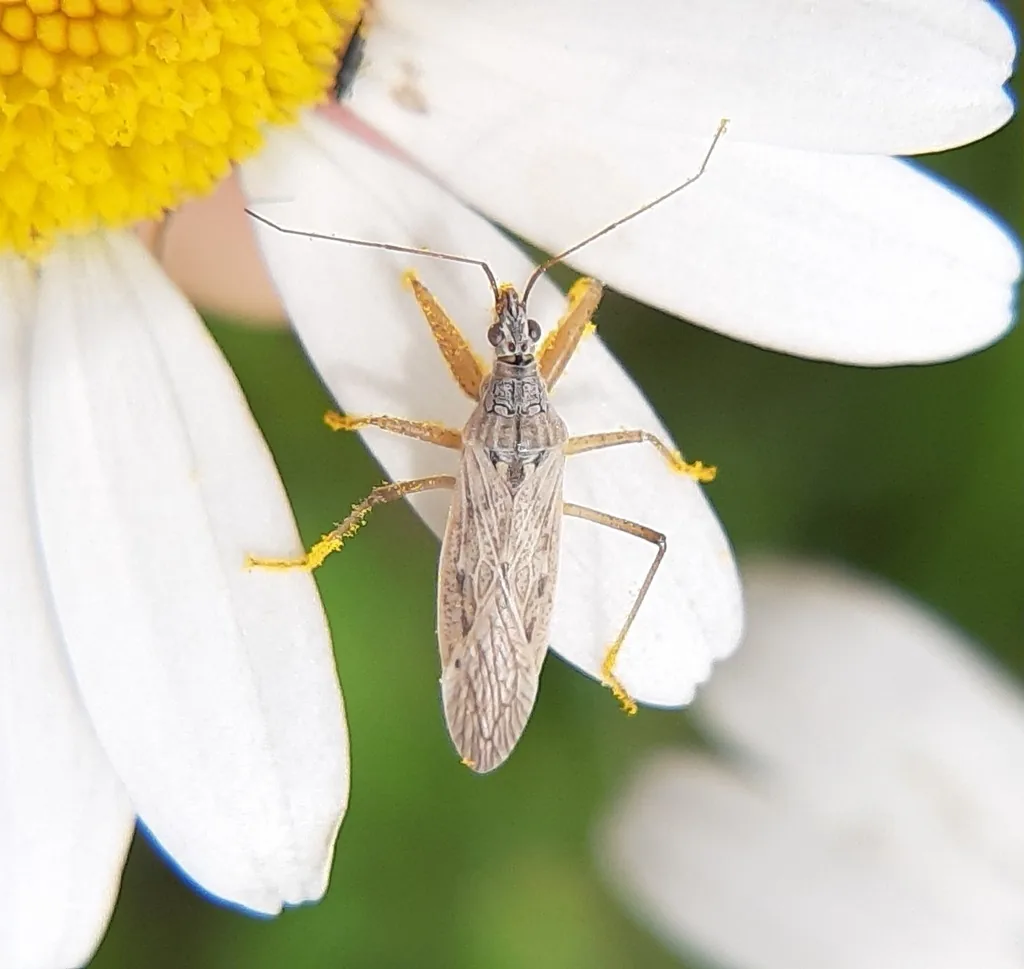
- Adults are slender, about 1/6 to 1/2 inch (4 to 13 mm) long, and usually tan, gray, brown or yellowish.[1][3]
- The head is narrow with bulging eyes and long antennae, and the front legs are slightly swollen for grasping prey.[1][4]
- Many short, parallel veins at the wing tips are characteristic of all damsel bugs.[4][1]
- Nymphs look like small, wingless adults; older nymphs show developing wing pads.[1][4]
Look-alikes
| Look-alike | How to tell them apart |
|---|---|
| Assassin bugs | Damsel bugs look like small, smooth assassin bugs, but they're a distinct family.[2][4] |
| Minute pirate bugs | Minute pirate bugs are smaller and have no obvious veins or cells near the forewing tips.[1] |
Where it lives
Native throughout North America. Nabis roseipennis is the most common damsel bug in the Southeast, and at least nine species occur in California.[4][1]
Biology and life cycle
Females insert eggs into soft plant tissue, leaving only a flat cap visible.[1]
Nymphs pass through five stages, and egg to adult takes 1 to 2 months in warm weather, with two or more generations a year.[1]
Adults overwinter in ground cover and debris and emerge in April or May to lay eggs.[3][1]
Small nymphs eat about one egg or aphid a day; older nymphs and adults may eat one to two dozen.[2]
Damage and signs
Health risk
Damsel bugs are predators of insects and mites; the cited extension sources do not describe them as a health concern for people.[1][2][3][4]
Control
Prevention
No control is needed; damsel bugs are beneficial predators.[4]
Biological control
They shelter in low grasses and ground covers, so keeping some of that habitat encourages them.[2]
Avoid regular use of broad-spectrum pesticides, and favor native plants, which give food and overwintering sites.[3]
Damsel bugs aren't sold commercially, so you rely on the ones already present.[4]
Common questions
- Is this a damsel bug or an assassin bug?
- Damsel bugs are smaller and smoother, with many short parallel veins at the wing tips, though at a glance they resemble small assassin bugs.[4][2]
- Do damsel bugs really control pests?
- They're considered important caterpillar predators in soybeans, but no studies show economic pest control, and their effect in home landscapes isn't known.[4][2]
Sources
- University of California Statewide IPM Program, “Damsel Bugs (Natural Enemies Gallery).” ipm.ucanr.edu/natural-enemies/damsel-bugs/ (accessed 2026-10-06)
- University of Wisconsin-Madison Extension, “Damsel Bugs, Family Nabidae.” hort.extension.wisc.edu/articles/damsel-bugs-family-nabidae/ (accessed 2026-10-06)
- Washington State University Extension, “Predatory Bugs: Damsel bugs (HortSense).” hortsense.cahnrs.wsu.edu/fact-sheet/predatory-bugs-damsel-bugs/ (accessed 2026-10-06)
- NC State Extension, “Damsel Bug (Biological Control Information Center).” entomology.ces.ncsu.edu/biological-control-information-center/beneficial-predators/damsel-bug/ (accessed 2026-10-06)
- iNaturalist, “Nabis taxon page (order and family).” www.inaturalist.org/taxa/203298 (accessed 2026-10-06)