On this page
How to identify it
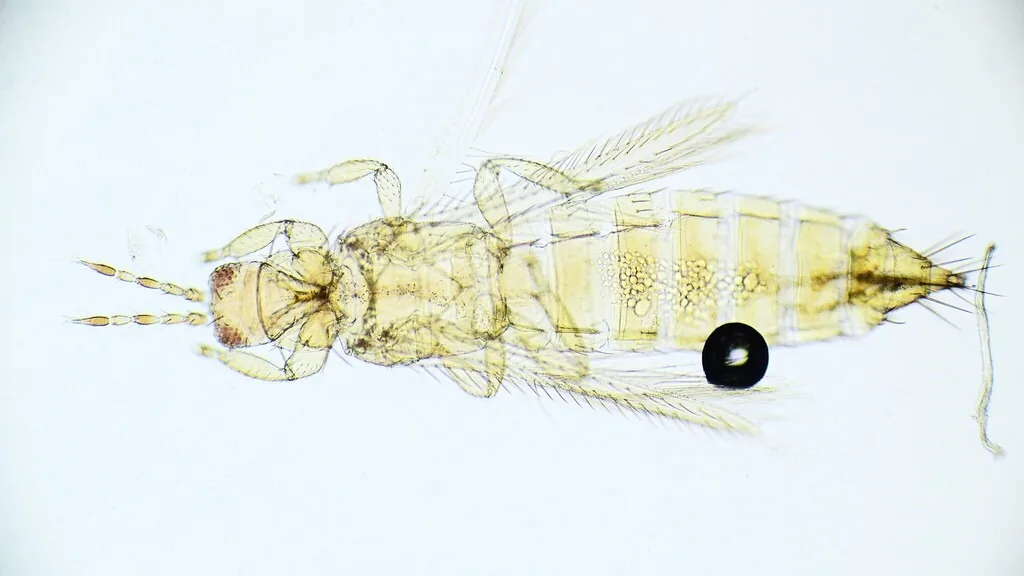
- Adults are slender, yellow and about 1 mm long, with narrow fringed wings.[1]
- Larvae are wingless, yellow, elongate-oval and about 0.5 mm long, resembling small adults. Larvae and pupae of different Frankliniella species look alike and are not usually identified to species.[1]
- Telling adults from other pale Frankliniella species takes a microscope: the third antenna segment has a swollen, mushroom-shaped stalk, and the comb of tiny teeth on the rear edge of the eighth abdominal segment is incomplete.[1][2]
Look-alikes
| Look-alike | How to tell them apart |
|---|---|
| Western flower thrips | A close relative that can be confused with it but spreads tomato spotted wilt virus and is much more damaging. In Florida fruiting vegetables, one western flower thrips adult per tomato flower calls for action, while ten or more eastern flower thrips per flower are tolerated.[1] |
| Florida flower thrips (Frankliniella bispinosa) | Another pale Frankliniella species of the Southeast that does spread tomato spotted wilt virus; it is the main thrips in Florida blueberries, while eastern flower thrips dominates in Georgia.[1][2] |
Where it lives
Native to eastern North America and found mainly east of the Rocky Mountains; it has also been reported in Asia, the Caribbean and Europe. It is caught in suction traps across the Midwest.[1][2][3]
Biology and life cycle
Females insert kidney-shaped eggs, about 0.4 mm long, into plant tissue and can lay up to 17 eggs a day. Unfertilized eggs produce males and fertilized eggs produce females.[1]
The life cycle runs egg, two feeding larval stages, then a prepupa and pupa that rest in the soil without feeding. Egg to adult takes about two to three weeks, development stops below about 10°C (50°F), and adults live about 38 days.[1]
It has several generations a year and builds up faster as the weather warms. In the Midwest, its activity began earlier in warmer conditions.[1][3]
Larvae and adults move about readily and live in flowers or on fruit. In a year-long north Florida study it was collected from 48 kinds of plants, 18 of which supported breeding, and it has been recorded from flowering weeds such as morning glory, dandelion, wood sorrel and clover.[1]
Crop hosts include asparagus, blackberry, blueberry, cotton, eggplant, peach, pepper, rye, soybean, strawberry and tomato, and ornamentals such as chrysanthemum and rose.[1][2]
Damage and signs
- In the Southeast it is an early-season pest of seedling cotton. Adults feed on new growth at the tip and under the leaves, which silvers the tissue; damaged seedlings may be stunted with distorted leaves.[1]
- In southern highbush blueberries it feeds inside the flowers on petals, styles, ovaries and young fruit tissue, and may eat pollen, which can impair pollination and fruit set and reduce yield. In Georgia blueberry plantings it made up 94 percent of the thrips caught.[2]
- In north Florida it is the most common thrips in eggplant, pepper and tomato flowers, yet causes no damage even at 20 to 25 adults per flower. It does not transmit tomato spotted wilt virus, and it can outcompete the damaging western flower thrips.[1]
- It is one of the thrips that carry soybean vein necrosis virus, first detected in Arkansas in 2008.[3]
Health risk
UF/IFAS describes it only as a flower-feeding plant pest; it mentions no harm to people.[1]
Control
Prevention
Identify the species before treating. In Florida fruiting vegetables, ten or more eastern flower thrips adults per flower are tolerated before action is recommended.[1]
Traps and physical control
To check flowers, tap blooms over a white board and count the thrips; in cotton, beat the plants over a white board. Thrips can be saved in 70 percent alcohol to have the species confirmed.[1]
Biological control
The minute pirate bug Orius insidiosus is the most effective predator of flower thrips. It moves into eggplant and pepper fields in late spring and can control thrips there, so favor reduced-risk insecticides over broad-spectrum ones to protect it.[1]
Pesticides
Insecticides are labeled for flower thrips in fruiting vegetables and cotton, but treat only after thresholds are reached. In cotton, the main approach is insecticide-treated seed, followed by an in-furrow systemic insecticide.[1]
Common questions
- Are the tiny yellow insects in my flowers harmful?
- They may well be eastern flower thrips, which are abundant in blooms across the eastern United States. In vegetables such as tomato, pepper and eggplant they usually cause no damage, even in fairly large numbers.[1]
- Does the eastern flower thrips spread tomato spotted wilt virus?
- No. Unlike the western flower thrips and the Florida flower thrips, it is not a vector of tomato spotted wilt virus.[1]
- When is the eastern flower thrips a real pest?
- Mainly on seedling cotton early in the season and in blueberry flowers, where its feeding can reduce fruit set and yield.[1][2]
Sources
- University of Florida IFAS Extension (EDIS), “Flower thrips, Frankliniella tritici (Fitch), Featured Creatures EENY-720 (D. Sprague, J. Funderburk and A. Lucky, 2018).” journals.flvc.org/edis/article/view/107786 (accessed 2026-11-09)
- Insects (MDPI), “Biology, Ecology, and Management of Prevalent Thrips Species (Thysanoptera: Thripidae) Impacting Blueberry Production in the Southeastern United States (Adhikari et al. 2025, Insects 16:653).” pmc.ncbi.nlm.nih.gov/articles/PMC12296047/ (accessed 2026-11-09)
- Environmental Entomology (Entomological Society of America), “Monitoring Eastern flower thrips and soybean thrips (Thysanoptera: Thripidae) and the generalist predator, insidious flower bug (Hemiptera: Anthocoridae) in the American Midwest Suction Trap Network (Lagos-Kutz et al. 2025, Environmental Entomology 54:1432-1444), abstract.” pubmed.ncbi.nlm.nih.gov/41126555/ (accessed 2026-11-09)
- iNaturalist, “Frankliniella tritici taxon page (order and family).” www.inaturalist.org/taxa/270745 (accessed 2026-11-09)